




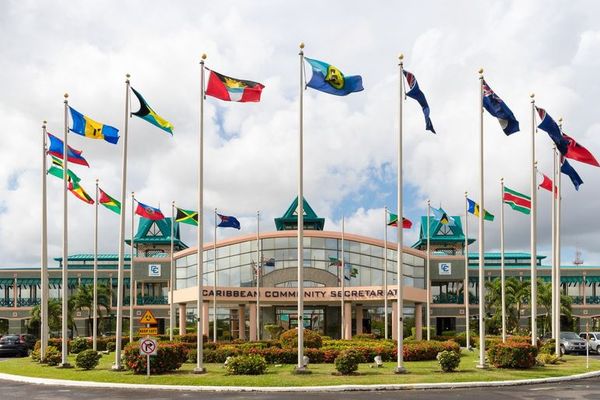
The Caribbean Community (CARICOM) is now the central organization for political, economic, and diplomatic integration in the Caribbean region. Established in 1973 by the Treaty of Chaguaramas, it aims to strengthen cooperation among member states in order to increase their collective influence in a globalized world.
An organization established under the Treaty of Chaguaramas
CARICOM (Caribbean Community) was founded in 1973 by the Treaty of Chaguaramas.
It succeeded the Caribbean Free Trade Association (CARIFTA), which was the first attempt
economic cooperation among several Caribbean territories.
The creation of CARICOM was a response to a strategic need: to enable small island states
to coordinate their economic and diplomatic policies in order to exert greater influence on the international stage.
Today, the organization comprises fifteen member states and several associated territories, forming
one of the most well-structured regional cooperation frameworks in the island world.
CARICOM's Structure and Governance
CARICOM's operations are based on a clearly defined hierarchy of political decision-making.
The Conference of Heads of Government is the organization’s supreme body. It defines
sets broad policy guidelines, makes major decisions, and enters into international agreements.
This conference generally meets twice a year, and the CARICOM chair rotates every six months
among Member States.
The Council of Ministers plays a central role in coordinating public policies. Composed of
Composed mainly of foreign ministers or ministers of regional integration, it is responsible for planning
strategic in fields as diverse as the economy, health, education, and the environment.
The CARICOM Secretariat, based in Georgetown, Guyana, serves as the organization's administrative body.
Led by a secretary-general, it ensures the implementation of decisions made by the member states and
coordinates the activities of the various regional institutions.
The Four Pillars of Regional Integration
CARICOM's activities are organized around four major areas of integration.
The first pillar concerns economic integration. Through the CSME (CARICOM Single Market and Economy),
Member States are working to create a single market that allows for the free movement of goods, services,
capital and skilled labor.
The second pillar is based on the coordination of foreign policy. Caribbean nations, which are often small,
are trying to speak with one voice in major international institutions such as the UN or the Organization of
U.S. states in order to increase their diplomatic influence.
The third pillar concerns human and social development. In particular, CARICOM coordinates policies
public health initiatives through the Caribbean Public Health Agency (CARPHA), educational programs through the
The Caribbean Examinations Council, as well as cultural initiatives such as the CARIFESTA regional festival.
The fourth pillar is security. Member States cooperate to combat crime
cross-border issues, drug trafficking, and natural disasters, particularly through the Caribbean Disaster
Emergency Management Agency (CDEMA).
Specialized Agencies
To implement its policies in practice, CARICOM relies on several technical institutions.
The Caribbean Court of Justice (CCJ), based in Trinidad and Tobago, interprets the CARICOM Treaty and serves
the court of final appeal for certain Member States, replacing the British Privy Council.
The Caribbean Development Bank (CDB) finances infrastructure projects and development programs
the economy and regional investments.
The Regional Security System (RSS) is a security cooperation mechanism that enables states to
to coordinate their actions in response to security or humanitarian crises.
Members and Challenges of Integration
CARICOM currently has fifteen full members. The majority of them are English-speaking,
but the organization also includes Haiti and Suriname, which reflects the linguistic diversity and
cultural life of the region.
Despite its ambitions, Caribbean integration faces several challenges. Unlike the European Union,
CARICOM does not have binding supranational authority. Decisions made at the regional level
must be transposed into the national laws of each country, which often slows down their implementation.
Another major obstacle is regional connectivity. The high cost of air travel and
Maritime barriers between the islands limit intraregional trade and hinder the movement of people and goods.
A Strategy for Collective Survival
Ultimately, CARICOM functions as a kind of regional union of small states seeking to
pool their resources and strengthen their capacity to act in an international environment
highly competitive.
In the face of the economic, climate, and geopolitical challenges of the 21st century, regional integration appears
as well as one of the main tools enabling Caribbean countries to defend their interests and
to assert their place on the world stage.