




IEDOM takes stock of an uneventful year, caught between fragile stabilization and the urgent need for transformation
The business climate index has gained a few points, inflation has eased, and consumer spending has held steady. Yet, behind these seemingly reassuring signs, the Martinican economy in 2025 has failed to regain momentum. With rising unemployment, sluggish investment, a struggling construction sector, and an increase in business failures, the IEDOM’s annual report, published on April 15, 2026, paints a picture of a region in search of a new economic model.
«The annual change in revenue for the commercial sector is expected to be zero.»
This is the key finding of the IEDOM Business Survey for 2025.
A Deceptive Business Climate
Following the shock caused by the movement against the high cost of living in late 2024, the Business Climate Index (BCI) gradually recovered in 2025, rising back above its long-term average at the start of the year. On an annual average, it stood at 102.4, representing a 5-point increase compared to 2024. This return to equilibrium reflects a normalization following the social crisis rather than a genuine surge in growth. Business leaders surveyed in the fourth quarter remain pessimistic and do not anticipate a short-term rebound.
Business activity has certainly rebounded over the past few months, but it has never truly entered a growth phase. The median year-over-year change in revenue for the commercial sector is zero, confirming a year of stagnation.
Employment: Instability Takes Hold
The job market still bears the scars of the crisis at the end of 2024. The number of employees fell by 0.4 % year-over-year, with a loss of 580 jobs in the private sector. Private-sector employment has declined by 1.7 % since its peak in mid-2023. The number of temporary workers decreased by an average of 6.5 %—representing about 170 fewer positions—and the volume of paid hours contracted by 0.9 %.
The unemployment rate reached 13.4 % in 2025, compared with 12.4 % in 2024 and 10.8 % in 2023. The number of people registered with France Travail (Category A) increased by 1.7 %. The decline is clear and rapid.
Unemployment rate: 10.8% in Q1-Q3 2023, 12.4% in Q1-Q3 2024, 13.4% in Q1-Q3 2025. The trend line leaves no room for ambiguity.
Inflation Under Control, Consumer Spending on Hold
Average inflation stood at 1.1 % in 2025, a sharp decline from the 2.8 % recorded in 2024. Energy prices fell by 4.8 %, while services remained the main driver of price increases (+2.6 %). The protocol to combat the high cost of living, signed in late 2024, has produced measurable results: an average price decrease of 10.5 % across 54 product categories benefiting from the elimination of the dock dues and VAT.
Household consumption remained steady, driven by VAT revenues that rose by 3 % and an increase in imports of non-durable consumer goods (+6.9 %). However, this apparent momentum masks a restocking effect following the crisis. By year-end, signs of a slowdown were evident: imports of non-durable goods fell by 4.4% quarter-over-quarter in the final quarter, and VAT revenue dropped by 3.3% quarter-over-quarter. The number of cases of excessive debt filed surged by 28.6% quarter-over-quarter.
Construction: A Year of Uncertainty
The building and public works sector has had a particularly difficult year. New construction starts fell by 4.3% year-over-year, median revenue for companies in the sector dropped by 5% year-over-year, cement sales plummeted by 11.2% year-over-year, and tile imports declined by 5.1% year-over-year. The low point was reached in the second quarter, with a slight rebound at the end of the year that points to a possible recovery in 2026.
The announcement of a 300-million-euro stimulus plan for public housing provides clarity for industry professionals. But a threat looms: the‘The implementation of the Carbon Border Adjustment Mechanism (CBAM) could increase the cost of cement by approximately 30 %, according to government simulations.".
Cement sales: -11.2% Q1-Q3. Housing starts: -4.3% Q1-Q3. The construction industry is looking to the social housing stimulus plan as a lifeline.
Tourism: Cruises Drive the Region's Growth
Martinique welcomed 1,029,863 tourists in 2025, an increase of 4 % compared to 2024. The number of cruise passengers surged by 19.7 %, driven by the arrival of larger-capacity ships. Fifteen percent of airport passengers are now cruise passengers. The 2025–2026 peak season is expected to see the arrival of 30 new ships.
In contrast to this growth, hotel room nights declined by 7 %, partly due to the closure of the Hôtel de la Batelière and the rise of vacation rentals. Inter-island traffic, meanwhile, fell by 9.1 % due to technical constraints on certain vessels.
Credit and Savings: A Wait-and-See Approach Is Gaining Ground
The total outstanding loan balance exceeds 13 billion euros, but growth is slowing. Loans to businesses declined by 2.2 %, following a 3.8 % increase in 2024. Investment loans fell by 2 %, marking a significant shift after several years of growth. Manufacturing (-20 %), trade (-11 %), and financial services (-14 %) were the hardest hit.
On the household side, home loans grew by only 0.7 %, compared with 4.1 % in 2024. Only consumer loans remain robust (+4.2 %), driven by financing for home improvements and rising car prices. Bank deposits are rising slightly (+0.7 %), but life insurance is performing well, with an 8.2 % increase among households.
The deterioration in risk is confirmed: non-performing loans have reached more than 700 million euros (5.3% of total outstanding loans). FICP-reported delinquencies rose by 6 %, and cases of over-indebtedness increased by 28.6 %.
2026: Turning Challenges into Opportunities
IEDOM is calling for a fundamental transformation of Martinique’s development model. Beyond short-term economic recovery, the challenge is to modernize key sectors, accelerate the ecological and energy transition, build out emerging industries, and focus on productive investment. In a region that remains heavily dependent on fossil fuels, rising oil prices linked to the conflict in the Middle East make this transition both more urgent and more complex.
The success of this path requires collective action, enhanced coordination between public and private stakeholders, and a just and inclusive transition that ensures social cohesion. It is only by meeting these conditions, concludes the IEDOM, that Martinique will be able to establish itself as a resilient and attractive region that drives sustainable solutions throughout the Caribbean.
Philippe Pied
Source: IEDOM Martinique, 2025 Annual Report, Economic Outlook No. 828, April 2026. Press conference on April 15, 2026
DOWNLOAD BY CLICKING ON THE IMAGE: SUMMARY DOCUMENT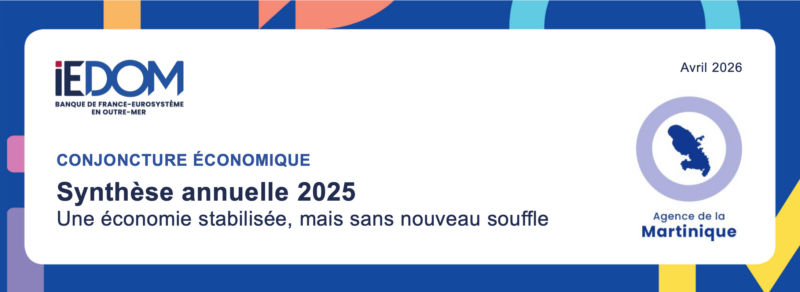
 SOLD OUT