




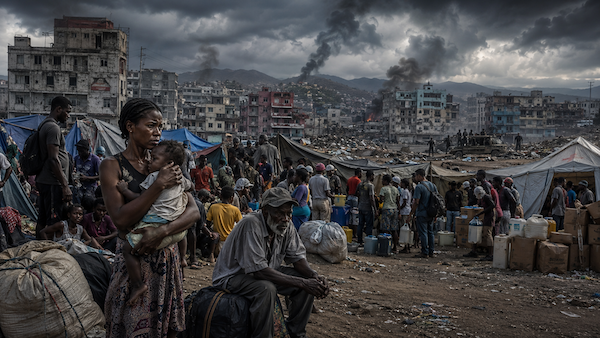
Six months before an uncertain election, Haiti is facing a humanitarian crisis of unprecedented proportions. The shockwaves are being felt throughout the Caribbean.
Half the population depends on international aid. The figure is staggering: 6.4 million Haitians will need humanitarian aid in 2026. This represents an increase of 6.7 % compared to 2025. More than one in two residents depends on international organizations to survive.
This humanitarian crisis is affecting every sector. Security, health, food, and education are all faltering at the same time. The challenges keep piling up without respite.
Armed Violence: An Escalation Spinning Out of Control
The death toll is beyond belief. Between March 2025 and January 2026, more than 5,500 people were killed. These deaths resulted from clashes between gangs, security forces, and self-defense groups.
UN figures confirm the scale of this disaster. Between January and September 2025, at least 4,384 deaths were recorded. The toll also includes 1,899 injuries and 491 abductions. The humanitarian crisis is worsening every month.
Port-au-Prince now resembles a battlefield. Firearms, armored vehicles, and explosive drones are used on a daily basis. Dozens of armed groups control large areas of the capital.
This outbreak is now spreading to the provinces. The danger is no longer limited to the capital.
Population displacement is skyrocketing
As of September 2025, nearly 1.4 million people were displaced. This represents 12 % of Haiti’s total population. The pace of displacement is accelerating: 69 % of the recorded displacements occurred in the provinces.
The hardest-hit provinces are the Centre and Artibonite. The epicenter of the crisis extends well beyond Port-au-Prince. Between September and December 2025, the number of displaced people rose by 23,% in Artibonite alone.
This humanitarian crisis is escalating in rural areas. Families are fleeing conflict zones in large numbers.
A Collapsed Healthcare System and the Return of Cholera
The health situation is grim. Estimated at 40 %, the brain drain of medical professionals is paralyzing the country. Healthcare professionals are fleeing in droves.
In Port-au-Prince, two-thirds of health care facilities are out of service. They have been attacked, looted, or set on fire. Only one public hospital with surgical capabilities remains operational in the capital.
Against this backdrop, cholera is making a dangerous resurgence. Between January and October 2025, health authorities recorded 2,852 suspected cases. The official tally stands at 186 confirmed cases and 48 deaths. More than one-third of the cases involve children under the age of 9.
Hurricane Melissa worsened the situation in October 2025. It claimed at least 46 lives and destroyed 842,400 homes. Critical infrastructure was devastated.
Upcoming Elections: A Fragile Timeline
Politically, the outlook remains unclear. The Provisional Electoral Council proposed August 30, 2026, for the first round. The second round is scheduled for December 6, 2026. The decree was signed on December 1, 2025.
However, restoring security is an essential prerequisite. Without security, the election remains impossible. The CEP president made this point very clear.
A new political agreement was signed on the night of February 21–22, 2026. The National Pact for Stability and the Organization of Elections binds the Prime Minister, the political class, and civil society. It provides that the Council of Ministers will exercise power until the elections.
However, these commitments remain fragile. Haiti has not held elections since 2016. Its parliament has been inactive since 2019. The humanitarian crisis complicates every step of the process.
Humanitarian funding is severely inadequate
The lifeblood of humanitarian aid is sorely lacking. Haiti is among the world’s least-funded humanitarian appeals. For 2026, $880 million is needed to assist 4.2 million vulnerable people.
However, the previous year, only a quarter of the needs were met. In 2024, the rate reached 40 %. The situation has deteriorated. This humanitarian crisis in Haiti is getting worse due to a lack of resources.
A shockwave sweeping through the Caribbean
The humanitarian crisis extends far beyond the borders of Hispaniola. Several countries are sending large numbers of migrants back to Haiti. The Dominican Republic, the United States, and the Bahamas are among the leading countries doing so.
Between January and October 2025, more than 225,000 people were deported to Haiti. This massive influx is exacerbating the humanitarian crisis. Forced returns are fueling despair.
The pressure from the Dominican Republic shows no signs of letting up. Since October 2024, the Dominican Republic has tightened its immigration policy. It is deporting an average of more than 30,000 Haitian migrants per month. This migration trend affects the entire Caribbean region, including Martinique.
In addition, a new United Nations Support Office in Haiti is scheduled to become operational by March 31, 2026. This support is expected to strengthen the management of the humanitarian crisis on the ground.
Between Reversible Progress and Regional Uncertainty
Some progress has been made. However, according to UN experts, this progress remains reversible. With six months to go before the election, Haiti is walking a tightrope.
The entire region is holding its breath. The humanitarian crisis in Haiti will determine the stability of the Caribbean. 1.3 million people are fleeing the violence, which further complicates the holding of elections. The issue is at once humanitarian, political, and regional.