

Antilla · Caribbean series · Rum
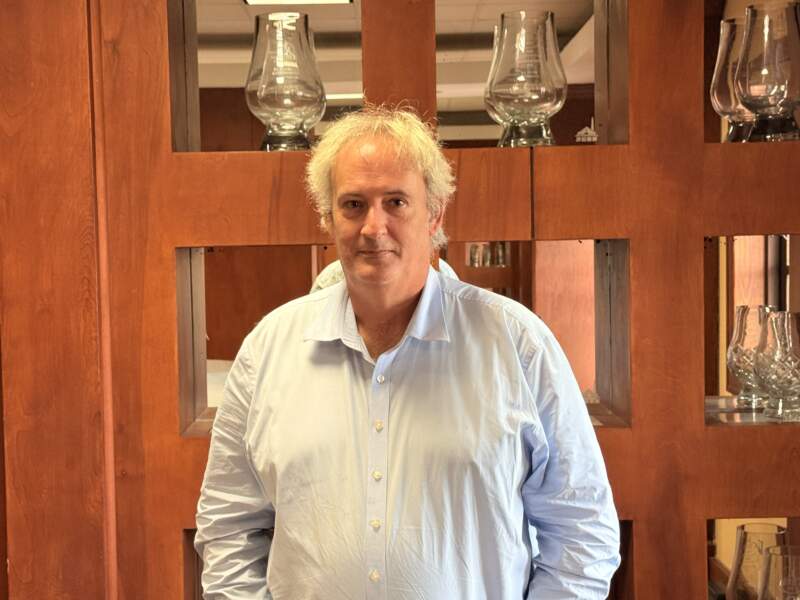
At the helm of Foursquare Rum Distillery, Richard Seale defends a vision of rum that reaches far beyond the bottle. For him, the stakes are as much economic as cultural: the Caribbean can no longer settle for producing a raw material, or a spirit shipped out in bulk, while most of the transformation, the marketing and the added value are built elsewhere. The heir of a family involved in rum since 1926, he argues for productions with a strong identity, protected by geographical indications, aged, bottled and given as much value as possible in their territories of origin. It is a strategy that rests, he says, on quality rather than volume, and on protecting know-how rather than chasing the lowest price. In that reflection, he looks with genuine interest at the Martinique model and its AOC. We met him in Barbados, a producer who wants Caribbean rums to keep at home a greater share of the wealth they generate.
Your family has been in rum for a century. Where does Foursquare fit into that history?
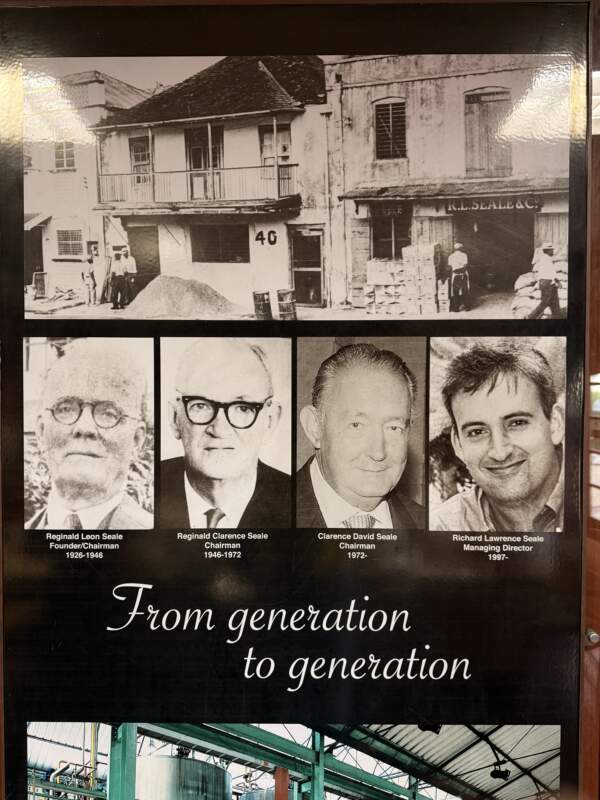
We are a family business, and our story begins in 1926 with my great-grandfather.
You have to understand that, back then, in the English-speaking world, the rum industry worked a little like the whisky industry. The distiller’s trade and the blender’s trade were often separate. For most of my family’s history, we were therefore first and foremost blenders. We bought different rums, then worked with them and blended them.
The major change comes in 1996, when we complete the construction of Foursquare. That is when we truly become producers and distillers. Then, from the late 1990s and the early 2000s, we start to develop our exports in earnest.
So it is a long history, but the Foursquare we know today is also the result of a relatively recent transformation of the family business.
Listening to you, one senses that your passion goes well beyond Foursquare.
Yes. When I travel abroad, I don’t see myself only as the ambassador of my brand. I also represent the rum of Barbados.
I have enormous respect for Scottish whisky producers and for the great cognac houses. But when I am with them, I do not consider us to be inferior to them.
We too have the history, the know-how and the provenance. We have as much reason as they do to be proud of what we produce.
I sometimes joke that if I made chocolate and went to Switzerland, perhaps I might feel inferior. But I make rum, and I believe we are as good as the best.
What drives me a great deal is precisely that I believe rum does not yet occupy the place it deserves in the world of great spirits.
Foursquare, a family distillery that became a global benchmark
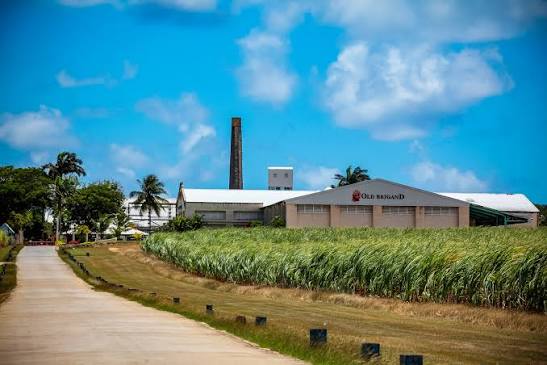
Located in St. Philip, in the south-east of Barbados, Foursquare Rum Distillery belongs to R.L. Seale & Co., a Barbadian family business founded in 1926. The Seale family, long specialised in blending and trading rums, took a decisive step in 1996 by opening Foursquare on the historic site of a former sugar factory. Richard Seale today represents the fourth generation of the family to be involved in the trade.
The distillery has made its name with a production that combines traditional methods and modern technologies. It works notably with pot stills and column stills, then ages and blends its rums on site. Foursquare produces or crafts several well-known brands, among them Doorly’s, R.L. Seale’s, Foursquare Spiced Rum and, above all, the Foursquare Exceptional Cask Selection limited series, which have become especially sought after by lovers of premium rums.
This move upmarket has earned Foursquare recognition well beyond the world of rum alone. R.L. Seale & Company was named Outstanding Spirits Producer of the Year by the IWSC in 2021, competing against producers from different spirits categories. In 2024, Foursquare also won the IWSC Rum Producer Trophy, while its Foursquare 14 YO Equipoise took the Rum Trophy at the same competition.
Foursquare today holds more than 45,000 casks maturing, according to the IWSC, which also presents it as the largest independent, privately owned rum exporter in Barbados. The distillery has, moreover, developed solar power, which accounted for roughly 40% of its energy needs at the time of this distinction in 2024.
Beyond its brands, Foursquare has thus become one of the symbols of the premiumisation of Barbadian rum: producing, ageing, blending, bottling and building the product’s reputation from its territory of origin, precisely the economic model that Richard Seale defends in this interview.
Are the international awards won by Foursquare precisely a way of having that place recognised?
Yes, especially when those awards go beyond the world of rum alone.
We are of course pleased to receive distinctions for our rums. But what matters to me in particular is when we are recognised against the whole field of spirits.
When the IWSC named us Outstanding Spirits Producer, for example, it was not a prize reserved for rum. We were in the same arena as whiskies, cognacs and the other great spirits.
That demonstrates exactly what I believe: we can compete with them.
I am also very proud that Foursquare has today earned a reputation that goes beyond that of a mere rum producer. We are recognised as distillers. That is important.
This international ambition takes you notably towards Europe. What place does France hold for Foursquare?
France is a very important market for us, as is the United Kingdom.
But France has an interesting particularity: it already has a genuine rum culture. The French consumer knows this category of spirits better than in many other countries.
We also sell in markets that would probably have seemed improbable thirty years ago, such as the Czech Republic or Poland.
Germany is a more difficult market because a significant share of demand is concentrated on relatively low-priced rums. That corresponds less to our positioning.
We are also present in the United States and a little in the Far East, even if I would like us to be there more.
But France does indeed remain one of our important European markets.
So you know French rums well. What do you make of what Martinique has built around its AOC?
I regard Martinique as a very good example.
The French understood very early the importance of linking a product to its geography and of protecting that relationship. It is something deeply rooted in your culture.
They have developed different standards and different levels of protection. The Martinique AOC is obviously one of the most advanced of these systems.
In many English-speaking territories, we have not historically developed this culture of protecting identities with the same strength.
On that subject, the French are therefore ahead.
You do, however, express a reservation about the French model.
Yes, but it is more a lesson than a criticism.
For a long time, French rums were very focused on their own market. The French market was large and, for many producers, more than sufficient.
The consequence is that certain names were perhaps not protected early enough in other parts of the world.
Today, as French rums develop further in the United States, they discover that some players can use terms such as “agricole” in a way that has little to do with what you actually call rhum agricole.
That shows it is not enough to protect an identity at home. When you want to develop that identity internationally, you also have to protect it in the markets where you are going to sell.
Is Barbados then seeking to reproduce the Martinique AOC?
Not exactly.
There are several levels of protection.
A geographical indication mainly seeks to protect the link between a territory and a product. The Martinique AOC goes further, since it also protects the very nature of the product and sets precise production rules.
For Barbados, our priority is first to protect the link between the name Barbados Rum and a rum genuinely produced in Barbados.
The Martinique experience therefore interests us greatly, but our aim is not necessarily to reproduce exactly the same system.
Why is this question of geographical indication so important in your eyes?
Because, ultimately, it is a matter of intellectual property, an economic question.
Geographical indications are sometimes presented as a very technical discussion about production methods. For me, that is not the heart of the matter.
The main subject is intellectual property.
A territory has a reputation. That reputation has a value. If anyone can use that reputation without genuinely producing in that territory, then you dilute that value.
Take cocoa. A great deal of cocoa is produced in West Africa, but much of the transformation and the economic value can end up in Europe.
Take too the history of sugar in Barbados. We produced raw sugar. It went to England, it was refined there, packaged, given value, and then it could come back here as a finished product.
We supplied the raw material, but a significant part of the value was created elsewhere.
I do not want us to reproduce exactly that model with rum.
Rum is produced here, it draws its reputation from our history, our territory and our know-how. We must therefore fight to keep a greater share of that value here.
Is this thinking shared by the other distilleries of Barbados?
Yes, I am absolutely not alone.
Mount Gay and St Nicholas Abbey are very strong supporters of this approach. And their support is not limited to words; the way they produce shows that they too believe in this logic.
You find comparable approaches in Saint Lucia, in Guyana with Demerara Rum, or in Jamaica.
Appleton, for instance, is an important supporter of protecting the identity of Jamaican rum.
There is therefore, in several Caribbean territories, a growing awareness around this question: if we want to build value around our rums, we must protect their origins.
You often cite the case of Jamaica in particular. Why?
Because it makes it possible to understand very clearly the economic interests that lie behind a geographical indication.
Jamaican producers registered their geographical indication in Jamaica in 2016. But its recognition abroad has met with many difficulties.
You have to understand why.
If you are a company that buys Jamaican rum in bulk, takes it elsewhere, bottles it elsewhere and then uses the image of Jamaica to sell it, you do not necessarily have an interest in a very strict definition of Jamaica Rum.
Conversely, the one who genuinely produces, ages and bottles in Jamaica has an interest in that identity being strongly protected.
That is why geographical indications are also economic questions. They partly determine where value is going to be created and who is going to keep it.
Is that also why you are so critical of the export of rum in bulk?
Yes.
When you simply ship your rum in bulk, you give up a significant part of the value creation.
The ageing, the blending, the bottling, the building of the brand, the distribution and the marketing can then all be carried out elsewhere.
In the end, the consumer may buy a product that benefits from the image of Jamaica, of Barbados or of another Caribbean island, while much of the economic value was not created on that island.
It is precisely this model that we must move beyond.
Barbados is not a territory capable of winning a global competition based solely on production costs. We will never be the cheapest producers.
We must therefore do exactly the opposite: produce less if we reason in terms of volume alone, but produce more value.
In other words, for you the future of Caribbean rum lies necessarily in the premium segment?
It lies, in any case, in added value and in quality.
In the Caribbean, we all want to improve our standard of living. We want better wages and better incomes. That is perfectly legitimate.
But you cannot want higher wages and, at the same time, build your economy on the cheapest possible production.
We can no longer be competitive on bulk sugar. Nor can we build the future of rum on bulk.
At Foursquare, our premium business is in fact continuing to perform well. We are selling more premium rums precisely because we are positioned in a niche.
The Caribbean has extraordinary products and an extremely strong image. We must build on that.
We have the capacity to create value. But it takes far more work than simply increasing volumes.
It is even an important part of my thinking about the future of rum. Growing does not necessarily mean turning every craft distillery into a mass-production plant.
Yet some producers consider that protecting a tradition too much can prevent innovation. What do you say to them?
I think one has to be very careful with the word “innovation.”
We can obviously evolve and experiment. But sometimes the word “innovation” simply serves to justify making a less demanding or less costly product while continuing to benefit from the reputation of a traditional one.
You cannot say for two hundred years, “Look at our history, our heritage and our tradition,” and then suddenly decide that those rules no longer matter the moment it becomes economically advantageous.
Protecting a tradition does not mean it must be frozen forever.
It means that there is a minimum identity that must be respected.
If you destroy everything that makes up the identity of a product and still keep using its name, then it is no longer innovation. You are simply profiting from the reputation built by those who came before you.
That is why I always come back to intellectual property. The geographical indication is first and foremost an economic tool that makes it possible to protect that value.
So you consider that “Barbados Rum” must be protected just as Foursquare protects its own brand?
Exactly.
No one asks me why I protect the name Foursquare. It seems obvious. If I invest for decades to build the reputation of my brand, I am not going to let someone else use its name freely.
For Barbados, it is exactly the same.
The word “Barbados” applied to rum has an economic value.
If that name can be used without a genuine link to production in Barbados, you dilute that value.
And that then raises a very simple question: why would anyone invest money in producing rum in Barbados if the identity of Barbados Rum is not protected?
Protection creates the conditions for investment. Without protected intellectual property, it becomes far more difficult to build value over the long term.
This desire to protect identities also leads you to reject the general expression “Caribbean rum.” Why?
Because it hugely oversimplifies a reality that is far richer.
The rums of Barbados, of Jamaica or of Martinique are profoundly different. And those differences are not only technical.
They come from the history of each territory, its economy, its relationship with cane, its production methods and the way its industry has been built over the centuries.
I am, moreover, not very fond of the simplistic classification between rums of the English, French or Spanish tradition. It gives a few historical bearings, but the reality is far more complex.
Even within a single territory, several rum cultures can coexist.
Look at Barbados and Martinique. The two islands are very close geographically, and yet their rums are very different.
It is precisely this diversity that we must protect.
And I would add one thing: the true history of Caribbean rum is so rich that it is far more interesting than many of the marketing stories invented around rum.
If the solution is therefore not to produce ever more, how do you picture the Barbadian rum industry in twenty or thirty years?
I would rather see more producers than a few producers that have become gigantic.
Governments often reason in terms of volume. They see four distilleries and think: how can we get these four companies to produce a great deal more?
But if you turn a craft producer into a mass producer, you also risk changing the very nature of what it does.
For me, a better path would be for us to have, one day, perhaps ten quality distilleries in Barbados.
We can grow without becoming mass producers.
We have the know-how here. We have a suitable climate. We can grow sugar cane. We have quality water and an exceptional history.
All the elements needed to produce great rums are here.
Our challenge is to attract the investment that will let us develop this industry without destroying its identity. And, once again, you will not obtain that investment if you do not first protect the intellectual property attached to the name Barbados Rum.
You are, in fact, quite severe towards the economic policies pursued by successive governments of Barbados. Why?
Because politicians naturally like quick, visible solutions.
Now, building a high-value craft industry is not quick.
Creating an international reputation, developing brands, protecting a geographical indication, improving quality, investing in ageing and in bottling, all of that can take twenty or thirty years.
These are difficult solutions.
For a long time, Barbados sought to attract industries that did not necessarily have any particular link to our territory. We could grant advantages to a company so that it would come and manufacture this or that product here.
But why would Barbados naturally be better than another country at producing that type of product?
With rum, the situation is different.
Rum genuinely belongs to our economic and cultural history. Like tourism, it is an activity in which we have a real natural and historical advantage.
We must therefore concentrate more effort on what we truly know how to do and on what the rest of the world cannot simply reproduce elsewhere.
Does this reflection on the economic model also apply to the environmental requirements that small producers face?
Yes, and it is a subject on which my position is sometimes misunderstood.
I consider climate change to be extremely serious and believe we all have responsibilities.
At Foursquare, we already make extensive use of solar power. We are at around 40% renewable energy and we will continue to increase that share whenever it is technically and economically relevant.
But what I refuse is a form of sustainability that is purely for show.
One has to be careful when large markets impose ever more complex standards on small countries and small companies.
A multinational has the teams, the consultants, the capital and the administrative resources needed to meet all kinds of new requirements.
A small Caribbean craft business does not necessarily have those means.
The risk is then that certain environmental requirements, even when they start from a good intention, in practice become a new barrier to entry that reinforces the large groups against the small producers.
We must act on the climate, of course, but the responses have to be global and genuinely effective. We must avoid asking a small Caribbean producer to bear a burden entirely disproportionate to its contribution to the problem.
After all this talk of quality, we still have to ask you the question: what is your best rum?
My answer is always the same: the next one.
After the economy, intellectual property, geographical indications and quality, what, in the end, does rum represent for you?
Rum is an extraordinary product because it can bring together several things at once.
It can show the world our ability to produce something excellent, but it can also carry our culture.
Picture someone in London, in the depths of a cold winter, pouring themselves a glass of Caribbean rum. Through that glass, they also experience something of our region, our climate, our history.
That is what makes this product so special.
When we export rum, we should therefore not simply be exporting alcohol.
We must export excellence, value and a part of our culture.
That is also why it is so important that the Caribbean keep a greater share of the value created by this product.
Interview conducted in Barbados by Philippe Pied/Antilla. Caribbean series on rum.