


Antilla · Caribbean series · Rum
“Mount Gay is from Barbados, and it will always be from Barbados.” — Antoine Couvreur
There are few places in the Caribbean where the history of rum can be approached with the same sense of continuity as at Mount Gay. The oldest surviving deed connected to the distillery dates from February 1703, allowing Mount Gay to present itself as the world’s oldest continuously operating rum distillery. More than three centuries later, however, the house is not content to live off its heritage.
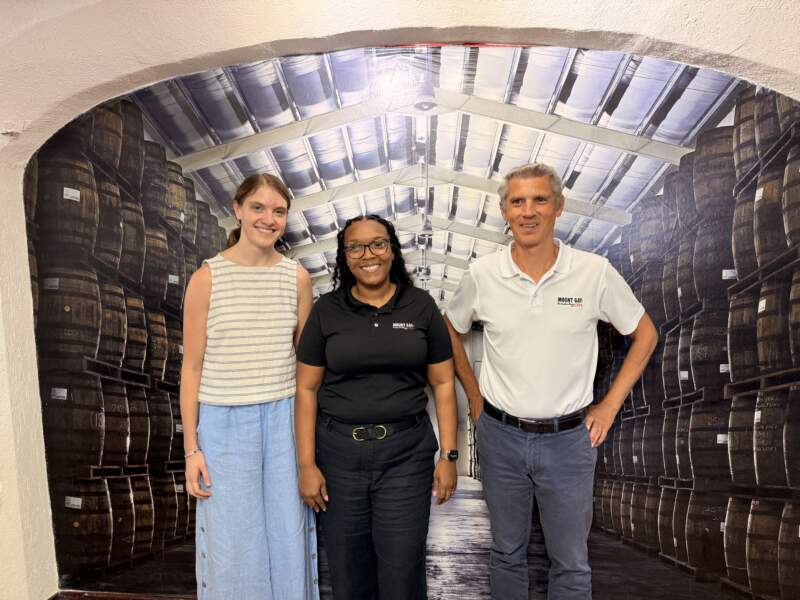
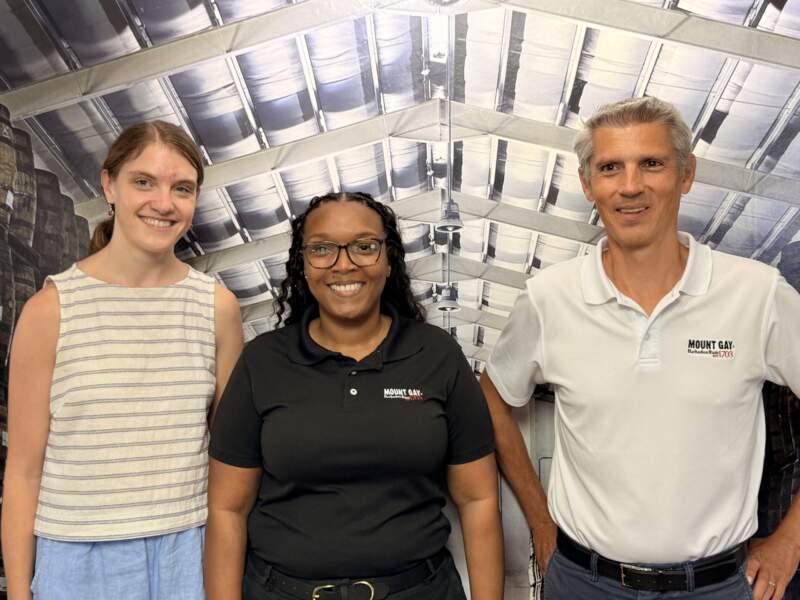
At its Barbados headquarters, we met three people representing complementary sides of the company: Antoine Couvreur, Managing Director of Mount Gay; Trudiann Branker, Master Blender; and Justine Schneider, Senior International Brand Manager. Couvreur has headed Mount Gay since 2022. Branker, appointed Master Blender in 2019, is the first woman to hold the position at Mount Gay and in Barbados.
Their message is clear: heritage matters, but only if it remains economically, technically and culturally alive.
Three centuries, one place
For Antoine Couvreur, the starting point is geography.
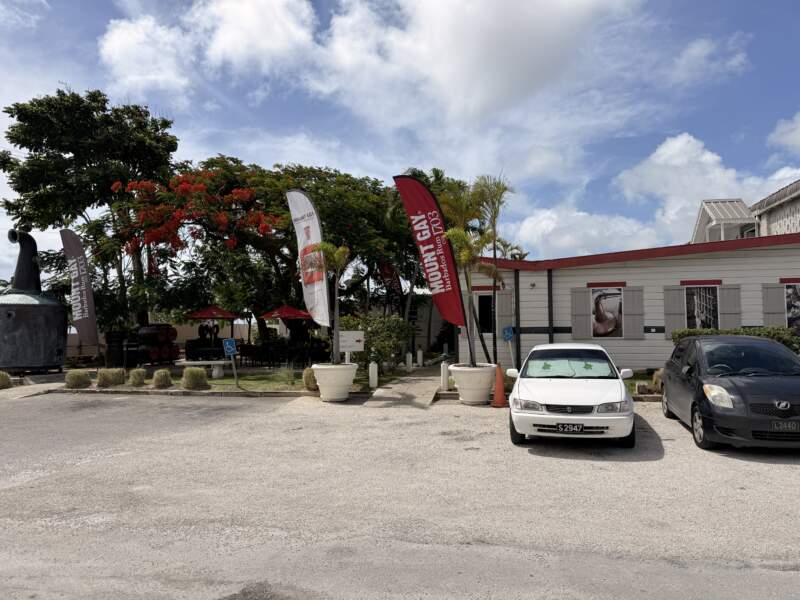
Mount Gay’s distillery remains at St Lucy, in the north of Barbados, where its history began more than three centuries ago. The same location, the same water source and an accumulated knowledge of fermentation, distillation, maturation and blending form the foundations of the house’s identity. That continuity is particularly important at a time when origin and authenticity have become central questions throughout the rum industry.
Mount Gay employs around 140 people, according to Couvreur, although the company does not disclose its production volumes. Its international reach is supported by Rémy Cointreau, the French spirits group that owns Mount Gay.
But Couvreur draws a clear line between international ownership and the identity of the product. Rémy Cointreau, he explains, provides financial capacity, investment resources and international distribution. The production knowledge, however, remains rooted in Barbados. The objective is not to make Mount Gay less Barbadian in order to make it more international. It is precisely its Barbadian identity that gives it value internationally.
Bringing the cane back into the story
One of Mount Gay’s most significant changes over the past decade has taken place before the rum even reaches the fermenters.
In 2015, Mount Gay acquired 324 acres of the historic Mount Gay and Oxford Estates. This allowed the company to restore a vertically integrated model, growing sugarcane, producing its own molasses, fermenting, distilling and ageing rum within the Estate.
This does not mean that all Mount Gay rum is produced exclusively from its own sugarcane. Like other Barbadian producers, Mount Gay also relies on molasses from outside the Estate because Barbados does not currently produce enough sugarcane to satisfy the requirements of its entire rum industry.
But the Estate has introduced a new dimension. The team can now follow a rum back to a particular harvest, cane variety or parcel of land. That logic has given rise to the Single Estate Series, which seeks to make traceability part of the product itself.
For Trudiann Branker, this greatly expands the possibilities available to the Master Blender.
“Every step gives you another tool. The toolbox simply gets bigger and bigger as you move through the process.” — Trudiann Branker
Different varieties of sugarcane alter the composition of the molasses. Different fermentation times create different aromatic profiles. Open or closed fermentations, pot stills, column stills, Coffey stills, barrel types and ageing periods all become variables available to the Master Blender.
Innovation, in this view, does not require abandoning tradition. It consists of creating new possibilities within it.
From Eclipse to 25-year-old rum
Mount Gay’s portfolio illustrates that strategy. The core range includes Eclipse, Black Barrel and XO, based principally on blends of pot still and column still distillates of different ages.
Eclipse offers a younger, fruitier profile. Black Barrel develops greater intensity. XO combines older reserves, with rums aged between roughly five to fifteen years.
At the other end of the spectrum, Mount Gay is developing increasingly mature and specialised expressions, including fifteen and twenty-five-year-old releases, as well as the Single Estate Series and Master Blender collection. Branker has also worked with Madeira, Port and Pedro Ximénez casks and, more recently, with Mount Gay’s restored copper Coffey still.
At the same time, innovation can also move towards younger consumers. The brand recently entered the spiced category with Bajan Spiced, initially developed with the British market in mind.
For Mount Gay, the two directions are not contradictory. The challenge is to maintain accessible entry points while creating expressions capable of competing in the premium and ultra-premium spirits market.
“We are not made for huge volumes”
That positioning also reflects the economic reality of Barbados.
“We are not made for huge volumes. Our ambition is to deliver quality.” — Antoine Couvreur
Couvreur makes no attempt to place Mount Gay in a volume competition with the largest global rum groups. Barbados is a small island, production costs are significant and Mount Gay cannot compete with mass-market brands by trying to become the cheapest producer.
Instead, its strategy is based on value. That means keeping Eclipse and other accessible products capable of bringing consumers into the brand, while offering them a route towards Black Barrel, XO and eventually much older or rarer expressions.
Couvreur compares the process to whisky: a young consumer may begin with a simple serve, then gradually become curious about origin, ageing, production methods and more complex products. In his view, premiumisation is not being imposed by producers alone. It is also being driven by consumers who are becoming more knowledgeable.
French consumers, he notes, are particularly interesting because France already possesses an established culture of rum, helped by the history and visibility of rhum agricole.
The Barbados GI: protecting identity without freezing it
Mount Gay also strongly supports the creation of a Geographical Indication for Barbados Rum. But here, its position is nuanced.
For Couvreur, a GI should make it easier to explain to consumers what a Barbados rum is and why it differs from rum produced in Jamaica, Nicaragua, the Philippines or elsewhere.
For Branker, the issue also concerns transmission. An eventual GI must protect both how Barbadian rum has been made and the possibility of how it may be made in the future. It should not create rules so restrictive that future Barbadian entrepreneurs are effectively prevented from entering the industry.
Their emphasis is therefore on consensus. Mount Gay wants an agreement constructed collectively by the island’s producers, with enough protection to safeguard Barbados Rum as an identity, but enough room to allow the tradition to continue evolving. That position places Mount Gay somewhere between protection and experimentation. The objective is not to turn three centuries of history into a museum.
Barbados first, Caribbean together
The discussion around the GI leads naturally to a broader question: should the Caribbean sell itself internationally as individual rum-producing nations, or as one great rum-producing region?
Mount Gay’s answer is essentially: both. A Barbados rum should remain recognisably Barbadian. Jamaican rum should retain its Jamaican identity. Martinique, Guyana and other producing territories must also preserve what makes their traditions distinctive; but the Caribbean can become more powerful internationally by telling part of that story collectively.
Couvreur points to Scotland, where visitors do not necessarily travel to visit just one whisky distillery. They may build an entire itinerary around several producers. He imagines a similar future for Caribbean rum tourism: someone visiting Martinique, Jamaica and Barbados as parts of a single journey into the diversity of rum. That is also where initiatives such as WIRSPA’s proposed Caribbean Rum Trail could become significant.
“Together, we are stronger. The diversity between our islands is not a weakness; it is precisely what gives Caribbean rum its richness.”- Trudiann Branker
For Mount Gay, cooperation therefore does not require standardisation; quite the opposite: the more clearly Barbados can explain why its rum tastes different from Jamaica’s or Martinique’s, the more valuable the collective Caribbean story becomes.
Sustainability, from the sugarcane field to the bottle
Sustainability is another area where Mount Gay says its practices have changed significantly over the past decade.
At the Estate level, the company is developing regenerative agricultural practices including cover crops, crop rotation, organic fertilisation and the reuse of distillation by-products. At the distillery, solar power contributes to energy requirements, while water consumption is measured with the objective of reducing the quantity required for each bottle produced. This matters particularly in Barbados, a water-scarce island.
Packaging is also evolving. Mount Gay says it is reducing bottle weight and incorporating recycled glass into some products. Its recent Single Estate Series packaging uses more than 70% recycled glass and is designed around recyclable and reduced-material components.
The company is also trying to change practices further downstream by encouraging bottle recycling in Barbados and supporting initiatives discouraging drinking and driving.
For the Mount Gay team, sustainability is therefore not a separate corporate programme. Their ambition is to integrate it at every stage, from agriculture to production, packaging, transport and consumption.
A sleeping giant?
Mount Gay’s story raises a wider question about Caribbean rum. The region possesses centuries of production history, distinctive technical traditions, some of the world’s most respected distillers and increasingly sophisticated premium products. Yet rum still struggles internationally to command the same automatic prestige as Scotch whisky or Cognac.
From a marketing perspective, Justine Schneider sees considerable untapped potential.
“Caribbean rum is a sleeping giant. It is simply waiting to awaken.” — Justine Schneider
The challenge, Schneider points out, is partly one of storytelling. For more than three centuries, Barbados has known how to make rum. What is changing is its determination to explain why that history, those techniques and that origin have value.
At Mount Gay, the strategy is therefore less about choosing between tradition and innovation than about making the two work together.
The Estate can return to growing sugarcane while the Master Blender experiments with new fermentations. Historical stills can coexist with modern production controls. A 1703 heritage can support both a twenty-five-year-old rum and a new spiced expression; and a distillery owned by a French group can still insist, without ambiguity, that its identity begins and ends in Barbados.
This may, in fact, be the main lesson to draw from this interview: preserving strong individual identities without giving up on a collective ambition for the Caribbean. When we asked them, “If you had to summarise the future of Caribbean rum in one sentence, what would it be?”, the Mount Gay team summed up that vision in one simple statement:
“A world of opportunities, where we will be stronger together rather than divided, a sleeping giant waiting to awaken.”
Philippe Pied