



Management supported by statistical and economic analysis
Transforming emergency management into a structural resilience strategy requires, above all, greater precision in assessing the impacts. The collaborative study conducted by IEDOM, INSEE, and AFD aims to shed light on the uncertainties surrounding the indirect costs of this phenomenon. This in-depth study aims to objectively assess the actual impact on the local economy by measuring revenue losses in the hospitality, restaurant, and small-scale fishing sectors. At the same time, these institutions are analyzing the vulnerability of real estate assets to understand how the frequency of strandings affects the depreciation of coastal properties. This interdisciplinary expertise thus serves as an indispensable compass to guide public policy toward efficient and sustainable investments.
The Sargasso III Plan as a Means of Ensuring Long-Term Sustainability of Resources
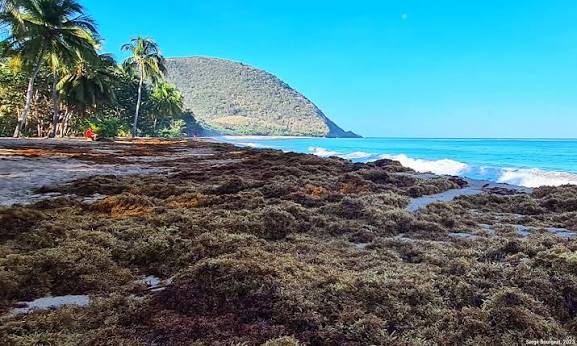
The upcoming Sargasses III Plan marks a decisive step in the evolution of financial support mechanisms. Unlike previous approaches, which were often limited to the purchase of equipment, the new program aims to stabilize operational budgets over the long term. The major challenge lies in covering operating costs—such as dam maintenance and personnel expenses—which place a heavy burden on the budgets of coastal municipalities. Furthermore, current discussions on establishing a legal status for brown algae could resolve complex insurance-related issues, leading to better compensation for property damage caused by corrosion and increased protection for at-risk populations.
The Industrialization of Resource Recovery and the Energy Challenge
The emergence of large-scale industrial projects, such as the research conducted by SARA, opens up concrete prospects for a circular economy in the Caribbean. The hydrothermal liquefaction process, which converts sargassum biomass into bio-crude, represents a major technological breakthrough. The success of this model depends on the ability to effectively isolate natural pollutants such as arsenic while establishing a supply chain capable of managing the intermittent nature of shipments. By transforming this environmental challenge into a local energy resource, the Caribbean could strengthen its energy sovereignty while developing an innovation sector that can be exported throughout the Caribbean region.
A Quest for Sovereignty for Overseas Territories
The Sargassum problem can no longer be treated as a mere climatic hazard but must be fully integrated into the structural management of the blue economy. The sustainability of this model depends on a convergence of government financial support, scientific research, and the commitment of local stakeholders to build sustainable industries. Through this coordinated effort, the ultimate goal remains to preserve the attractiveness of these regions and protect public health, thereby ensuring a sustainable future for the coastal areas of Martinique, Guadeloupe, and the Northern Islands.