




Once again, this country celebrated May 22 with great enthusiasm. That’s right. That’s good… But…
By publishing this article by Guy Cabort-Masson, which appeared more than 20 years ago in our newspaper ANTILLA, we are fulfilling a twofold duty:
1/ Give a voice back to the one Who, among our generation, took the greatest risk to ensure that his actions matched his beliefs? (As a «French» officer, he joined the Algerians in their struggle and the ALN
2/ Reaffirm the realities that, in 1848, led to the 22nd of May.
Everyone is free—in particular, to compare, on the one hand, this historical analysis and, on the other hand, the 2026 speeches of those who led or emerged as the «leaders» of May 22, 2026…
Henri (Luc) Pied /// (May 23, 2026)
Abolition of Slavery
An analysis by Guy Cabort-Masson
Cyrille Auguste Bissette, the Liberator
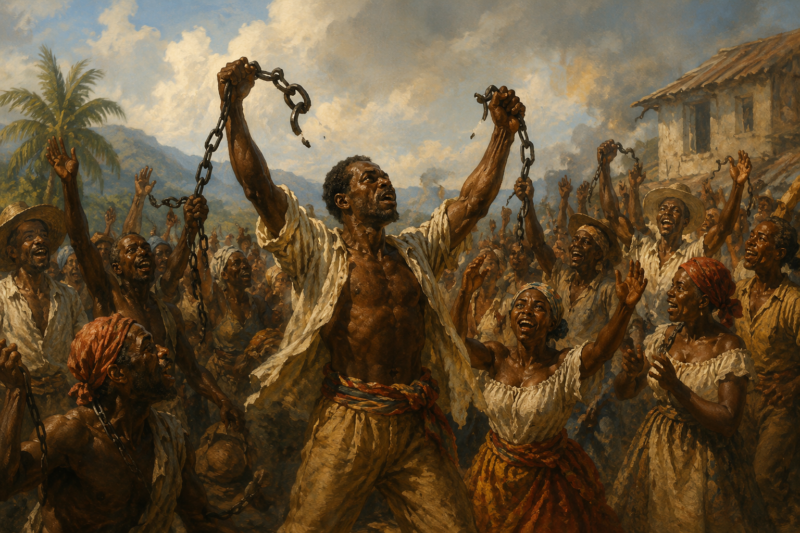
The revelers from May 22 have fallen silent.
We listened to them or read them.
We talked, just as we have for the past 10 years, a little about Schœlcher, Porry Papy, Roman slavery and its drum, and Rostolant the Governor… About Schœlcher’s decree of April 27, which arrived on May 3, following the effective abolition on May 23 at approximately 3:00 p.m.
And then, nothing new. Of course, it was said that there was a «series of slave revolts» before May 22. Just like seasonal outbreaks of cold sores.
But we didn't mention anyone from before!
May 22 marks the final and definitive outbreak of pimples.
A story so anonymous that it becomes collective, almost robotic. A true historical miracle that Marx would be proud of, saying that it is the people who make history.
This May 22 is terrifying in its inhumanity.
Yet throughout the Americas—from the United States to Brazil, including the Caribbean islands, both large and small, Martinique is the only country, after Haiti, to have abolished slavery through the efforts of people of color alone. Everywhere else, slavery was abolished thanks to the joint struggle of people of color and anti-colonial settlers.
We’re familiar with Haitian originality. We know about the deeds of the great men from Mackendal to Christophe, not to mention the great mulattoes.
Who could talk about the French Revolution without tracing its history from Voltaire all the way to Robespierre and Bonaparte?
Who could talk about the Russian Revolution without going back to Lenin and his friends in Switzerland, who used their newspaper, *Iskra*, to rally activists on the ground, sending out emissaries and receiving them to organize actions?`
Who would talk about any revolution without tracing it back to its masterminds, its leader, and its organizational structure—in short, without showing its full historical context? And yet this is not what happens with our 1848 anti-slavery revolution, which, through radio broadcasts and contemporary newspapers, is still portrayed in 1997 as a violent, spontaneous act, falling from the sky like the hands of the Roman slave on his drum… An almost sudden act by a people of slaves who had suddenly come of age and emerged victorious. That doesn't exist.
The article by Ms. E. L. (Name redacted by me: HP)
Of all the commentary and analysis surrounding May 22, 1997, the most disappointing article is the one by a Ms. É. L.
Before recounting, like everyone else, those «events» that are so well known, she writes:
«Today’s abolition is the result of a long struggle, a long-standing demand dating back at least 35 years. Left-wing and nationalist political parties, labor unions, and civic organizations had made it their top priority in the 1970s, as a symbol of an entire people’s struggle for liberation.».
This is a falsehood that we must correct.
In fact, the struggle for recognition (or rather, awareness) of May 22 began precisely on April 27, 1970, at 9:00 a.m. in front of the capital’s Palace of Justice, where all the leaders of the left-wing parties and unions (except for Césaire, who was out of the country) to commemorate April 27 around the statue of Schœlcher, under the chairmanship of the Cercle V. Schœlcher, led by Mr. Louis Adrassé.
The assimilationist speeches were about to begin when three nationalist activists (Bourgade, Cabort, Honoré) burst in with leaflets denouncing the sham of April 27.
The following week, Mr. Armand Nicolas, a history teacher and head of the PCM, responded harshly in an article titled «Ideological Struggle.» Here is a significant excerpt:
«On the occasion of the April 27 demonstration organized by the Victor Schœlcher Circle to commemorate the liberation of slaves in Martinique, a leaflet that purports to be revolutionary, ultra-revolutionary, «more revolutionary,» was distributed by a clandestine leftist splinter group, opposing what is called the “cult of April 27.”».
(«Justice,» May 7, 1970 – ideological struggle)

Fifteen days later, Mr. Émile Maurice, leader of the UNR (RPR) and a history teacher, also responded in his newspaper *Le Combat*. Here is a significant excerpt from an article titled «To a Demagogue…» dated May 16, 1970:
«…Now, on the occasion of the commemoration of the 112th anniversary of the decree of April 27, 1848, abolishing slavery, a small leftist group operating underground has just taken another step toward escalating violence and has gone even further down the path of demagogic grandstanding….».
Ms. L., it is therefore clear that, in 1970, the Left did not at all have May 22 as its «primary demand.» At that 1970 commemoration, the PPM was well represented by Arthur Régis, among others. Why don’t you do some research at the Schœlcher Library?.
There is a stark contradiction between knowing that May 22 exists and celebrating April 27 with great fanfare. The struggle for May 22 was essentially the fight of pro-independence nationalists, not «nationalists» of the PPM variety.
If the left and the right have finally come to accept the priority of May 22, it is thanks to the setbacks dealt by the separatists.
Ms. L., also a history teacher, finally raises the real issue of history being written «in light of the questions of the present.» She rightly observes: «Just as the demand to make April 27 a holiday until 1946 might have seemed reductive, the demand to make May 22 a holiday takes the opposite approach and leads to the same result: that of treating it as an isolated event, one of causal unity within the explanatory framework of history.».
And finally, she asks: «Can we now set out to write a history of the abolition of slavery that focuses on its structures, processes, and stages? Can we contextualize it by taking into account mentalities, cultural influences, the dissemination and reception of information, and so on?».
Actually, Ms. L., if you were serious, that is exactly what your article should have been about after you tore apart the one that appeared in *France Antilles*.
You simply continue to act «as if the bearers of memory—such as family, former neighborhood communities, and (especially) teachers—had failed in their mission.». They almost did, ma'am.
If, instead of indulging in the works of Messrs. De Brudel and De Duby De France, you had read the insignificant novel titled *La mangrove mulâtre* by Guy Cabort Masson de St-Joseph, you would have learned that the issue of May 22 was «the Event placed in its historical context.».
Please allow me, Madam, to give you a brief summary of it.
After 24 years of struggle
There have been numerous slave revolts since the days of the slave ships. In Martinique, three social classes gradually came to coexist.
– The intertwined French administration and settlers,
– The slaves, who were more numerous,
– and gradually expanding the group between the two preceding classes to include free people of color known as «mulattoes,» regardless of skin color.
When slave revolts broke out, not only did the colonists and the administration crack down, but so did free people of color—because, as free people, they had a vested interest in slavery. Just like the clergy, for that matter.
An event takes place on January 15, 1824. Today, free people of color are being arrested, thrown into prison, returned to slavery, and then banished. They had written to the authorities—almost a plea—to improve the plight of the slaves. Nothing serious, on the surface?
Oh no! Some mixed-race people had dared to write and to behave like human beings, plain and simple.
From that point on, the struggle against slavery took a different turn, for two reasons. The first had to do with the very strong personalities of these condemned mulattoes. The second is that the mixed-race class became aware that their freedom was revocable, that each of them—due to the arbitrary actions of the colonists and the administration—was a slave on borrowed time.
There are no longer three social classes, but two: the colonists and the slaves—whether in name only or in reality. These mulattoes, condemned in 1824 (we know who they are, but we don’t celebrate them!), are above all Cyrille Auguste Bissette, Fabien, and Volny.
C.A. Bissette is no ordinary person. He is the first cousin once removed of the former Empress Joséphine de Beauharnais, and above all, he will prove that he has a very strong personality, courage, and tenacity. He will struggle as an exile until 1852 to impose his emancipatory ideas…
Based in Paris, Bissette founded a newspaper (La Revue des Colonies) to expose slavery scandals. He welcomed visitors from the colonies so they could share their testimonies. He sent emissaries to the colonies to gather material, and later to establish «committees for abolition» in every municipality. In short, he leads and organizes. That is exactly what Lenin would do in Switzerland 60 years later…
Until 1842, Bissette fought for abolition in general, and after that he took a more radical stance. He was in favor of l’immediate and unconditional abolition" And here he stands opposed to the abolitionist philanthropists united in «the French Society for Abolition,” which brings together men such as De Broglie, V. Hugo, Schœlcher, Tracy… Influential figures who sought a gradual, reasonable abolition—that is, one agreed upon by the colonists.”.
Immediate and unconditional abolition?
Gradual abolition in agreement with the settlers?
This is where the divide lies between the «revolutionary» (Bissette) and the abolitionist (Schœlcher).
24 years of tenacious struggle by Cyrille Auguste Bissette, affectionately known as “Grand Charles” and then “Papa Bissette” when he returned home in triumph. Enslaved, branded with a hot iron, thrown into a penal colony, exiled, and 24 years of struggle—that is the story of this national hero. The most severely punished and the greatest figure in our entire history.
The events of April–May 1848 were just the tip of the iceberg in a Martinique where almost every municipality was organized into Committee for Abolition, established at Bissette’s instigation and supported by free men of color, white and Black Freemasons, and «slaves with passes»…
Bissette won: Martinique achieved immediate and unconditional abolition, but—whether through a twist of history or the power of «democratic» colonialism— Schœlcher also won, since, as a minister, he was able to compensate the colonists (by buying back the slaves), and with that money, the colonists industrialized sugar production and created… the Crédit Martiniquais (1)… from Crédit Foncier… Interesting, isn't it?
Even the official historian, Léo Élisabeth, noted in a dense brochure on abolition—which did not address national issues—that in 1848 the St-Pierre prisons released a certain inmate named Lacaille who, 22 years later, would lead the great revolt in the South in 1870. Ms. L., do you think this Lacaille had been thrown in jail for stealing peanuts? We should wrap up this summary, Ms. L., but we’d like to tell you something else.
In 1851–52, Bissette just like all the liberators of Latin America, such as Bolivar, he joined forces with the colonists in an attempt to seize power through a coup d'état and separate Martinique from metropolitan France. While in Paris, Bissette socialized with Latin Americans. He failed. He left.
The stage is set for Schœlcher, his agent Perrinon, and Ernest Desproges, who take the ideological helm of the colony. Schœlcherism, the ultimate stage of assimilation—since it was «left-wing»—was adopted by all the people of color in positions of power (including Césaire, who, in a speech, lashed out at Bissette, accusing him of allying himself with the colonists without specifying for what purpose. In an ironic twist of history, the colonists now subsidize the elections of Césaire’s PPM), Schœlchérism—that is, the events of April 27—erased the memory of May 22 for 120 years and continues to obscure the exemplary struggle of Cyrille Auguste Bissette, the father of abolition. “Schœlchérism” is Ms. L., the dominant ideology that still reigns in your school.
Conclusion
Is history repeating itself?
You were right, Ms. L., to say that April 27 is reductive because it attributes all the credit for the abolition to the External. And that May 22 is reductive because it seems to give all the credit to the Internal. But we must understand that the pro-independence nationalists had no choice. They had to fight for 10 years to have it recognized that May 22 existed and that it went beyond April 27.
What is simplistic, almost childish, is the way May 22 is currently being portrayed, in an almost miraculous way, outside any spatio-historical context. And, above all, without bringing to light the real heroes of this revolution. Which is exactly what you do in your article. And then you’d like to «highlight the slow fracturing of a society that produces its own contradictions in relation to a changing environment; to study the abolition of slavery in all its implications—political, economic, and social, of course, but also cultural, mental, and even psychological—and over a period that is not limited to April–May 1848 but encompasses the long nineteenth century.».
That’s a very nice-sounding academic phrase, but if you’d read our humble *Mangrove mulâtre* instead of the great French classics, you would have seen that more than half the work is already done there.
April 27 or May 22, you say? That’s old news—Martinique has chosen the truth of May 22.
A "problem" with history, you say? No, it is you (and your university)—as the official historians—who have problems because you are not immersed in our country’s history and therefore cannot instill it in your students.
All this academic jargon and fuss is meant to muddy the waters. A fish named Cyrille Auguste Bissette. It is in him that the historical significance of May 22 is embodied, rendering April 27 superfluous for Martinique (but not for Guadeloupe).
How can you expect politicians, historians, and academics—who have the mindset and ideal of being managers and commanders—to give a man like Bissette, who has achieved the ideal of a Martinican head of state, his rightful place, his full place?
In 1970, nationalists took action to raise awareness of May 22, celebrate it, and give it the recognition it deserves.
It's done.
Now the nationalists must fight to raise awareness of and honor the greatest hero in our history, Bissette.
Let's oversimplify things and put it bluntly: as long as all the streets, buildings, etc., remain, a people without a worthy role model is unworthy.
G.C.M.
Article published in Antilla No. 733 on June 7, 1997
DOWNLOAD THE ARTICLE AS A PDF