


Source: Cayman Compass
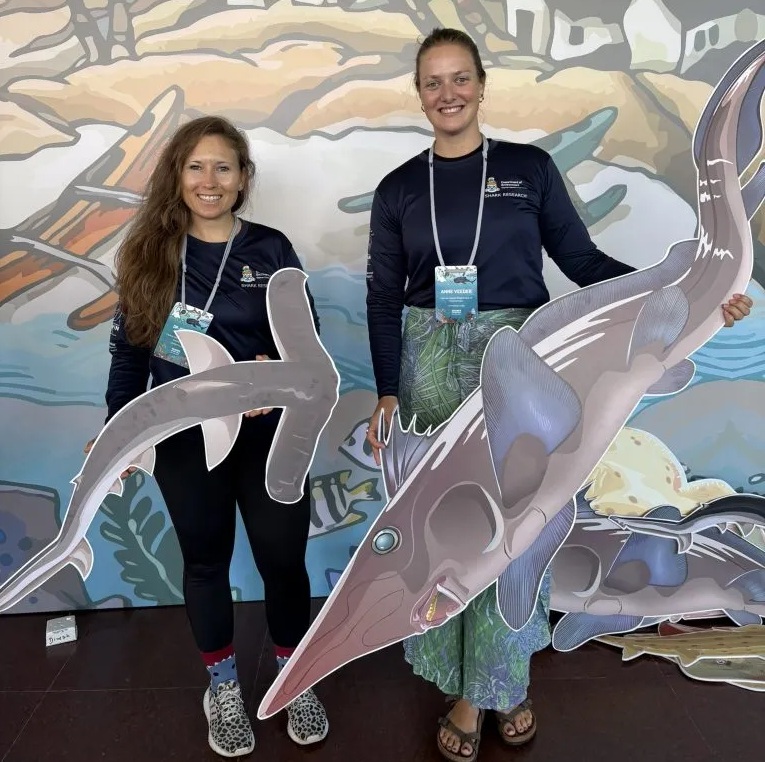
Among the 800 researchers, environmental advocates, and policymakers from 81 countries in attendance were Johanna Kohler and Anne Veeder of the Cayman Islands Department of the Environment’s Shark Research and Conservation Program. They participated in discussions on overfishing and the shark meat trade, as well as on new conservation technologies and community-based solutions.
«This conference is held only once every four years,» Kohler said. «It is a privilege and a source of great satisfaction to be able to meet and exchange ideas with other passionate researchers who are pursuing the same goals as we are here in the Cayman Islands.»
Deep-sea research in the Cayman Islands
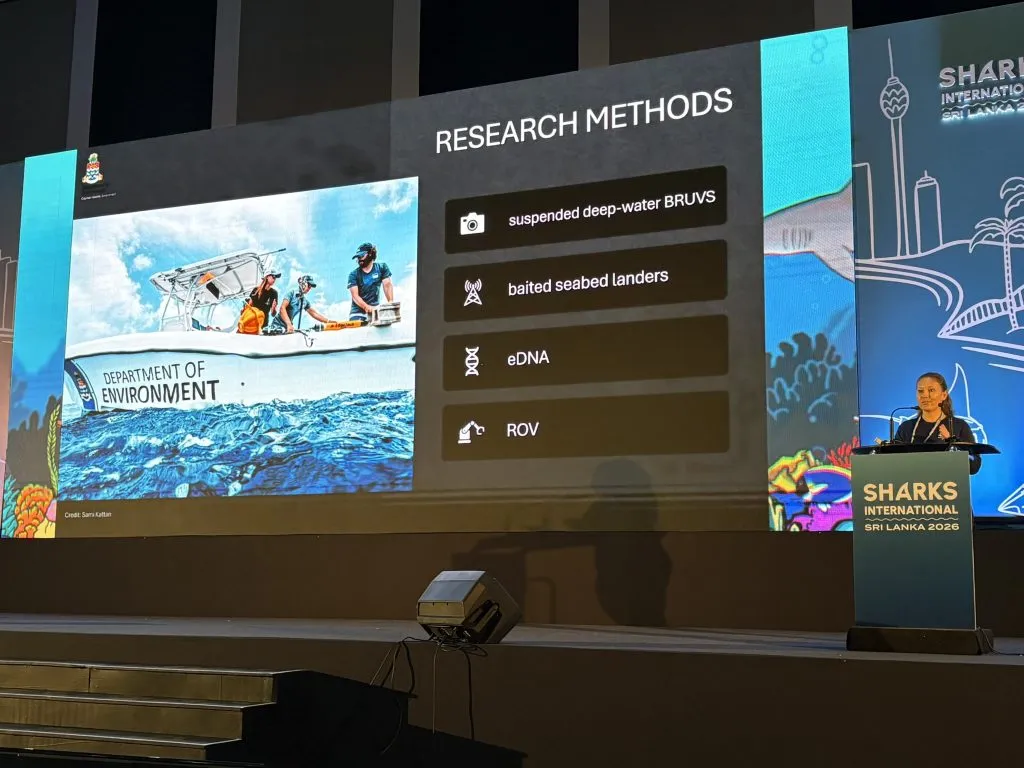
As part of the five-day conference held in May, Kohler presented the latest findings from the Cayman Islands regarding deep-sea sharks and the reappearance of a school of scalloped hammerhead sharks.
In her presentation, she explained that 18 species of sharks have been recorded in local waters.
In the Cayman Islands, sharks have been a protected species for just over ten years. It is illegal to capture, kill, harass, or feed them. Kohler noted that 55 % of the Cayman Islands’ continental shelf is protected, but only down to a depth of 45 meters (150 feet).
She told conference delegates: «Our shark populations are relatively stable, but they remain small, and deep-sea fishing is neither monitored nor regulated, so it is potentially unsustainable.»
Kohler described a two-year project led by the Ministry of the Environment, in partnership with the nonprofit organization Beneath the Waves, Marine Conservation International, and Heriot-Watt University in Edinburgh, and funded by the UK’s Darwin Initiative, to study deep-sea marine life. She presented video footage, filmed in March 2022 at a depth of more than 200 meters, showing a school of 11 to 13 long-horned hammerhead sharks, an endangered species. This was the first sighting of a school of these animals in local waters in 50 years.
“This was a truly special moment for us,” Kohler said in her presentation. “I certainly cried when I saw the video because it was a sign of hope. Scalloped hammerhead sharks are critically endangered.”
The sighting of the school of scalloped hammerhead sharks in the Cayman Islands, she said, was “just confirmation of the hard work that people have put in, both in the past and the present, in the Cayman Islands, but also around the world, because scalloped hammerheads are a migratory species and their decline or regional extinction in the Cayman Islands was likely due to overfishing elsewhere.”.
As part of the same “Deep See” project, which involved deploying baited remote underwater video cameras to depths ranging from 165 to 6,560 feet, she also showed footage of a glow-in-the-dark blurred lantern shark, filmed at a depth of less than 2,000 feet. She told delegates that, prior to this footage, this species of shark had never been recorded in the Atlantic Ocean.
Another species captured on camera off Little Cayman as part of that project was the roughskin dogfish, a creature first described in Japan. This was the first time the species had been recorded in the Caribbean, Kohler said.
She noted that, until recently, seabed mapping had not been available in the Cayman Islands, “and, as you can imagine, conducting deep-sea research has been quite an adventure without proper maps … we were really relying on our knowledge and skills.”.
The lack of seabed or bathymetry maps in the area is being addressed by a Saildrone research expedition, which was completed last year. The raw data was transferred to the UK Hydrographic Office for chart updates, with some of the data also intended for Seabed 2030, the UN-backed initiative to map the world’s oceans by 2030.
Using a fully autonomous Saildrone Surveyor – an unmanned surface vehicle capable of operating at sea for months – 56,000 square miles of the Cayman Islands’ Exclusive Economic Zone (EEZ) were mapped in high resolution for the first time.
Impact of the COVID Lockdown on the Shark Population
At the conference, Veeder presented the Department of Environment’s citizen science program, the Sharklogger Network, highlighting how long-term monitoring—with the help of volunteer participants—combined with local COVID-19 regulations, was used to assess the human impact on shark populations in the Cayman Islands.
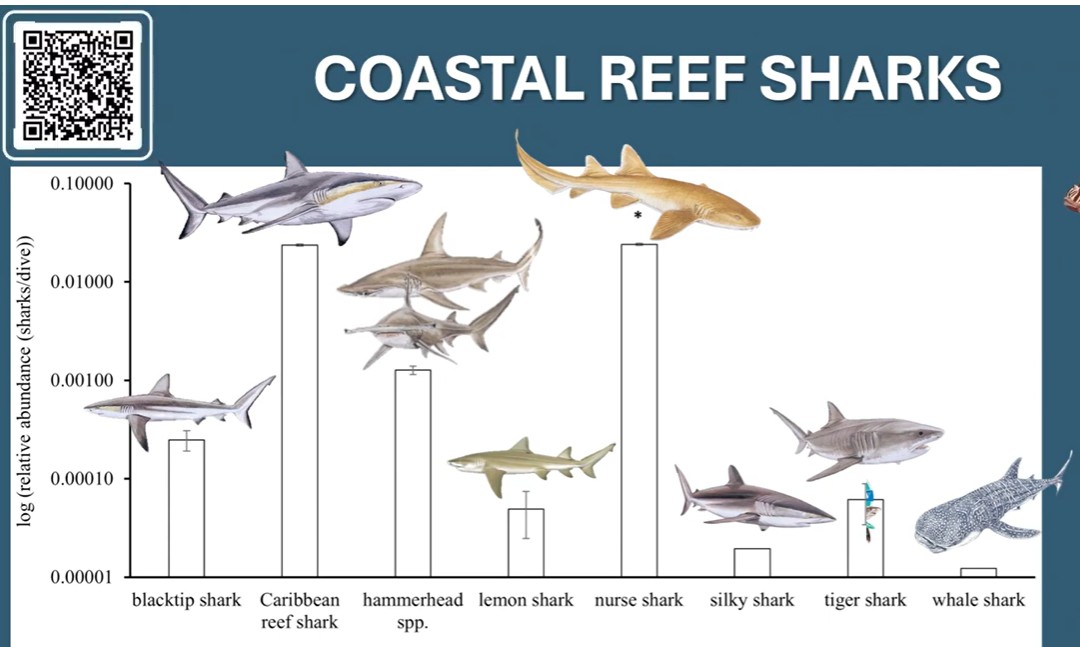
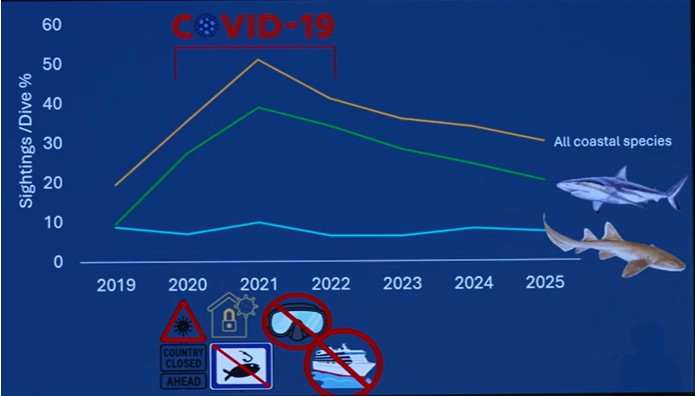
In her presentation, Veeder discussed the impact of COVID-19 restrictions—including the local lockdown and the closure of the Cayman Islands’ borders from March 2020 until March 2022, when cruise ships were allowed to return—on sharks. These included Caribbean reef sharks and nurse sharks, the two most common shark species found in the Cayman Islands.
The Sharklogger network, established in 2016, records shark sightings, as well as dive details and environmental variables.
Veeder stated that the network’s findings indicated a negative correlation between the abundance of reef sharks and human population density, noting that between 2019 and 2025, the population of the Cayman Islands increased by 30 %, but that there was a positive correlation when human activity on the water was lower during COVID-related restrictions.
She presented a chart, district by district, of shark sightings in the Cayman Islands from 2019 to 2025, which showed that the reef shark population is concentrated around the northern, eastern, and southern coasts of Grand Cayman—which are more exposed and experience stronger currents— while sightings are less frequent along the island’s leeward west coast, which is more densely populated and urbanized.
She noted that, during the period when the borders were closed, the «prolonged reduction in human activity» had a «significantly positive effect on our coastal shark species.».
Veeder also pointed out that human population density does not appear to affect the abundance of nurse sharks in an area, «which means that Atlantic nurse sharks are quite willing to inhabit the shallow waters of densely populated areas of Grand Cayman.».
During the conference, the team also participated in four specialized workshops focusing on the challenges and solutions related to shark conservation in the Cayman Islands. Through roundtable discussions, workshops, and exchanges throughout the week, the team was able to share its experience in the Cayman Islands and learn from the experiences of other research teams.
Click here To watch Johanna Kohler's presentation on the findings of the Deep See project.
Click here To watch Anne Veeder's presentation on the Sharklogger network.