


Public liability upheld by the courts
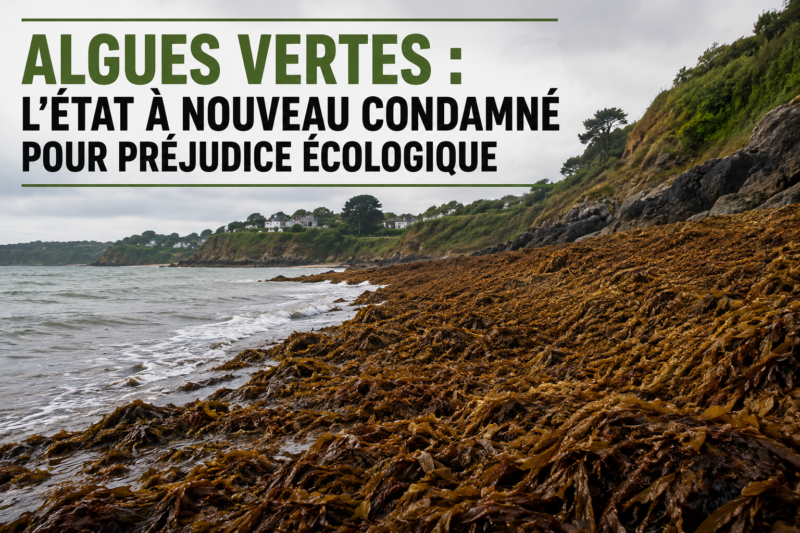
On June 16, 2026, the Nantes Administrative Court of Appeals upheld the ruling that the State was liable for the proliferation of green algae in Saint-Brieuc Bay. The judges found that the government’s failure to effectively combat agricultural pollution contributed to lasting ecological damage.
The court finds that excess nitrates, stemming primarily from intensive agriculture, are responsible for the massive growth of green algae along the Brittany coastline. As these algae decompose, they produce, among other things, hydrogen sulfide, a toxic gas that can cause serious, even fatal, poisoning.
The judges have ordered the government to remedy the ecological damage found, to prevent further damage, and to take measures within six months to significantly reduce nitrogen inputs into the waterways feeding into Saint-Brieuc Bay.
This decision upholds an initial ruling handed down in 2023 by the Rennes Administrative Court.
Ecological harm at the heart of legal reasoning
This case illustrates the growing prominence of the concept of ecological harm in French law. Since its inclusion in the Civil Code in 2016, this concept has made it possible to legally recognize direct harm to ecosystems, regardless of the harm suffered by individuals or legal entities.
The decision also notes that the government may be held liable not only for its actions but also for its inaction when it fails to implement the necessary measures to prevent environmental degradation that has been known for several decades.
A decision whose impact extends beyond Brittany
This ruling could be of interest to other regions facing long-term environmental pollution.
For the French West Indies, this case is of particular interest in the context of litigation related to chlordecone or Sargassum. Although the legal situations differ, the court’s reasoning confirms that prolonged inaction by the government in the face of an identified environmental risk can give rise to its liability.
Between a Legal Victory and Implementation Challenges
This decision represents a symbolic victory for environmental groups, but its practical effectiveness remains to be seen.
On the one hand, the causes of pollution in France are deeply rooted in an agricultural model that has been in place for several decades. Significantly reducing nitrogen flows will require major economic changes for some farms. Numerous measures will need to be taken to achieve this.
On the other hand, previous plans to combat green algae have already led to some local improvements, though they have not succeeded in eradicating the problem. The difficulty lies less in the scientific understanding of the problem than in the political ability to strike a balance between environmental imperatives and economic interests.
The Breton Precedent in the Chlordecone Case
When it comes to chlordecone, the legal issue may seem simpler, given the government’s responsibility for authorizing and allowing the continued use of a product whose harmful effects had been widely established.
The central issue, however, remains that of effectiveness: the path from a court ruling to the actual restoration of ecosystems can be a long one. This case illustrates once again the frequent disconnect between the legal recognition of environmental damage and its concrete remediation on the ground. In the overseas territories, the process will be even more difficult.
Measures Already Highlighted by Government Authorities
In response to the long-term contamination of Martinique and Guadeloupe by chlordecone, the French government has, in fact, implemented several successive plans since 2008 aimed at monitoring pollution, protecting exposed populations, and advancing scientific understanding.
The authorities will also be able to point out that they have stepped up inspections of agricultural production, fisheries, and food products in order to minimize risks to consumers. At the same time, a comprehensive survey of contaminated soil has been conducted to guide agricultural practices and identify the most affected areas.
The government also states that it has funded research on the health and environmental effects of chlordecone, as well as on decontamination techniques. The recognition of prostate cancer as an occupational disease for certain exposed agricultural workers was a significant step forward, complemented by the creation of compensation programs for eligible victims.
The 2026 Law: Toward Greater Recognition of Damages?
Another step forward was taken with the law of June 12, 2026, which recognizes the government’s responsibility, strengthens cleanup efforts, supports the affected agricultural and fishing sectors, expands research on health impacts, and provides for improved oversight of compensation mechanisms.
Repair the damage or deal with its consequences?
Despite these measures, many criticisms remain. Soil remediation efforts remain limited, compensation is often considered insufficient, and the effects of contamination will continue to be felt for several generations.
The Caribbean Challenge: Between Recognition, Reparations, and Trust
However, even though the sense of injustice remains strong among many people in the French West Indies, and chlordecone represents one of the most significant health and environmental scandals in the history of the French overseas territories, we doubt that our courts will adopt the same line of reasoning as that applied in the green algae case.
When Environmental Law Reaches the Limits of Public Action
The green algae case serves as a reminder that legal recognition of ecological harm is only one step in the process. The time between the state’s conviction, the actual implementation of corrective measures, and the genuine remediation of the damage caused to ecosystems and communities can span decades. This is precisely what the chlordecone case reveals today: the difficulty public authorities face in fully remedying environmental damage whose health, economic, and social consequences extend over the long term.
Gérard Dorwling-Carter