




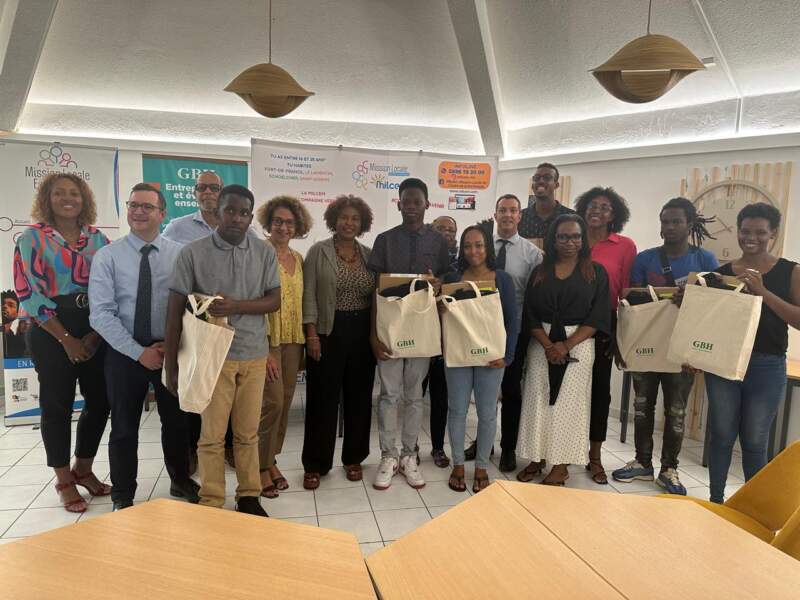
On Friday, at the offices of the local employment mission for central Martinique in Le Lamentin, six young people each received a computer to help them enter the workforce.
Everything is moving toward digitization. No more paper. The number of procedures being handled online is rising sharply, leaving behind those who lack access to screens and digital tools. In addition to some seniors, young people also fall into this category of those left behind. Based on its experience working with its beneficiaries, this is what the local mission in central Martinique has identified. To bridge this gap, Milcem and Milsud—thanks to a donation of equipment from GBH—provided six computers to six young people: three supported by Milsud and three by Milcem. This is one way to address the digital divide.
20% of Milcem youth do not have a connected device
Another problem arises. According to Claudie Vetro, president of Milcem, some young people also lack professional digital skills. «Paradoxically, one could even go so far as to speak of »illectronism«» for a generation often described as ultra-connected. “These are young people who sometimes have degrees but struggle to upload a resume to our platform or verify reliable information.” Milcem found that 20% of the young people they supported did not have access to a connected device. However, local employment agencies have begun a shift toward providing enhanced digital support to their beneficiaries. In this context, the young people who received computers were not chosen at random.
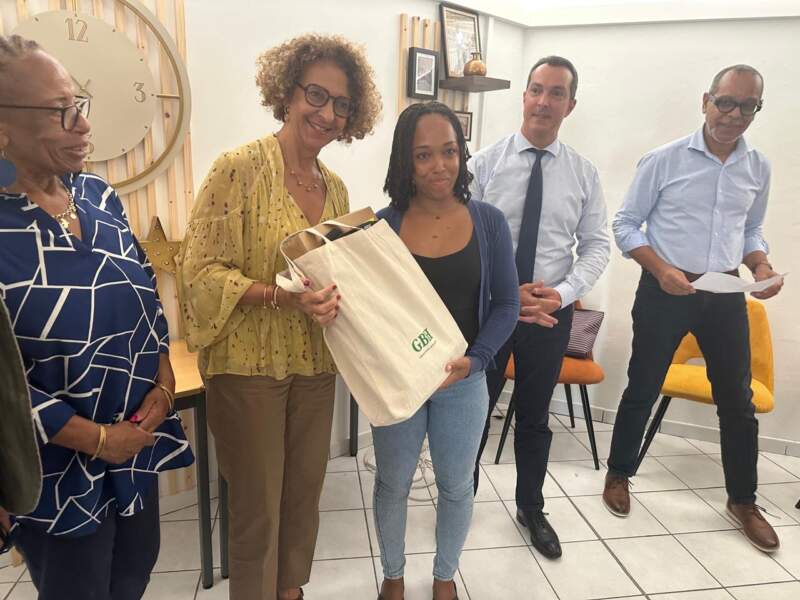
Marie-Gabrielle Baspin received one of these donated computers. The 21-year-old is awaiting funding from France Travail and the CTM for a medical secretary training program. «As a medical secretary, you need a computer for everything related to Word and PowerPoint. I’m going to use it throughout my training to practice and learn how to write documents,» says Marie-Gabrielle Baspin happily.
A total donation of nine computers
Malachi King was also given a computer. He is working toward a professional certification as a tour guide and will follow that up with training to become a tourism and recreation coordinator. «This will mean I won’t have to work on my phone anymore. My instructor told me that using phones was prohibited, but an exception was made for me so that I could still work.»
For Clément Des Robert, Chief Human Resources Officer of the Bernard Hayot Group, this is more than just a donation. «Above all, it’s a message of encouragement for the work being done by the staff at the local missions, who are committed to helping young people every day. » The director of the local mission in central Martinique welcomes this much-needed boost. It’s a step toward bridging the digital divide. «People assume that young people are very comfortable using computers and phones, but their use is mostly for entertainment. They won’t be able to participate in a workshop or training session. Everything is online, and young people don’t always have those skills.» Claudie Vetro explains that, according to a study, 7 out of 10 people in Martinique lack digital access.
This donation is part of a broader initiative in which nine recipients from Milnord, Milsur, and Milcem received a computer.
Laurianne Nomel