




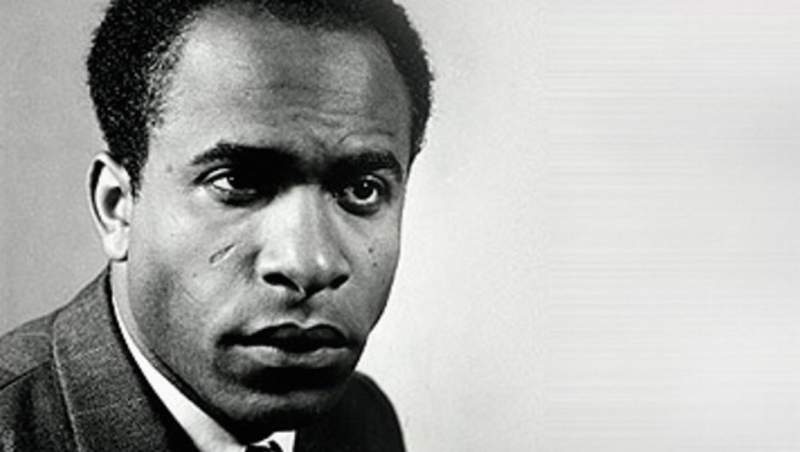
Source: *Nouvel Obs*. By Eric Aeschimann
Frantz Fanon, in the Shoes of a Colonized Person Fifty years after his death on December 6, 1961, Frantz Fanon remains a major author: his «Works» have been published in a single volume, with a preface by Achille Mbembe, by La Découverte. (La Découverte)
A native of Martinique and Algeria, a psychiatrist, writer, and activist—both colonized and free—Fanon was all of these things. He remains an essential author for understanding contemporary violence.
On December 6, 1961, after having been hospitalized for several weeks at a clinic in Washington, Frantz Fanon died of leukemia. «That’s not what will give me back my bone marrow,» he had said shortly before, upon receiving the first reviews of his book, *The Wretched of the Earth*, which had just been published by Maspero. On the very day of his death, in Paris, French police began seizing copies of the book, which had since become a symbol of the anticolonial struggle.
To mark the 50th anniversary of Frantz Fanon’s death, Éditions de la Découverte—which succeeded Éditions Maspero—is publishing a collection of the major writings by the Martinique-born psychiatrist who became an FLN activist. Written at the age of 27, *Black Skin, White Masks* is a stunning study of the effect of racial discourse on the psyche, striking both for the themes it addresses—«the woman of color and the White man,» «the man of color and the white woman»—as much as by its freedom of form.
«Colonization was responsible for quite a few crimes…,» by Maryse Condé
«Hey, a black guy!»
Fanon discusses everything from a remark by André Breton or a text by the psychoanalyst Octave Mannoni to his own experience as a young man from Martinique subjected to the gaze of the metropolitan world, when people would say: «Look, a Negro!»; when «on the train, instead of one seat, they’d leave [him] two or three»; when he wondered: «Where do I belong? Or, if you will: where do I fit in? (…) Where do I hide?»
«The Wretched of the Earth» confirms Frantz Fanon’s powerful writing and the sharpness of his insight. A reader of Hegel, Sartre, and Merleau-Ponty (whose lectures he would attend while studying psychiatry in Lyon), he engages in a true phenomenology (in the sense of “that which appears”) of the condition of the colonized:
»The colonized person is always on edge, because, finding it difficult to decipher the many signs of the colonial world, he never knows whether or not he has crossed the line. Faced with a world shaped by the colonialist, the colonized person is always presumed guilty."
Or:
The city of the colonized—or at least the indigenous city, the »Negro” village, the medina, the reservation—is a disreputable place, populated by disreputable people. People are born there anywhere, anyhow. People die there anywhere, anyhow. It is a world without space; people are piled on top of one another, and huts are stacked one on top of another.”
Aimé Césaire: “I Will Remain a Black Man”
«Killing a European»
«The Wretched of the Earth» is prefaced by Jean-Paul Sartre’s famous preface, in which he explains that ’in the first stage of the revolt, one must kill; killing a European kills two birds with one stone, eliminating both an oppressor and an oppressed person at the same time.«
In the biography of Frantz Fanon published simultaneously by Éditions de la Découverte («Frantz Fanon, a Life,» by David Macey), we learn that in 1967, Fanon’s widow asked François Maspero to remove Sartre’s preface from future editions, «because of the author’s pro-Zionist and pro-imperialist stance» (Sartre had defended Israel at the time of the Six-Day War).
Above all, Macey recounts the highly dramatic meeting between Sartre, Beauvoir, Lanzmann, and Fanon in Rome during the summer of 1961: the conversation, which began at lunch, lasted until 8:00 a.m. the next morning. At 2 a.m., Beauvoir had suggested that Sartre get some sleep. «I don’t like people who hold back,» Fanon had replied.
The Slave Who Became a Clown: The True Story of Chocolat
The Future of Violence
Finally, Amsterdam Press will publish *Frantz Fanon: From Anticolonialism to Postcolonial Criticism* by Mathieu Renault, which highlights Fanon’s current significance in the field of postcolonial studies in the United States and France.
Focusing on Fanon’s theory of violence, Renault highlights the danger it poses—namely, that of «leaving unresolved,» or even «making it impossible to resolve,» the question of the future of violence (when do we emerge from violence?), which attests to the imprint of colonial ideology on his thought; but he also believes that by theorizing conflict in the postcolonial context, Fanon helps us make sense of contemporary postcolonial wars. We must therefore reflect today both «with» and «against» Fanon.
Sorting, deportation, incarceration, categorizing individuals based on their skin color or origin: the racialization of the world has never ceased to have an impact, as Cameroonian sociologist Achille Mbembe points out in the preface to *Œuvres*. «How can we be surprised,» he adds, «that the renewed interest in Fanon »begins, once again, with a critique of violence and ends with a critique of life as a trial of the self and a trial of the world«? To take on the suffering of the struggling human being, to describe and understand it in such a way that from this knowledge and this struggle a new human being might emerge—such was, in fact, Fanon’s project.»
Eric Aeschimann