

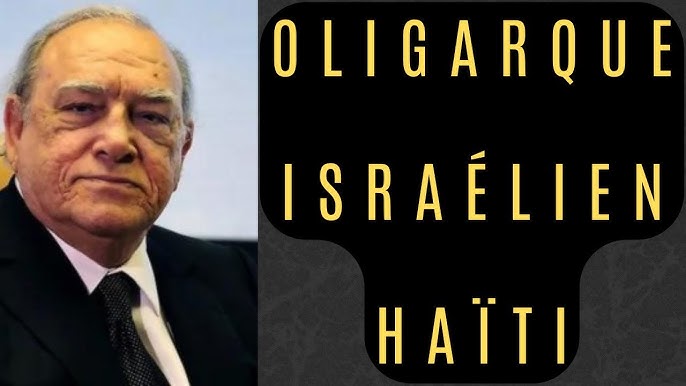
A symbol of Haitian capitalism concentrated in the hands of a few families, Gilbert Bigio remains a figure who is both admired and controversial. Caught between entrepreneurial success and accusations of collusion with armed gangs, his name illustrates the ambiguities of a country held captive by its economic elites.
An empire born of trade and steel
Born around 1935 in Port-au-Prince, Gilbert Bigio came from a Sephardic Jewish family originally from the Middle East. His father, Isaac Bigio, settled in Haiti in the 1920s, where he founded an import-export company. From these humble beginnings, an empire was born: the GB Group, founded by Gilbert Bigio in the 1970s, which grew into a conglomerate that dominates the Haitian economy.
The group operates in several strategic sectors: steel manufacturing through GB Steel, retail through Delimart, logistics and import-export through Carribex and Haytrac, energy through GENSA, and, most notably, Port Lafito, an ultra-modern private seaport inaugurated in 2015, considered a major logistical asset for the country. The GB Group is now worth several hundred million dollars and maintains partnerships with multinational corporations such as TotalEnergies, Nestlé, and Heineken.
An influential man at the heart of power
Gilbert Bigio is not only an industrialist but also a man of influence. He served for many years as Israel’s honorary consul in Haiti and remains a central figure in the Haitian Jewish community. Close to several successive governments—notably those of Jean-Claude Duvalier, Michel Martelly, and Ariel Henry—he embodies the so-called “imported bourgeoisie” accused of having taken over the Haitian state.
Researchers such as Jake Johnston (Center for Economic and Policy Research) and Alex Dupuy (Wesleyan University) point out that this economic elite has been able to adapt to every regime, taking turns financing those in power to preserve its economic and tax privileges.
Subject to international sanctions
In December 2022, the Government of Canada imposed sanctions on Gilbert Bigio, as well as Sherif Abdallah and Reynold Deeb, accusing them of supporting armed gang activities and participating in money-laundering schemes. Ottawa claims that these businessmen have enabled gangs to «continue to terrorize the population.».
Although the United States has not directly sanctioned him, U.S. diplomatic sources confirm that Bigio is on a U.S. Treasury (OFAC) watch list. The New Republic magazine has also cited the port of Lafito as a possible transit point for weapons and ammunition, an accusation that Bigio categorically denies, calling it a smear campaign.
Offshore Schemes and the Pandora Papers
The Pandora Papers revealed that the Bigio family owned several offshore companies in the British Virgin Islands, which were used to transfer funds between Haiti, Florida, and Switzerland. Although legal, these structures illustrate the massive outflow of capital from the country and the low tax contribution made by the country’s wealthiest individuals.
A Figure of Crony Capitalism
To some, Gilbert Bigio symbolizes a visionary entrepreneur who built a modern conglomerate despite the political chaos. To others, he embodies crony capitalism, propped up by import rents and control over strategic infrastructure. For years, civic movements and political parties have denounced the stranglehold that an oligarchy—composed of the Bigio, Mevs, Brandt, Madsen, and Apaid families—has on the country’s institutions.
A Symbol of Division in Haiti
The Bigio case highlights a long-standing divide: that of a Haiti split between an elite concentrated in Port-au-Prince and a poor majority excluded from economic power. This duality, analyzed by Jean Casimir and Michel-Rolph Trouillot, partly explains the country’s inability to build a strong and inclusive state.
An Empire That's Still Going Strong
Now nearly 90 years old, Gilbert Bigio maintains a low profile, leaving his son Reuven Bigio to run the GB Group from Miami and Lafito. His name remains synonymous with influence and controversy. An industrial visionary to some, a predatory oligarch to others, he symbolizes a deeply unequal Haitian economic model, where the power of money is intertwined with that of the state.
— Article written by ChatGPT, based on sources from *The New Republic*, Wikipedia, *Haïti Liberté*, and CEPR (2022–2025).