




A bicentennial that brings memories back to life
April 17, 2025, marked the 200th anniversary of an event that still weighs heavily on Haiti’s history: the day France imposed a colossal «indemnity» on the young republic in exchange for recognizing its independence. This debt, incurred under military threat, has left the country in a state of lasting poverty.
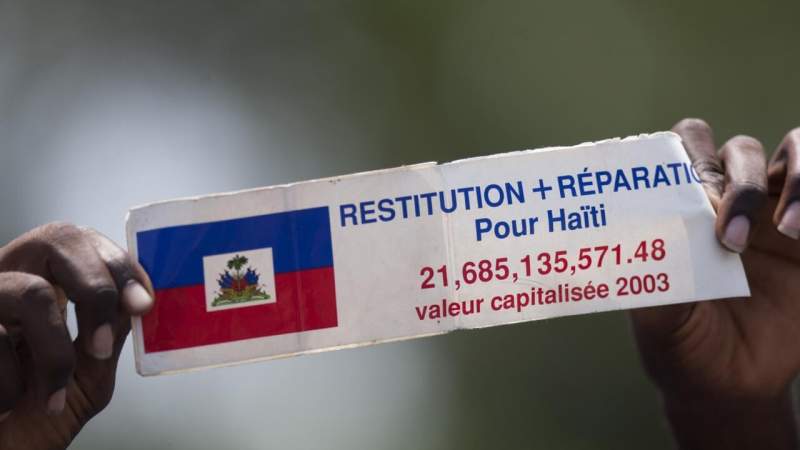
In 2002, Haitian President Jean-Bertrand Aristide estimated this debt at $21 billion and officially demanded its repayment. More recently, in January 2025, Leslie Voltaire, then president of the Transitional Presidential Council, renewed the call, asking Paris to «repay the debt of independence and provide reparations for slavery.» In March, tennis player Naomi Osaka, who is of Haitian descent, shared this request on social media.
Independence with Conditions
Haiti declared its independence on January 1, 1804, after defeating Napoleon’s troops. But France refused to recognize this new state, while harboring hopes of reestablishing slavery.
In 1825, Charles X changed his strategy. He offered to recognize independence, but in return demanded 150 million gold francs to compensate the former slave-owning colonists—that is, nearly the twice the amount paid by the United States for the Louisiana Purchase. Baron de Mackau, the king’s special envoy, arrived in Haiti escorted by 14 warships and more than 500 cannons. This was no diplomatic mission: Haiti had to sign the treaty or face war and a blockade.
On July 11, 1825, President Jean-Pierre Boyer agreed to the terms and accepted payment in five installments.
To pay off this crushing debt, Haiti is forced to borrow heavily from French banks, jeopardizing its economic future.
A spiral of debt
As early as 1838, faced with defaults, France returned to the fray. The amount was reduced to 60 million francs, but the loans continued to drain the Haitian treasury. The taxes imposed to repay the debt stifled the economy.
This «price of independence» has had a lasting negative impact on funding for education, infrastructure, and public health. According to a 2022 investigation by The New York Times, Haiti has paid a total of more than 112 million francs—the current equivalent of $560 million—at an estimated economic cost in lost growth ranging from $21 billion to $115 billion.
Economist Thomas Piketty estimates that France should return at least 30 billion euros.
A persistent refusal to make amends
Successive French presidents—Jacques Chirac, Nicolas Sarkozy, and François Hollande—have sidestepped the issue of reparations. In 2015, François Hollande spoke of «settling the debt,» before clarifying that it was solely a «moral» debt.
For historians, denying that the consequences of slavery and debt are material amounts to erasing an economic reality: in mainland France, 14 % of the population lives below the poverty line, compared to 38 % in Martinique and 46 % in Guadeloupe. In Haiti, this rate rises to 59 %, with a per capita GDP of less than $1,700, compared to nearly 45,000 in France.
Macron Breaks His Silence… Without Going So Far as to Offer Reparations
On April 17, 2025, Emmanuel Macron acknowledged, for the first time, the «heavy financial indemnity» imposed by France on Haiti. He announced the the creation of a joint Franco-Haitian commission tasked with examining «all aspects» of this shared history. But he did not mention any financial compensation.
For many Haitians, this stance is insufficient: in their view, only a concrete proposal for financial restitution would make it possible to heal this two-century-old wound.