



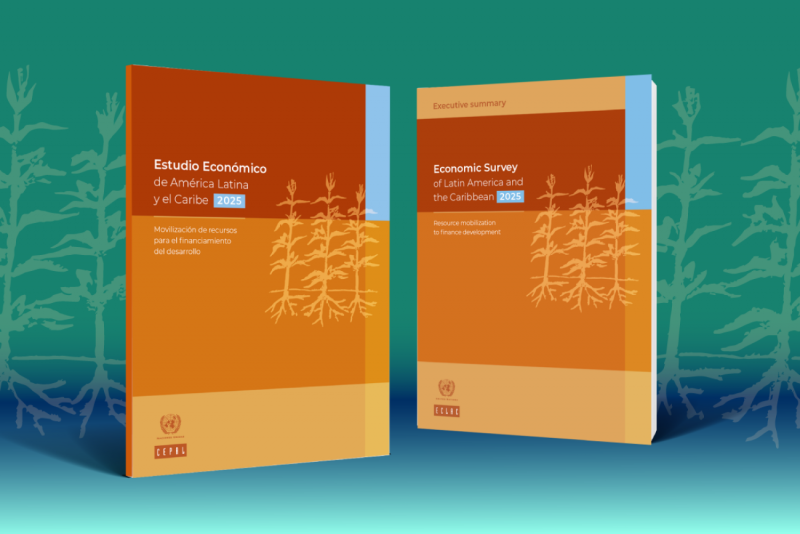
The Economic Commission for Latin America and the Caribbean (ECLAC) has presented na new edition of its annual report

The new projections for 2025 represent a slight upward revision from those published by the organization in April (2.0%), which is attributable to improved GDP performance in the first quarter of the year.
The report – released at a press conference led by the United Nations regional commission’s Executive Secretary, José Manuel Salazar-Xirinachs – emphasizes that the estimates point to different dynamics among subregions and countries.
In the Caribbean (excluding Guyana), growth is forecast at 1.8% in 2025 and 1.7% in 2026, marking a deceleration versus 2024, which is attributable to lower GDP growth in the United States, and the ensuing reduction in the demand for tourism services, in addition to lower global demand for services. The subregion continues to face high costs for energy imports and transportation, as well as notable exposure to natural disasters – factors that impact its external position and debt levels. In contrast, Guyana is seen maintaining high growth rates, thanks to continued investment in the hydrocarbons sector.
In South America, a 2.7% expansion is foreseen in 2025, above the regional average, based mainly on a recovery in Argentina and Ecuador, an upturn in growth in Colombia and Paraguay’s solid expansion. However, in the rest of the subregion’s countries, a slowdown versus 2024 levels is expected. In 2026, South America’s growth is seen easing again to settle at 2.4%.
In Central America and Mexico, projected growth for 2025 is 1.0%, nearly half the 1.8% expansion recorded in 2024, due to the weakening of external demand, especially from the United States. Countries such as Guatemala, Panama and the Dominican Republic will exhibit a more dynamic performance, however, with rates topping 3.5% thanks to the impetus of the services sector, private consumption and remittances. On the whole, a modest recovery to 1.7% growth is expected in 2026, although the subregion will continue to be highly vulnerable to external shocks due to its structural dependence on the U.S. economy in commercial, financial and migration-related matters.
The macroeconomic scenario for 2025-2026 will be marked by less dynamism in domestic aggregate demand. The regional macroeconomic environment will be characterized by weak domestic demand, particularly due to slower private consumption. In addition, international prospects remain unfavorable, limiting the external impetus for regional growth.
In 2025 and 2026, global economic growth is expected to slow due to a variety of factors, including geoeconomic tensions and fragmentation, tighter financial conditions, a decline in international trade, and armed conflicts. This situation is exacerbated by increased external vulnerability, which is reflected in a projected wider current account deficit and greater dependence on foreign capital. The report indicates that, during the 2025–2026 period, the region’s balance of payments will remain exposed to various risks, such as escalating geopolitical conflicts, volatility in commodity prices, and a synchronized slowdown in the world’s major economies.
Employment growth is also expected to slow. In line with economic trends, ECLAC forecasts that employment growth will remain weak in the region’s economies in 2025 and 2026. The increase in the number of people employed is expected to be lower than in previous years. Under this scenario, the unemployment rate is expected to stabilize at around 5.6 %. Although a slight reduction in the informal sector and in productivity gaps between men and women is expected, these indicators will remain at high levels. Projections for 2025 and 2026 indicate stable regional inflation, although risks of upward inflationary pressures are expected to persist.
En résumé, le rapport met en garde contre la grande incertitude qui pèse sur les perspectives mondiales et régionales pour 2025 et 2026. La dynamique de croissance des économies de la région pourrait se détériorer en raison de l’aggravation des risques mondiaux.
Mobilizing Resources to Finance Development
In light of these complex prospects, ECLAC emphasizes the urgent need for the region to «mobilize more resources in order to overcome the traps of low growth, high inequality, limited social mobility, and persistent structural disparities in development.» In the medium term, Latin America and the Caribbean will face the challenge of maintaining macroeconomic stability and continuing their productive transformation amid an increasingly unstable international environment. “To meet this challenge, it is essential to define a long-term strategic vision that supports sustainable and inclusive development, accompanied by short-term macroeconomic policies designed to mitigate risks and reduce exposure to external shocks,” the organization’s Executive Secretary stated in his presentation.
The’ 2025 Economic Study addresses three key dimensions for strengthening development financing capacity in the region, building on three strategic pillars.
The first pillar focuses on mobilizing domestic resources . The report identifies the fiscal and structural challenges that limit this mobilization in the region. It proposes improving the quality of spending, increasing public investment, and strengthening tax collection by reducing fraud and streamlining tax expenditures, while moving toward a more progressive tax system.
The second pillar focuses on mobilizing external and private resources . In this regard, the document emphasizes the need to reform the international financial architecture in accordance with the Seville Commitment, to redefine the eligibility criteria for Official Development Assistance (ODA), and to strengthen sovereign debt resolution mechanisms. It further proposes increasing private investment by developing capital markets at the national level and encouraging the use of instruments such as thematic bonds, debt swaps, and blended finance.
The third pillar emphasizes the importance of strengthening the role of development banks in mobilizing resources . The report highlights the strategic role these banks play in channeling funding to key sectors. To accelerate progress toward achieving the Sustainable Development Goals (SDGs) by 2030, development finance institutions must drive large-scale projects through innovative mechanisms that combine public and private investments. The report emphasizes the importance of collaboration among development finance institutions to increase their lending capacity and scope of action.
The Seville Commitment
The Fourth International Conference on Financing for Development , held recently in Seville, Spain, reaffirmed the global commitment to sustainable development and increased financing. In its new report, ECLAC urges countries in the region to seize this opportunity to accelerate the mobilization of financial resources, strengthen economic stability, and move toward more productive, inclusive, sustainable, and resilient development.
Attachment(s)
……………………………………………………………………………………..
Ce texte est une adaptation d’un communiqué de presse initialement publié par la CEPALC.