




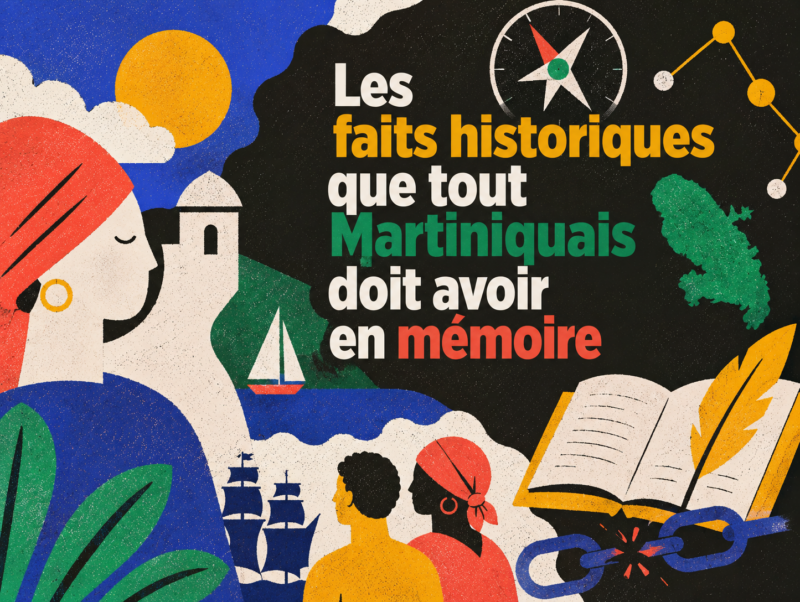
History is never merely an exercise in memory. It serves as the foundation upon which a society builds its identity, guides its decisions, and shapes its future. But this story still needs to be told accurately, by distinguishing facts from oversimplifications and reality from clichés.
For a long time, the colonization of Martinique was summed up by convenient phrases such as «The West Indies became French.». Behind this apparent neutrality lie the key players, political decisions, power dynamics, and human consequences that have shaped our region.
The history of Martinique is rooted in A Few Basic Guidelines that everyone should know: the presence of Indigenous peoples before 1635; the conquest organized by France; the expulsion of the Kalinago; the economic transformation brought about by sugarcane; the establishment of the slave system; the Code Noir; the abolition of slavery, its reinstatement in 1802, and then emancipation in 1848; and finally, the departmentalization of 1946, championed by Aimé Césaire to secure equal rights.
These events are not just a series of dates. They explain land use, economic structures, relations with mainland France, debates on the high cost of living, demands related to historical memory, and institutional changes which continue to shape Martinique.
Being aware of these facts does not mean harboring resentment or rewriting history. On the contrary, equip ourselves with the tools to understand the present with clarity. A society that ignores its past runs the risk of viewing its difficulties as inevitable, even though they often stem from clearly identifiable historical choices.
Memory has value only when it is based on established facts. That is why Every Martinican should be familiar with these fundamental historical landmarks. They do not impose any political interpretation; ; They provide the keys we need to understand where we come from, assess how far we've come, and build the future with full knowledge of the facts. Gdc