

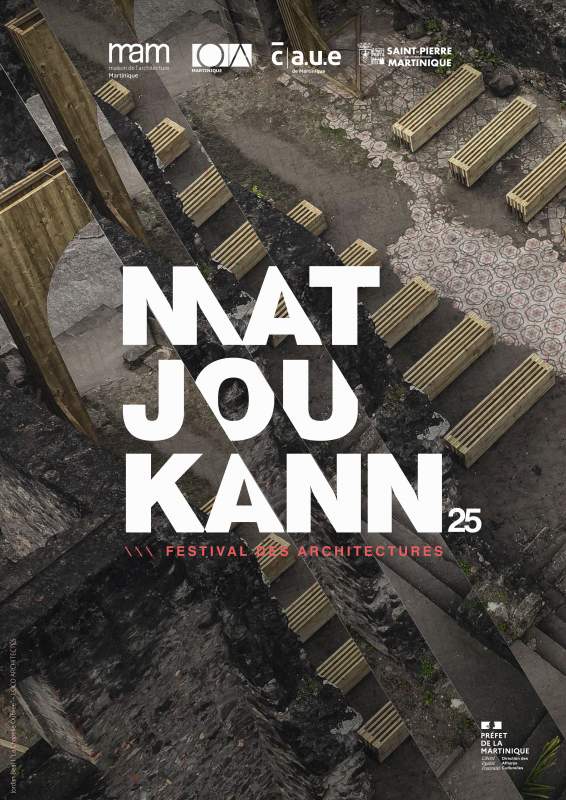
Through Matjoukann, the city of Saint-Pierre—designated a «City of Art and History»—will be transformed into a living laboratory during the National Architecture Days, October 17–19, under the theme «Remission.» Six temporary installations designed by multidisciplinary teams of artists and architects—many of whom are very young—will reveal the city’s scars and sketch out paths to rebirth, navigating the realms of memory, imagination, and reconstruction.
—
A City in Dialogue with Its Past
Saint-Pierre, «martyred city» Etched in people’s memories since the 1902 eruption, it still bears the scars of its history. Its ruins, its «gaps,» and its abandoned spaces bear witness both to an exceptional cultural heritage and to a slow urban recovery.
It is within this context that the Matjoukann Festival, organized by the Maison de l’Architecture de Martinique, CROAM, and CAUE, takes place. Its name, derived from Martinican Creole—«pa(ma)trimoine»—clearly expresses its ambition: to highlight a shared heritage, not to sanctify it but to reinvent it.
Matjoukann: A Cathartic Event
For this second edition, the organizers issued a call for submissions to design five site-specific installations. Each is conceived as a catalyst: transforming a forgotten, overfamiliar, or trivialized place into an active, meaningful space. The installations aim to stimulate the public’s senses and create a liannaj , that delicate connection between residents, history, and the city.
These temporary structures are meant to serve as witnesses to a moment in time—fragile yet fruitful imprints. They tell the story of the past and the present, while opening up new perspectives on a shared future to be built. Matjoukann is not a nostalgic celebration: it is an invitation to see the city in a new light and to imagine its future.
2025 Theme: Remission
After a first edition centered on the theme of «eruption,» the festival has chosen «remission» as its theme for 2025. The goal: to help people move past their grief, to spark a new vitality, and to reinvent color and music in the heart of Saint-Pierre.
The installations are designed as «urban vitamins»—symbolic supplements capable of helping the city shake off its lethargy. In practical terms, they avoid being anchored to the ground—to work around archaeological constraints—and settle gently, «like comforting caresses on the wounds of a convalescent.».
Beyond raising awareness of architecture and ephemeral art, Matjoukann is also a collective experience: reimagining how we view Saint-Pierre, building bridges between the past and the future, and bringing memory to life.
The city will likely never again become the cultural and economic capital it once was. But it is regaining a new vitality by transforming its empty spaces and scars into resources.
That is the challenge the Festival has taken on: to breathe new life into the city and rekindle a passion for it, to transform forgotten sites into places of the future, and to make architecture a remedy for the city that is both poetic and political.
Nathalie Laulé
Anne Jégouzo, archaeologist, researcher, and director of the Heritage Department of the City of Saint Pierre
«We are delighted to host this festival for the second time. We have made two iconic sites available: the ruins of the Fort Church, one of the places that best illustrates the power of the eruption and has a particularly romantic atmosphere. Another religious site is Abbé Gosse’s chapel—a beautiful spot situated on the ruins of the Bethléem asylum—as well as several vacant lots strategically placed along the route, since we’ll be taking a fairly long stroll through the city, from the Fort neighborhood to the Mouillage neighborhood.”.
This year’s chosen theme is of direct interest to Saint Pierre, as it addresses the specific issue of construction in Saint Pierre. Since today’s Saint Pierre is built on the site of a city that has completely disappeared, there are inevitably impacts on archaeological remains—both underground and above ground. And this poses a real challenge for investors in particular, since whenever someone wants to build something in Saint Pierre, an assessment and an excavation are required—and rightly so. Of course, we welcome the progress made in research and the preservation of these remains, but this does represent an additional cost.
The question is: How can we build today in this context, which combines the constraints of archaeological remains with natural constraints? What if we built suspended structures? The challenge for these projects is how to build Saint Pierre differently. This event combines the exploration of architectural installations in heritage sites with activities centered on the city’s architectural heritage.»
Festival Program
Friday, October 17:
Day Programs: School groups meet the teams, explore the five installations, and participate in the School Architecture Scavenger Hunt
Evening Event: Architecture Film Screening (Registration Required)
—
Saturday, October 18:
During the Day:
- Self-guided tour of the facilities
- Guided tours of the facilities (by reservation)
- Guided tour focusing on modernist architecture (registration required)
- Archi Rally for Everyone
Evening Events: Light displays and concerts
—
Sunday, October 19:
Morning: Self-guided tour of the facilities and Architecture Scavenger Hunt for everyone
The festival ends at 12:00 p.m.
The Winning Projects
«Fabric», amid the ruins of the chapel at the Bethléem asylum. “Reimagining the Asylum Chapel: Once a Place of Suffering,” an artistic reflection on healing, invites visitors to wander through a textile structure made of red panels.
Fabrice Henri, Mathieu Nouhen, Quentin Jousselme
————
«Ghost Members», on the ruins of the Fort’s church. A reference to the common sensation of a limb’s presence after amputation. Trap-like structures.
Pastel Benoît, Johann Capgras
————
«Tèmpl», a bamboo structure at the mouth of the Roxélane.
Benjamin Vitry, Bastien Tanguy, Romain Beziat
————
«What Time Puts on Hold», Rue de la Prison, a street scene composed of drapery.
Valentine Bescond, Leeloo Dannhauer, Léa Forgereau
————
«Anba Soley Brings Life», Rue de la Raffinerie, «a space that playfully depicts an «after» that exudes joy, in contrast to a tumultuous «before.»».
Corentin Divol, Lisa Liffraud, Léa Broco, Vincent Lussac