



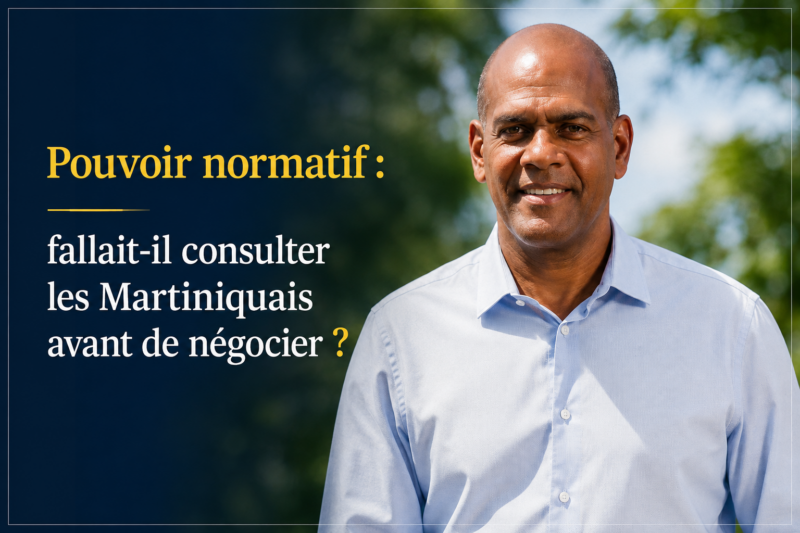
A question arose during an appearance by Eddie Marajo on the program *À Contretemps* on Zitata TV: beyond the traditional debate between supporters and opponents of autonomy, the real question now may be about the method chosen to achieve it. Should negotiations with the French government on Martinique’s institutional evolution have been initiated before asking the people of Martinique whether they wished to pursue this path? Or should we, as the current process envisions, first negotiate the details of a possible transition and then consult the public on a proposal that is sufficiently specific for them to make an informed decision? Behind this difference in timing lies a fundamental question of democratic legitimacy.
On the issue of autonomy, Serge Letchimy has never made a secret of his goal.
He has repeated it many times: he had promised Aimé Césaire to «set Martinique on the path to autonomy.» From this perspective, he can now consider that he has kept his promise. With the framework agreement concluded with the French government, Martinique is indeed engaged in a process that is likely to profoundly alter the organization of its government.
But setting Martinique «on the path to autonomy» is not a decision without consequences.
Above all, a political goal consistently championed by a leader does not, by definition, become the goal of an entire population. That is precisely where the democratic debate begins.
What exactly are we talking about?
The aim is to enable Martinique to exercise on its own the powers or authority currently held by the central government. This applies to economic regulation, but also—depending on the outcome of the negotiations—to certain areas related to taxation, health care, education, and other public policies.
The framework agreement thus opens up a much broader scope for negotiation than the powers currently available to the Territorial Collectivity of Martinique under Article 73.
"So we need to call a spade a spade," concludes Eddie Marajo:
Behind the negotiations that are now underway, the outlines of a special status for Martinique are taking shape, though the precise details of that status have yet to be worked out.
This is precisely why the next phase is so important. The various parties designated in the agreement will negotiate with the French government the future division of powers between Paris and Martinique. In other words, the discussion is no longer limited to a few isolated adjustments to national laws. The question now is whether Martinique will be able to establish more of its own rules applicable within its territory.
But this development inevitably raises constitutional issues.
Martinique is currently governed by Article 73 of the Constitution, and a substantial change to its institutional structure cannot be decided upon as if it were a mere administrative reform. Depending on the exact nature of the status ultimately envisaged, specific constitutional procedures must be followed, and consulting the voters of Martinique is an essential step whenever a change in the institutional framework is involved.
Therefore, the real debate may not be whether, as a matter of principle, one should be for or against autonomy. It lies at an earlier stage: at what point should the people of Martinique have a say in shaping their institutional future?
The method currently in use essentially involves first negotiating to determine the content of the project, and then submitting the result to the public when required by law.
But there was another option: first ask the people of Martinique whether they truly wished to move their territory in that direction and, if the answer was yes, then negotiate with the French government on the basis of that popular mandate.
The difference is significant. In the first case, politicians negotiate a proposal that they will then present to voters. In the second, voters first give their representatives a mandate to negotiate.
A unanimous decision that must be interpreted correctly
However, we must go back to the origins of the current process, as it did not arise solely from the will of the president of the Executive Council. A decisive political milestone was reached at the Congress of Elected Officials of Martinique on October 8 and 9, 2025. At that congress, elected officials unanimously adopted a policy aimed at securing its own regulatory authority, enabling Martinique to better adapt national rules to its specific circumstances and, in certain areas, to define the standards applicable within its territory. This initiative subsequently informed discussions with the French government and led to the framework agreement of July 1, 2026.
However, this unanimity warrants some explanation.
It does not necessarily mean that all of Martinique’s elected officials have come to share the same vision of autonomy, much less that they have agreed in advance on a definitive institutional status. Politicians with very different political views were able to agree on one common observation: the current framework does not always allow for a sufficiently rapid and effective response to the economic, social, and territorial specificities of Martinique.
It was therefore possible to vote in favor of greater regulatory authority without necessarily accepting all the institutional consequences that might result from it.
The consensus initially centered on the need to secure additional resources and to begin negotiations with the government. It should not automatically be interpreted as unanimous approval of a model of autonomy whose specific terms, in fact, have yet to be negotiated.
It is this distinction that is now becoming essential. The unanimous support of elected officials has given considerable political weight to the launch of the process; however, it cannot replace the public’s input on the status that might result from it.
This brings us back to the question raised at the outset of the debate in *À Contretemps*.
Should the people of Martinique have been consulted before negotiations began, so that the negotiators would have a prior mandate from the people? Or is it better to negotiate first so that citizens can then choose among concrete proposals rather than take a position on the necessarily vague term ’autonomy«?
This is by no means a minor issue.
Because at the end of this process, the question will no longer be simply whether Martinique wants more powers. It will be necessary to determine what powers, in which areas, with what resources, under what democratic oversight, and within what framework of relations with the State.
And that decision—regardless of any previous consensus reached among elected officials—must ultimately rest with the people of Martinique.
Gérard Dorwling-Carter