


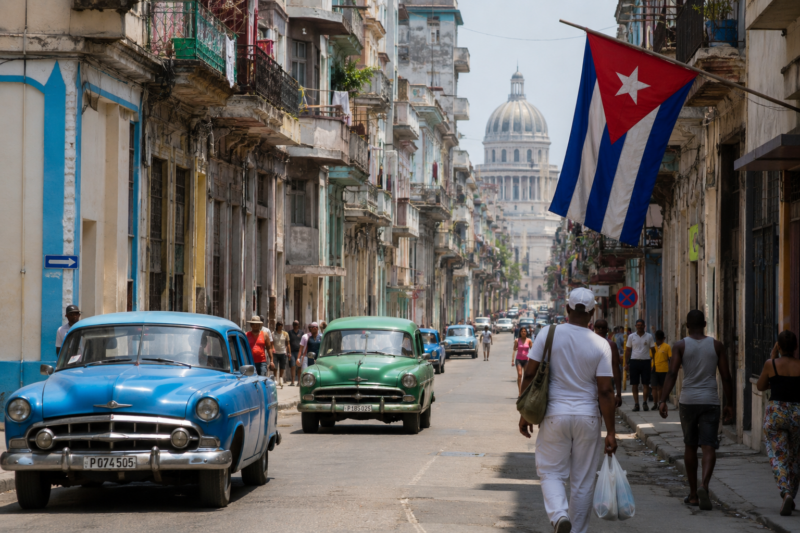
On May 1, 2026, Donald Trump signed an executive order imposing unprecedented sanctions on Cuba. The sanctions now target any foreign company doing business with the island. This escalation is further crippling an already fragile economy and forcing the Caribbean to make a difficult choice.
A decree unprecedented in the history of sanctions against Cuba
On May 1, 2026, Labor Day, Donald Trump took strong action. He signed Executive Order 14404. This order aims to impose sanctions on those responsible for the repression in Cuba. The date is no coincidence: on that very day, hundreds of thousands of Cubans marched in Havana in front of the U.S. Embassy to denounce the blockade.
This executive order goes far beyond traditional sanctions. It establishes a sanctions regime against Cuba that targets the entire island. This is prompting non-U.S. companies to cease their business activities with Cuba. This mechanism is similar to the secondary sanctions targeting Iran, Russia, or North Korea.
Banks and Shipowners in the Crosshairs
The legislation authorizes the U.S. Treasury to impose sanctions on foreign financial institutions. These institutions have conducted or facilitated significant transactions with sanctioned entities. The goal is to limit Cuba’s access to the global banking system.
The first designations followed quickly. On May 7, 2026, the State Department imposed sanctions on three entities. Among them is the Cuban military-industrial conglomerate GAESA. In addition, the U.S. Treasury Department imposed sanctions on 11 Cuban officials. This also affects the country’s intelligence agencies.
As a result, the commercial repercussions were immediate. The French shipping company CMA CGM and the German shipping company Hapag-Lloyd suspended deliveries to Cuba. They also halted shipments following the May 1 decree.
An island already in economic decline
These new measures are hitting Cuba’s already battered economy. The island is already in the throes of a deep economic crisis. This crisis stems from tightened sanctions, structural weaknesses, and a failed monetary reform. Since late January 2026, economic activity among its 9.6 million residents has been virtually paralyzed.
Total blackout across the power grid
The energy crisis reached a critical level. In May 2026, the deficit exceeded 2,000 MW. Coverage was only 45 %. As a result, power outages lasted between 10 and 20 hours a day, depending on the neighborhood.
In addition, Washington has been imposing an oil embargo since January. It has allowed only one Russian oil tanker to enter. Francisco Pichon, the United Nations coordinator in Cuba, warned that there are real risks to people’s lives. The island relies heavily on oil for electricity and transportation.
Furthermore, more than 84 % of water pumping systems rely on electricity. This electricity comes largely from petroleum products. This vicious cycle disrupts all essential services.
Tourism in Free Fall, the Economy at a Standstill
The tourism sector—once one of the few pillars of the Cuban economy—is collapsing. Between January and March 2026, the island welcomed only 298,057 visitors. That is 48,% fewer than during the same period in 2025.
The figures are alarming. Visitors from Canada, the top source market, have fallen by 54 %. Arrivals from Russia have dropped by 37 %. Between 2019 and 2025, tourism revenue has already fallen by 70 %.
Other sectors are also suffering. Nickel and cobalt production has come to a standstill. The tobacco sector, another mainstay of exports, is suffering from a lack of fuel. The fuel crisis has turned into a waste crisis. Due to a lack of diesel, many garbage trucks are out of service, leading to a buildup of trash in Havana.
CARICOM Balances Solidarity and Pressure in Response to Sanctions Against Cuba
The Cuban crisis is not confined to the island. It presents the entire Caribbean region with an acute geopolitical dilemma. Governments are walking a fine line. They depend on the United States for security and economic stability. But they have long cooperated with Cuba.
However, CARICOM has chosen solidarity. Member governments are preparing to send humanitarian aid to Cuba. This decision was announced at the 50th regular session of the Conference, which took place in Saint Kitts and Nevis from February 24 to 27, 2026.
The supplies were purchased in Mexico. They include powdered milk, nonperishable food items, medical supplies, solar panels, and water tanks. The Caribbean Community reaffirms its commitment to participating in any initiative that benefits the Cuban people.
For decades, Cuba has provided health care professionals to the region. It has also offered medical training, disaster relief, and scholarships to Caribbean nationals. Cuba stood by the region when resources were scarce.
However, U.S. pressure is also being exerted on regional allies. Secondary sanctions constitute a violation of the principle of non-interference. They also violate the right of third countries to economic self-determination. This reality weighs heavily on small island states.
For the Caribbean nations neighboring Cuba, Washington’s message is clear. Any company that maintains trade ties with Havana risks direct retaliation. This is precisely what Martinique feared, just a stone’s throw away from an island that is sinking.