Have you ever looked closely at the shape of a sunflower, the structure of a snowflake, or the morphology of a fern? Beyond their fascinating beauty, we can also see mathematical objects in them, since the spirals of the sunflower follow a famous numerical sequence called Fibonacci sequence, snowflakes have hexagonal symmetriesThe specific characteristics and morphology of the fern describe a geometry fractal.
There are many other examples that illustrate just how prevalent mathematical concepts are in nature. Conversely, mathematics is used to understand the phenomena around us: for example, it is thanks to differential equations that we can precisely calculate the trajectories of celestial bodies or predict what the weather will be like in a few days. Mathematical concepts seem to apply to nearly all sciences with remarkable effectiveness. This effectiveness is particularly intriguing in physics.
Eugene Wigner, winner of the 1963 Nobel Prize for his contributions to elementary particle theory through the discovery and application of fundamental principles of symmetry, raised the question of «unreasonable effectiveness» in 1960» of mathematics in the natural sciences. This effectiveness may seem superficial if we reduce mathematics to a mere toolkit used by other sciences. But the connection between mathematics and nature runs much deeper: mathematics is often indispensable for understanding phenomena, and it enables us to make unexpected predictions that will not be observed until much later. Here are two examples
Cicadas singing to the rhythm of prime numbers
Cicadas Cassini Cicada have a very unique life cycle: these insects remain underground for years and emerge to reproduce either every 13 years or every 17 years—and exclusively at these two intervals.
Experts have offered to explain this phenomenon using evolutionary arguments: these insects tend to minimize their interactions with predators (which have a life cycle of n years). However, this explanation is only satisfactory when supported by the following purely mathematical result: if p is a prime number and n an integer strictly less than p, then the least common multiple of p and n is p × n. In fact, let’s imagine that the predator’s life cycle is 4 years. If the cicadas (which have a 17-year life cycle) encounter their predator one year, they will not encounter it during their next emergence, since that predator will appear in the 16the year and the 20the year, but not the 17the years. In fact, they won't cross paths until they are 68 years old (since 17 × 4 = 68).
This raises the question of whether the Darwinian mechanism of natural selection It would not, in fact, be a mathematician who would apply this theorem in his work. Whatever the answer may be, another question remains: Is there another explanation for this phenomenon that does not rely on abstract mathematical concepts?
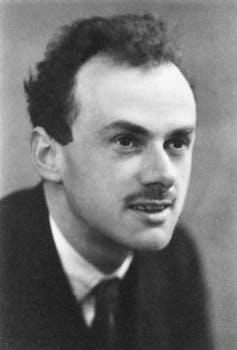
«My equation was smarter than I was,» said Paul Dirac, Nobel Prize winner
In the late 1920s, the two major theories in physics—namely, the general relativity and the quantum physics are still young but already well-established and extensively studied. However, it seemed at the time—and this is still largely true today—that these two branches of physics were unaware of each other: the first describes the large-scale behavior of the universe, while the other focuses on the infinitely small.
Paul Dirac then decided to reconcile these two perspectives by formulating an equation that describes the quantum state of an electron while taking into account the principles of relativity. Armed with advanced mathematical concepts, which until then had been confined to the realm of abstract concepts, Dirac established a equation that accurately describes electrons and is consistent with the’Schrödinger equation when the speeds of the particles are very small compared to the speed of light.
However, alongside these successes, new problems have arisen, since the equation also admits solutions other than the already known particles… In other words, the Dirac equation seemed to predict the existence of particles unpublished who have «negative energy.» One consequence mathematics of the Dirac equation, which was rejected by all physicists of the time, including Dirac himself. It was only after several years of heated debate and relentless effort that Dirac came to accept his own equation and named the hypothetical particle with negative energy an «antielectron.» This particle would be observed experimentally three years later, thus paving the way for the discovery of antimatter. Commenting on this episode, Dirac will say later : «My equation was smarter than I was.»
Mathematics: The Language of Nature?
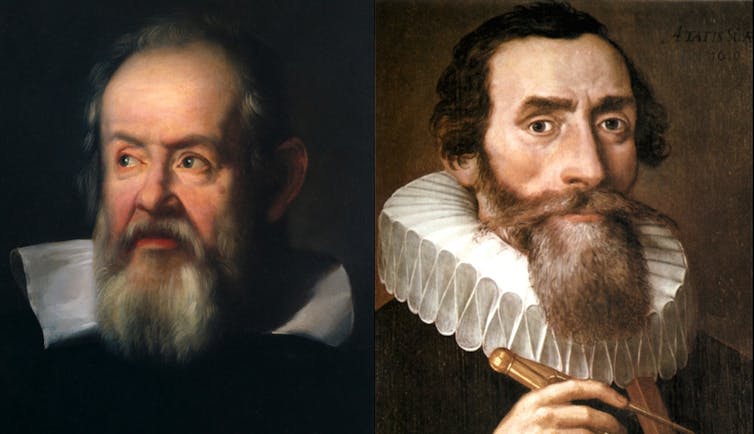
The beginning of this close relationship between mathematics and physics is often attributed to the work of Kepler and Galileo in the 17th centurye century. This marked a major turning point in the history of science, as expressed in Galileo’s famous quote:
«Philosophy is written in this vast book that lies constantly open before our eyes (I mean the Universe), and we cannot understand it unless we first learn the language and the characters in which it is written. Now, it is written in the language of mathematics, and its characters are triangles, circles, and other geometric figures, without which it is humanly impossible to understand a single word of it, and without which we truly wander in a dark labyrinth. » (Galileo Galilei, *The Tester*, 1623)
Galileo Galilei, painted by Justus Sustermans in 1635, and Johannes Kepler in a painting from 1610, the original of which has been lost.Wikipedia
The use of the adverb «humanly» gives this sentence an ambivalent meaning that has occupied—and continues to occupy—the greatest minds of the past three centuries. Does Galileo’s assertion mean that mathematics is the true and only language of nature? If so, humans must learn this language in order to understand the reality they observe. Or does it mean, on the contrary, that mathematics is a human invention that makes observed phenomena intelligible through study? Naturally, there is no definitive answer that would bring everyone to agreement on the nature of this mysterious link between mathematical objects (abstract objects) and physical reality (empirical objects).
Nevertheless, major philosophical schools have put forward their theories on the subject. Some empiricists believe that mathematical objects are the result of a process of refinement (or abstraction) of concrete, observable objects. Conversely, some idealists, sometimes called Platonists, believe that mathematical objects exist as ideals separate from the observable world, and that these ideals apply to natural phenomena because they served as models for their formation. The Kantians For their part, they believe that we cannot understand natural phenomena apart from innate structures that are common to all human beings: the «A priori» forms of sensibility, which are space, time, and the concepts of understanding. Space and time are therefore the conditions for all physical experience, but also for all mathematical constructs, It is inevitable that any natural science be a mathematical science.. Finally, from’other, more formalist philosophers see no mystery in the story, since mathematics is merely a set of symbols that scientists (physicists, biologists, economists, etc.) interpret as they please.
While scientists and philosophers continue to debate the issue, bees have known for centuries how to build nests whose hexagonal structure allows them to create the maximum number of cells using the minimum amount of wax. This mathematical property has been estimated in IVe century but was not proven until 1999—the theorem is even named after honeycomb theorem.
Whether mathematics is merely a representation that makes nature intelligible to study or whether it is nature’s true language, nature never ceases to fascinate, and it will certainly continue to do so for a long time to come.