



In this op-ed, Jean-Marie Nol, an economist and legal scholar, offers his personal perspective on the political, cultural, and economic evolution of Guadeloupe and Martinique. Following assimilation, creolization, and the reappropriation of African roots, he puts forward the idea of «Europeanization,» which, in his view, could represent a new horizon for the Caribbean. He develops this thesis as a line of thought—encompassing economic, political, and institutional dimensions—in a context marked by technological, demographic, and geopolitical shifts.
From Assimilation to Europeanization: The New Collective Narrative That Could Transform the Economy of the French West Indies.
There are periods in history when a society changes before it even realizes that it has changed. Behaviors shift, new generations develop new aspirations, technologies transform our relationship with the world, and old ways of thinking gradually lose their explanatory power and their points of reference, while political vocabulary continues to operate within the categories of a bygone era. Guadeloupe and Martinique seem today to be entering one of these periods of transition. In the future, they will face a profound transformation of their economies, their demographics, and their relationships with France, the Caribbean, Europe, and the world, but they do not yet truly possess the collective narrative needed to give a shared meaning to this new reality, which will profoundly reshape Caribbean society. .
It is precisely in this space that a new concept could gradually take hold: Europeanization.
This is not about artificially creating a new ideology, much less replacing one identity with another. It is about understanding that a society is never defined solely by its origins. It is also defined by the economic and social transformations it undergoes and by the vision it chooses. Thus, in the long run, Europeanization is the only credible political solution for preserving the social gains of departmentalization and, above all, the only credible economic alternative for ending dependence.
The political and cultural history of the French West Indies can, broadly speaking, be viewed as a succession of major collective narratives. These narratives have never completely supplanted one another. They have overlapped, clashed, complemented one another, and at times coexisted in a contradictory manner.
The first major phase was that of assimilation and departmentalization. In 1946, integration into the Republic represented a historic response to a society deeply marked by inequalities inherited from the colonial system. Departmentalization held out a considerable promise: that of equal rights, social protection, infrastructure modernization, and economic catch-up. For several generations, this promise represented one of the main horizons of progress.
But assimilation also had its contradictions. While it brought about legal equality, it did not automatically eliminate the sense of distance and cultural alienation.
By integrating the Caribbean societies into the Republic, it did not dispel the questions about their history, their identity, and their cultural distinctiveness. .
A second sequence would then emerge.
Beginning in the 1960s, and especially in the 1970s and 1980s, anti-colonial, autonomist, independence-seeking, Third Worldist, and identity-based doctrinal thought gradually began to challenge the narrative of assimilation. These movements would point out that legal equality was not enough to resolve the issue of identity. They would question the persistence of colonial domination, economic dependence, the history of slavery, and the political and cultural relationship with France.
It was within this intellectual context that Édouard Glissant would develop one of the most fruitful schools of thought in Caribbean modernity.
In *Le Discours antillais*, and subsequently throughout his body of work, the concept of creolization would make it possible to move beyond a conception of identity based on the search for a single origin. Caribbean identity could be conceived as an identity rooted in relationships, encounters, transformation, and cultural mixing.
Creolization was a minor intellectual revolution because it freed people from the Caribbean from having to choose between conflicting origins.
She was essentially saying that a society could emerge from several worlds and become something other than any one of them. This is the metaphor of the rhizome.
This story remains essential.
But history never ends with a single story, even when that story has been particularly powerful.
For several years now, another intellectual and cultural movement has been developing in Caribbean societies: the rediscovery of Africa and the affirmation of African descent, along with a growing connection to certain African countries. This dynamic responds to a legitimate historical need. For a long time, the African history of Caribbean populations has been insufficiently recognized in official narratives. The reclaiming of African roots therefore constitutes a form of restoring balance to collective memory.
But here again, a problem arises when the search for our origins tends to become a sufficient answer to the question of the future.
Because knowing one's roots does not necessarily determine what kind of society one wants to build for the future. .
Memory explains where we come from.
It doesn't automatically determine where we're going, especially when the path is already fraught with obstacles. .
It may be precisely at this level that the paradigm shift is taking place today.
The generation of young people from the Caribbean who are now coming of age did not grow up in the same world as those who led the political and identity struggles of the 1950s, 1960s, 1970s, or 1980s. They were born into a world of the Internet, social media, digital platforms, low-cost travel, academic exchanges through Erasmus, professional mobility, and the global circulation of images, music, and innovative ideas.
She can simultaneously feel deeply Guadeloupean or Martinican, embrace her African heritage, listen to old French songs and Afrobeats, watch American content, work with European companies, and dream of an international career.
This plurality is not necessarily a contradiction.
It could be the contemporary expression of Caribbean identity.
This is where Europeanization could gradually begin to take shape.
Europeanization would not be a new form of assimilation.
It would be precisely the opposite of assimilation understood as the erasure of cultural distinctiveness. .
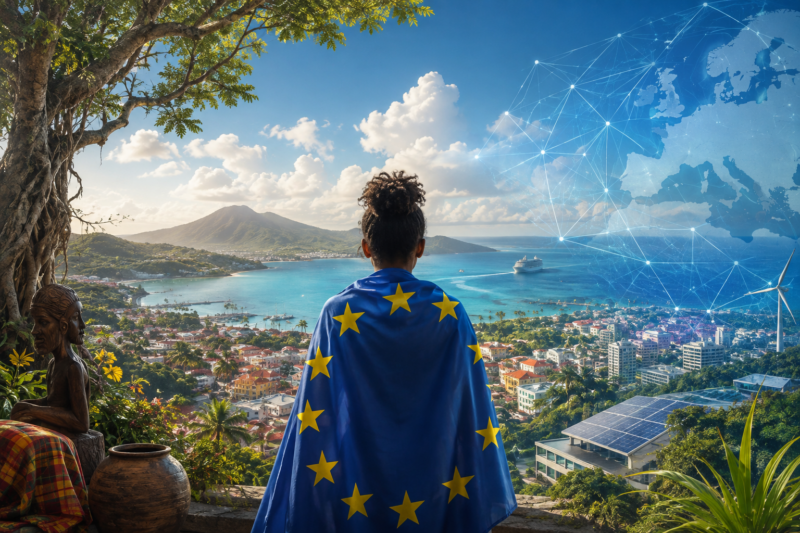
It would involve politically embracing a new sense of European identity—one that is already deeply embedded in the institutional, legal, economic, and social reality of the French Antilles, with the European passport and the euro already serving as its foundation—and turning it into a tool for collective self-expression.
The difference is fundamental.
The idea behind assimilation was: let’s become French to achieve equality.
Creolization held that: we have become something else through the encounter of worlds.
The quest of people of African descent calls for us to rediscover and embrace our African roots.
"Europeanization" could now mean: Let’s embrace all our identities and make Europe one of the economic and financial spaces of our future.
So this is not about replacing Africa, France, and the Caribbean with Europe.
That would be an intellectual mistake.
Africa can be a source of roots without necessarily being a credible prospect in geopolitical, economic, and financial terms.
The Caribbean can be a cultural space without necessarily being an exclusive political space.
France can remain a fundamental sense of belonging without being the sole strategic level of projection.
Europe can become a political and, above all, economic horizon without constituting a uniform identity.
This diversity is precisely what defines the uniqueness of the Caribbean.
For a long time, political debates have sought to resolve this plurality by choosing a dominant identity. The new challenge, on the contrary, might be to learn how to reconcile them.
That is why Europeanization must be understood as a unifying narrative.
It does not undermine creolization; rather, it extends its logic.
Creolization had taught the people of the Caribbean that they could draw from multiple worlds without having to choose between them.
Europeanization could build on this idea—particularly through the diaspora—by asserting that people can belong to multiple spaces at the same time and use this plurality as a resource.
Guadeloupe and Martinique are Caribbean societies.
They are French.
They are European.
They are Creole.
They embody a piece of African history. .
They are now also part of a globalized digital world.
The issue, then, is no longer which of these dimensions should take precedence over the others.
The challenge is figuring out how to bring them together to build a collective vision for the future. .
This issue is becoming even more important in the wake of the technological revolution.
Artificial intelligence and automation are not merely the next step in economic modernization. They could profoundly transform the societal and social structure of the Caribbean. Some administrative jobs, service sector activities, retail, accounting, transportation, and even certain intellectual professions will gradually be automated or profoundly transformed.
In a region where the public sector and services play a major role, this shift could be particularly destabilizing and, above all, detrimental in terms of a sharp rise in the unemployment rate.
But it could also create a historic opportunity.
Digital technologies alleviate some of the constraints associated with being an island. A company based in Guadeloupe or Martinique can now sell services remotely to Paris, Brussels, Montreal, or elsewhere. An engineer can work from the Caribbean for a company located on another continent. A college degree can be earned online. A digital service can be exported without physically transporting goods.
Geography is becoming less of a constraint for certain activities.
This means that Guadeloupe and Martinique can begin to approach their development in a different way.
The challenge will no longer be limited to producing more physical goods for a small island market. It will also involve producing knowledge, services, software, content, research, engineering, and exportable intellectual value.
Yet Europe has, in fact, considerable resources at its disposal to support this transformation.
"Europeanization" thus becomes an economic as well as a political—and ultimately a cultural—concept for young people scattered across the globe. .
It means that Europe is no longer seen solely as an external administrative framework but is instead becoming a space for development.
This means that European programs, research policies, funding, academic networks, digital infrastructure, industrial policies, and energy strategies must be integrated into a genuine development strategy for the Caribbean.
The institutional issue itself should be rethought in light of this reality.
The long-standing debate between autonomy and independence is often based on a top-down view of the relationship with the government: more local authority versus less authority for the state.
But the modern world is increasingly governed by multilevel dynamics.
A decision can be Guadeloupean, Martinican, French, European, and international all at the same time.
A company may be local in its operations, European in its financing, and global in its markets.
A student may be of Guadeloupean or Martinican origin, French by citizenship, and European by passport and freedom of movement.
Why, then, should we continue to think about political identity exclusively in binary terms?
"Europeanization" proposes, precisely, to break away from this line of thinking.
She doesn't say: "Less Guadeloupe and Martinique for more Europe.".
She says: more funding for Guadeloupe and Martinique through more effective use of European funds.
It is here that the plan to create an Antilles–Europe Institutional Front takes on a special significance.
Institutional ties to Europe could serve as the political vehicle for a narrative that does not seek to replicate old divisions but rather to prepare society for a shift in the economic cycle. .
Its goal would not be simply to amend a statute.
The goal would be to change a collective perception.
To make it clear that the fundamental issue is no longer just one of belonging, but one of ability.
Production capacity.
Ability to invest.
Ability to train.
Ability to innovate.
Ability to attract capital.
Ability to retain young people.
Ability to use new technologies.
Ability to expand throughout the Caribbean.
Finally, the ability to turn European membership into a strategic advantage.
This new vision of Europe could also revolutionize the way we think about regional cooperation.
For a long time, there seemed to be a contradiction between the Caribbean’s openness and its French and European identity. But this contradiction could be largely overcome.
Guadeloupe and Martinique could, in fact, become European territories in the heart of the Caribbean.
They could serve as interfaces between two spaces.
Their uniqueness would no longer be a disadvantage to be overcome, but rather a strategic economic and financial position to be leveraged through import and export trade.
Guadeloupe could become a European hub for economic, scientific, energy, and digital cooperation in the Caribbean.
Martinique could follow the same approach, based on its own strengths.
However, this vision requires a profound transformation of the economic narrative.
For decades, progress was primarily associated with catching up in terms of consumption. The standard of living in France served as the benchmark. Access to goods, services, and public benefits was considered one of the main measures of progress.
But according to some, this line of reasoning is now reaching its limits. .
A society cannot sustainably improve its standard of living without simultaneously increasing its capacity to create wealth and value. .
The real challenge of the next economic cycle will therefore be production and industrialization.
Guadeloupe and Martinique will need to generate more local value, attract more capital, foster investment by mobilizing local savings, develop more innovative businesses, and integrate more fully into European and international logistics and value chains.
It is here that “Europeanization” can become a new economic doctrine to counter the economic theory of “creative destruction” developed by the economist Joseph Schumpeter.
Creative destruction is a concept developed by economist Joseph Schumpeter in 1942. It refers to the process by which new technologies and innovations replace old products and companies. This process eliminates jobs and skills, but it creates new ones and drives the economy forward.
It could support the transition from a model based primarily on redistribution to one based more on production.
From a model of dependency to a model of increased investment capacity. .
From a catch-up economy to an innovation-driven economy.
From a society that demands protection to a society that seeks to become competitive.
This transformation will not be easy.
It involves challenging certain mindsets, habits, interests, dependencies, and cultural perceptions. .
It also calls for a new generation of political and economic leaders capable of thinking in terms of plans, capital, productivity, innovation, training, and competitiveness.
In other words, it involves restoring the importance of economic thought in the Caribbean debate.
This may be one of the most significant turning points in the new cycle.
The Caribbean has produced a remarkably rich body of political and cultural thought on identity, memory, colonization, Creole identity, and relationships.
They must now apply the same level of ambition to developing an economic philosophy for the 21st century.
Artificial intelligence, automation, the energy and ecological transitions, new value chains, the rise of major economic blocs, and the transformation of public finances are driving this intellectual revolution.
In this new context, young people could play a decisive role.
Because it is less constrained by the intellectual boundaries of previous generations.
Because she's already connected to the world.
Because it can belong to several cultural spheres at the same time.
Because she sometimes considers natural what still seems revolutionary to older generations.
Europeanization might therefore not be imposed from above.
It could emerge from below.
It could be driven by mobility, education, digital networks, businesses, European exchanges, and professional experiences.
It could become a sociological reality before becoming a political doctrine.
That is why the new collective narrative should not be presented as a break from the search for identity.
It should be viewed as a further stage in the process of creolization.
The search for one's roots answers the question: Where do we come from?
Creolization answers the question: How did we become who we are?
Europeanization would raise another, equally fundamental question:
Where do we want to go in a future that we want to be secure in material and financial terms?
This last question is probably the one most sorely lacking in the political debate in the Caribbean today.
Caribbean society has many memories.
She has several identities.
It has a rich and painful history.
But she needs a new beginning.
The European horizon could serve as that horizon without eliminating the others.
It might even give their coexistence a new sense of coherence.
Europe could become the arena in which Caribbean society transforms its diversity into strength.
That is why Europeanization should not be reduced to a mere institutional demand.
It should be viewed as an underlying phenomenon of a new economic doctrine for the Caribbean. .
A new way of representing oneself.
For a long time, people from the French West Indies may have seen themselves as existing on the periphery of several worlds: too French to be fully Caribbean, too Caribbean to feel completely French, shaped by Africa yet geographically separated from it, culturally Creole but politically integrated into and assimilated by the French Republic.
Europeanization could change this perception.
Guadeloupe and Martinique would no longer be peripheral regions caught between several centers.
They could become interfaces.
Regions capable of facilitating the movement of people, capital, knowledge, and cultures between Europe and the Caribbean.
This change in representation could be significant.
It would turn a geographical weakness into a geopolitical advantage in the face of Donald Trump's America. .
It would turn its remote location into a strategic advantage.
It would turn identity diversity into a resource.
It would finally transform European identity into a forward-looking vision for a future of progress, rather than regression.
Ultimately, this new perspective could naturally lead to a rethinking of institutions.
If Europeanization were to gradually become a political and economic reality, the question might arise as to how far the institutional integration of Guadeloupe and Martinique into the European area—which is expected to undergo profound changes over the next decade—should go. .
It is from this long-term perspective that we could begin to explore the idea of a unique status as an associate member of the European Union—or even, depending on developments in European and constitutional law and the democratically expressed will of the people, a form of state associated with the European Union.
The goal is not to replicate traditional models of independence.
The goal would be to find an institutional framework that reflects the unique character of a Caribbean territory—historically French and culturally Creole, yet deeply and long-standingly integrated into the European sphere.
Obviously, this scenario can only be considered after a long process of gradually assuming greater responsibility and building economic power.
It cannot precede economic development.
It must be the culmination of it all.
That is why Europeanization must first be economic, cultural, and generational before it can eventually become institutional.
The real revolution, then, would be less legal than mental.
It would involve moving definitively away from the notion that Guadeloupe and Martinique are territories doomed to choose between integration and secession.
There may be a third way: differentiated integration, multiple affiliations, and a European vision. No institutional changes will be proposed without first assessing the rights, funding, protections, and capabilities that would be gained or lost.
That is probably where the great cultural battle of the coming decades will be fought.
Previous generations experienced the struggle for equality.
Subsequent generations carried on the fight for cultural recognition.
A new generation could lead the fight for economic development. .
Production capacity.
Ability to innovate.
Ability to make decisions.
Entrepreneurial spirit.
The ability to shine.
The ability, at last, to choose one's own future without having to renounce any of one's identities.
If this trend continues, “Europeanization” could become for the Caribbean what “Creolization” was intellectually for the preceding decades: not a closed doctrine, but a new way of understanding the world’s geostrategic reality.
Creolization had made it possible to conceive of identity as a relationship.
Europeanization could allow us to envision the future as a network of connections.
Connection between Guadeloupe and Europe.
Connection between Martinique and Europe.
Connecting Europe and the Caribbean.
Connections between regions and global networks.
Finally, a connection between identity, the economy, and technology.
So this is not to say that Europeanization has already won out.
That would be premature.
It still needs to be discussed, critiqued, expanded upon, and tested against political and social reality.
But it is a political and cultural hypothesis that is strong enough to be put on the table.
For Caribbean societies cannot go on forever relying on narratives designed to answer the questions of the previous century.
The world of tomorrow will be shaped by climate change, artificial intelligence, automation, the transformation of work, competition among major economic blocs, the mobility of capital and skills, the energy transition, and the economic and military realignment of both Western powers and those of the Global South. .
In this new world, the issue of identity will not disappear.
It will change in nature.
It will no longer be enough to simply know where we come from.
We'll need to figure out what role we want to play.
And it may be this transformation that will give Europeanization its true historical significance.
After assimilation, which brought equal rights; after creolization, which made it possible to conceive of singularity; after the reappropriation by people of African descent, which restored the quest for memory; the time for Europeanization may be coming, which would open up a new horizon in the search for European roots. .
Jean Marie Nol, economist and lawyer