




In a Europe shrouded in the fog of crises, the French West Indies cannot be reduced to a mere administrative outpost. On the contrary, their history, geopolitical position, and human experience place them at the heart of a discussion about the future of the world.
The European Union is now moving forward in a suffocating fog. Strategic reference points are fading, economic certainties are crumbling, and, in the distance, the sound of marching boots is growing ever louder. High-intensity warfare is no longer confined to military staff scenarios: it has taken root in the public imagination, in public discourse, and in national budgets.
This outlook unfolds against a backdrop of intertwined crises:
economic crisis, financial instability, climate change, energy tensions, geopolitical turmoil, and the ongoing deterioration of social conditions. As the working and middle classes see their purchasing power, prospects, and trust in institutions erode, the temptation to retreat into identity-based politics grows. Populism rarely thrives in times of calm; it feeds on fear, social decline, and a sense of abandonment.
Europe is therefore not facing just one challenge among many. It is undergoing a crisis of meaning, a crisis of power, and perhaps a crisis of civilization.
The risk is no longer merely that of gradual decline, but that of a systemic collapse—economic, political, social, and moral. The vast European machine threatens to fall apart if its parts continue to operate separately, without a common vision, without a shared narrative, and without the political will to rise to the challenges of this century.
A Europe Without a Compass
The European Union remains a major historical achievement. It has helped create an area of peace, free movement, and cooperation among peoples who were long torn apart by war. But that original promise now appears to be undermined by a series of compromises.
Europe is struggling to define its strategic autonomy in a world where power dynamics are becoming more tense. It is torn between power and dependence, between solidarity and competition, between defending its values and safeguarding its immediate interests. It would like to speak on behalf of a democratic and social model, but it is allowing the divisions that undermine its own societies to deepen.
Climate change adds an existential dimension to this vulnerability.
Overseas territories are already experiencing its effects: pressure on resources, the weakening of ecosystems, and threats to agriculture, food security, housing, and public health. Climate change is not a future crisis. It is a present reality that reveals the unequal exposure of different populations and the inadequacy of collective responses.
In this context, democracy itself becomes more vulnerable. When fear prevails, freedom recedes. When governments can no longer provide protection, authoritarian rhetoric gains ground. When politics is reduced to crisis management, citizens eventually turn to anger as a form of representation.
The West Indies in the Great American Game
In this new context, the French West Indies cannot be viewed solely through a European lens. They are located in the Caribbean, a region subject to power dynamics that involve a mix of U.S. interests, international rivalries, control of maritime routes, energy issues, and tensions over resources.
The «Monroe 2.0» doctrine, associated with the Trump administration, serves as a reminder that Washington continues to view the Caribbean as a strategic priority. The French West Indies are thus American by geography, Caribbean by their immediate surroundings, French by their institutional history, and European by their political status. They lie at the intersection of several identities—sometimes contradictory, but always defining.
This situation should not be viewed as a curse.
It can be a source of strength, provided that Martinique ceases to be viewed as merely a peripheral part of the Republic or as an administrative speck of Europe. It is a place of passage, encounter, and translation between several worlds. Its location gives it a special responsibility in understanding contemporary changes.
But this responsibility cannot erase our history. Martinique’s destiny is rooted in the historical fabric of France and Europe, while being deeply shaped by the Caribbean, by Africa, by indigenous resistance, and by global flows. We are not merely a docile extension of a distant continent. We are the product of a unique, painful, and fruitful history.
From the Cassava Civilization to the Whole World
Before becoming a Creole society, Martinique was Kalinago land. The cassava-based civilization—linked to agricultural knowledge, land use, and forms of solidarity—constitutes one of the fundamental layers of our collective memory. This root is not merely botanical: it is cultural, political, and existential.
From this history—rooted in Native American, African, European, Asian, and Levantine traditions—a Creole society emerged.
A society born of colonial violence, slavery, and dispossession, yet one that has not been entirely defined by the brutality of its origins. In a world that could have produced nothing but hatred and fragmentation, the women and men of Martinique have created their own ways of life, language, cuisine, music, beliefs, and solidarity.
That is the true depth of Aimé Césaire’s thought. In Notes on a Return to My Native Land, the poet does not merely denounce the inhumanity of the colonial system. He restores to Black people, to the people of Martinique, and to all humiliated peoples a capacity for rebirth and universality. We are, he writes in essence, the firstborn sons of the world: not because we dominate others, but because we carry the memory of catastrophe and the possibility of overcoming it.
Creolity is not a form of identity confinement.
It is a way of embracing complexity. It does not deny any roots, but refuses to allow one set of roots to be used to stifle others. It is the opposite of closed nationalism, aggressive communitarianism, and nostalgia for a supposedly pure age. Creolity is movement, relationship, and invention.
Show the way to human beauty
In light of what lies ahead for the European continent, Martinique must recognize its historic responsibility. We cannot simply stand on the sidelines and watch the world’s crises unfold. We must assert that our experience can help shape the future of humanity.
We have experienced dehumanization, but we have not given up on our humanity. We have been shaped by upheavals, but we have forged connections. We have inherited deep wounds, but we have produced beauty: words, music, cuisine, spirituality, an understanding of relationships, and an ability to transform pain into creation.
Perhaps that is where our true horizon lies. Not in constantly imitating models from elsewhere, but in highlighting what we are capable of offering the world. Martinique can become a testing ground for coexistence, ecological transition, food sovereignty, social innovation, and the reconciliation of memories.
The future will be neither exclusively European, nor exclusively American, nor exclusively African or Caribbean. It will necessarily be based on relationships. It will belong to the peoples capable of connecting their histories without conflating them, of acknowledging their wounds without becoming trapped by them, and of building a power that is not based on domination.
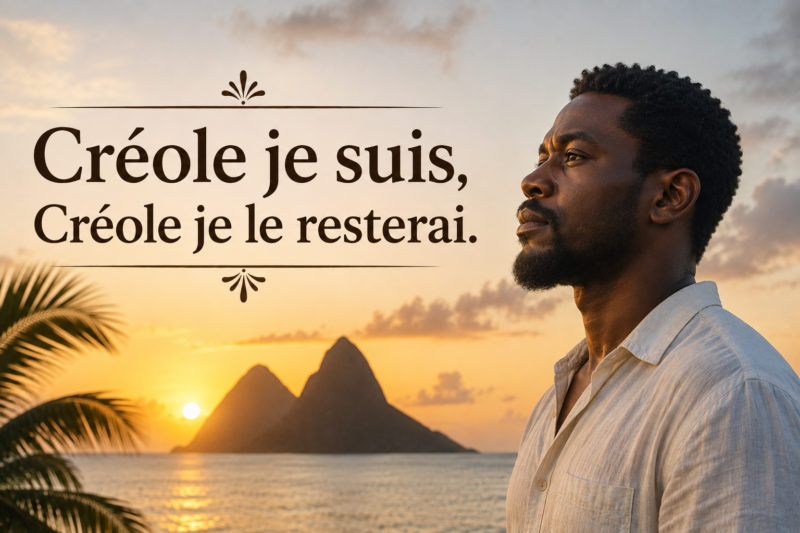
I am Creole, and I will always be Creole. This statement is neither a slogan nor a retreat. It is a promise—the promise that a people born from the ruins of a profoundly inhumane society can help bring about a more humane world.
As the peoples of the Earth cry out in rejection of chaos, wars, and endless crises, it is up to us to remind them that peace is not a sign of weakness, that solidarity is not naivety, and that human beauty remains a political force.
Martinique may not have the means to determine the world order on its own. But it does have experience of the world. And that experience—if it is embraced, reflected upon, and passed on—could very well help humanity rediscover the path to dialogue before the sound of marching boots permanently drowns out the voices of the people.
Mikaël Glondu-Monnerville