

In this op-ed, Franck A., a reader of *Antilla*, offers a personal and deliberately critical analysis of political life in Martinique. In his view, the recurring debates on institutional and statutory changes tend to overshadow another issue: that of political practices, priorities, and culture themselves.
The author argues that Martinique should now focus less on changing its institutional framework and more on making better use of the expertise, resources, and affiliations it already has, particularly within the French Republic and the European Union. He also calls for a shift in the approach to history, symbols, cooperation, and the evaluation of the results of public policy.
The views expressed in this article are those of the author and do not reflect the views of the Antilla editorial staff. Because the issues it raises directly relate to the public debate in Martinique and may elicit a wide range of opinions, we will include a link at the end of this op-ed to a poll where everyone can share their views.
What if Martinique finally changed…
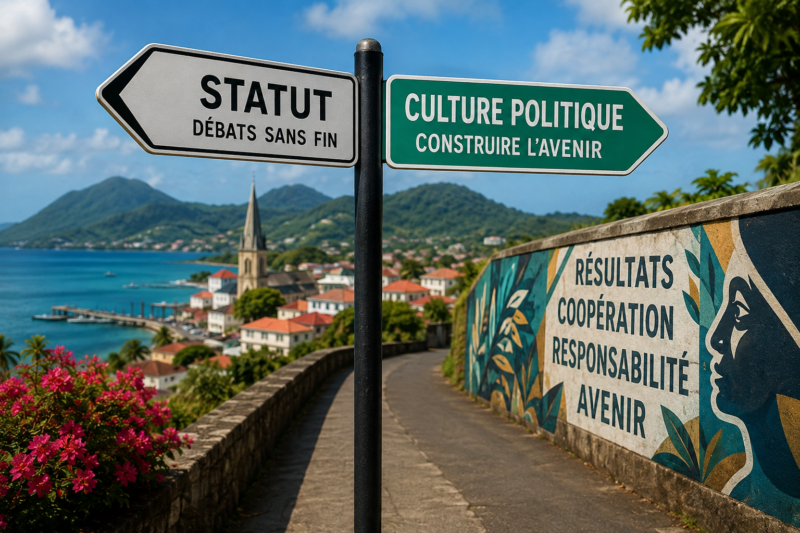
Not a matter of status, but of political culture?
For more than seventy years, Martinique has been questioning its status. Departmentalization, decentralization, regional status, a single local authority, autonomy, independence—we even hear fanatics influenced by totalitarian regimes talking about decolonization. The reality is clear: institutions have evolved, powers have been transferred, and yet the same debates—out of touch with reality—keep recurring endlessly.
While the debate over its status continues, Martinique isn’t waiting around: it’s in decline, and its residents are either burning out or leaving.
What if the problem weren't institutional? What if the real change for Martinique were to change its political culture? No one dares to ask these questions, and perhaps that is where the real solution lies.
Since 1946, Martinique has undergone significant institutional changes. The transition to departmental status ushered in a period of equal social rights and public services. Decentralization strengthened local responsibilities. Then came the creation of the Territorial Collectivity, which granted even more powers to local authorities.
So we changed the tool. Several times. It was modified. Many times. And yet, the difficulties are still there.
This should force our elected officials to face a reality that remains a taboo subject for them: status does not explain everything. The people of Martinique, for their part, have already made their decision at the ballot box: changing our status will not change the way we are governed.
A change in status brings neither a new vision nor new courage. One can have more power and misuse it. One can have more power and not know where one wants to go.
Conversely, we can bring about profound change in a region by making smart use of the skills and resources we already have.
Our postwar political history should serve as our guide. Martinique’s political culture in the 20th century was shaped by demands, activism, and confrontation with the state.
This history has its reasons. It has brought about major advances for the people and produced great political figures. But since the great social and political achievements of Aimé Césaire’s generation—and its historic victory in the form of departmentalization—one question deserves to be asked: what decisive progress can our elected officials claim today as part of their legacy?
Perhaps we need to look elsewhere for the answer.
We all know it: no political culture lasts forever. Yet today’s elected officials persist in governing with yesterday’s political methods, as if Martinique and the world hadn’t changed. What was once a strength in the fight for rights is now a weakness. We cannot build the 21st century with the political reflexes of the 20th.
Therefore, we must urgently shift from a political culture of protest to a political culture of building. From a culture of confrontation to a culture of cooperation. And above all, from a culture of symbolism to a political culture focused on results. This is the political transformation that Martinique has never undergone.
This requires breaking free from the confinement imposed by those very same elected officials and intellectuals of the 20th century: the trap of memory. Colonization and slavery are part of Martinique’s history. They must be known, taught, studied, and passed on. Knowing our history does not mean letting it dictate our present.
A society cannot turn every generation into the heir to a debt. We must stop turning every issue of today into a reckoning with the past.
France cannot be the eternal scapegoat that is supposed to explain all our difficulties.
Martinique’s isolation is not institutional. The real isolation has become political and mental. And it is from this isolation that we must break free.
Martinique is part of the French Republic and the European Union. Its residents are French and European citizens. They elect their own senators, their own members of parliament, and their own mayors. They participate in French and European elections, enjoy the freedoms of a constitutional democracy, use the euro, and benefit from French and European mechanisms for solidarity, social protection, and public investment.
Martinique is fully French. Resentment as a political agenda, as we know, is a complete dead end. Yet some people keep substituting solutions with conferences or speeches.
For every concrete challenge, the same response: a new status, more powers for the institutions. And for the people of Martinique, what progress has been made?
And while the problems keep piling up, the responses are always symbolic: speeches, conferences, framework agreements, a flag, an anthem, a regional cooperation treaty. Lots of symbols. And still the same old problems.
But there is another way!!!
It is less spectacular and less politically convenient. But infinitely more ambitious.
What if we finally tried to work together fully and responsibly? Let’s use everything that our membership in France and Europe makes available to us with strength, intelligence, and skill.
Don't just put up with this sense of belonging. Use it to your advantage.
To make Martinique a territory capable of simultaneously tapping into French government resources, European funding, the legal certainty of a major nation, and the euro. Quite simply, to cooperate more and better with Paris and Brussels.
That is what a modern Martinican strategy should look like. It’s not about becoming less Martinican. It’s about embracing all the identities we hold, rather than spending our time pitting them against one another.
France and Europe are not obstacles that Martinique must overcome. They are powerful tools that it must learn to use more effectively.
The world ahead will be challenging. An aging population, the digital revolution and artificial intelligence, the transformation of work, climate change, international competition, and geopolitical tensions: none of these upheavals will wait for us to settle our historical and status-related disputes.
The fundamental question is not how to reenact the battles of the 20th century. It is what kind of Martinique we want to create.
That is what a true political gathering is all about.
That's the next big fight in Martinique.
A Martinique that produces more. A Martinique that attracts more people. A Martinique that educates its children and inspires them to stay, to return, and to start their own businesses. A Martinique capable of being a region of stability, creativity, and influence—not only in France but also in Europe and the Caribbean. That is the true political vision.
And perhaps the first condition is the most difficult: changing our political culture.
It is time to turn away from rhetoric that endlessly perpetuates the divisions of the past without offering solutions to today’s problems.
It's time to break free from the trap of memory.
It's time to prioritize results over symbols.
We know our history. We don’t need to erase it. But we don’t have the right to exploit it—and certainly not to trap our children in it.
For several years now, our political culture has been in a state of exhaustion.
The next revolution in Martinique is here: no more changes in status. A change in political culture.
Because from now on, it is no longer up to Martinique to change its status. It is up to Martinique’s political system to enter a new era.
Franck A.