




Author
Our most recent common ancestor with the octopus lived more than 500 million years . So why do they seem to share such striking similarities with humans, even as they appear so alien? Perhaps because, despite their sucker-covered tentacles and lack of bones, their eyes, their brains, and even their curiosity remind us of our own thirst for knowledge.
In ethology—the study of behavior—we explore this intelligence, which we refer to as individual «cognitive abilities.» These are the mechanisms through which information from the environment is perceived, processed, transformed, stored, and used to make decisions and take action.
From a behavioral perspective, the flexibility with which an animal can adapt and adjust its behavior to new situations is a good indicator of its cognitive abilities. Numerous studies indicate that octopuses exhibit a high degree of flexibility in their behavior, whether in their natural habitat or inside a laboratory tank.
Armed and Dangerous
So, what makes octopuses so smart?
Let’s first take a look at their defense mechanisms. Faced with numerous predators—including fish, birds, and whales—octopuses have become masters of camouflage. They can mimic their surroundings by changing the color and even the texture of their skin.
Without a shell, octopuses are vulnerable and always try to stay hidden in a shelter such as a cavity or the space under a rock. Some species maintain their shelter by removing sand and adding pebbles and shells. Some prefer to wrap themselves in shells and pebbles, while others carry their shelter in their arms. This is the case with the octopus of the coconut , which, true to its name, has been observed carrying coconut shells to hide inside them in case of danger.
Octopuses are also formidable predators in their own right, and their hunting strategies are adapted to the wide variety of prey they consume, including shellfish, crustaceans, fish, and even other cephalopods. They can use their vision and camouflage skills to hunt, and their arms to explore, touch, and taste their surroundings in order to seize every piece of food within reach.
The octopus is a strategic hunter. It can cooperate with other species, such as groupers, to hunt hidden prey . It can learn to avoid crabs carrying poisonous anemones or find a way to attack them cautiously while avoiding being stung.
Octopuses use various techniques to eat shellfish and mollusks: either by prying the shell open and placing a small stone inside to keep it open, or by drilling into the shell to inject a paralyzing toxin that will to open the prey. This toxin is injected into a very specific muscle beneath the shell, and octopuses learn and remember the injection site of every shell they consume.
Boneless, but not brainless
We can test octopuses’ cognitive abilities in the lab. In our EthoS lab, we are currently studying the common octopus’s memory and ability to plan for the future. These animals are complex to study because of their remarkable abilities.
Their incredible strength allows them to easily destroy our lab equipment: watch out for underwater cameras—they can open the waterproof housing and drown them! And because octopuses have no bones, they can easily escape from their tanks through even the tiniest of openings. They’re also extremely curious and will spend their time grabbing hands, nets, or any other object placed in their tank. From there, it’s up to them to decide when to let go of their catches.
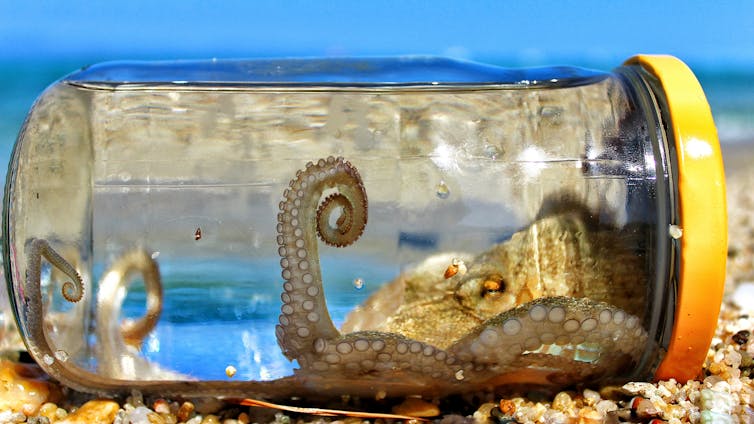
Although opening jars—an impressive feat often used to illustrate the octopus’s intelligence—is not their most remarkable ability. It’s mainly a matter of dexterity and grasping ability, and octopuses are quite slow at performing this task: even when highly trained, an octopus still takes more than a minute to open a jar. A better example of their impressive intelligence is their ability to handle an L-shaped object so that it can fit through a small square opening in a wall.
Octopuses also excel at discriminative learning: when presented with two objects, they learn to select one of them in exchange for a reward, basing their choice on characteristics such as color, shape, texture, or taste, and they can retain this information for several months. They can also generalize , a complex thought process in which they must spontaneously apply a previously learned rule to new objects. For example, octopuses that have previously learned to attack a real ball may continue to hit a virtual ball on a screen .
Octopuses can also use conditional discrimination, meaning they can adjust their choices based on the context. For example, they can learn to attack an object only when bubbles are present . They can also use spatial learning to find a hidden shelter by remembering its location, or use visual cues to know how to position their arm inside a opaque T-shaped device .
Last but not least, octopuses can learning by watching other octopuses perform tasks , such as choosing one specific object over another. This is surprising, since they are primarily solitary creatures.
Grade: Sea Minus
Octopuses meet all the criteria for defining intelligence: they demonstrate great flexibility in gathering information (using multiple senses and social learning), in processing it (through discriminative and conditional learning), in storing it (through long-term memory), and in applying it to both predators and prey.
Despite their obvious abilities, octopuses are strangely erratic in their responses, particularly in visual discrimination tasks, in which they give the correct answer about 80% of the time, while other animals perform almost perfectly.
And make no mistake: octopuses may be intelligent, but in the class of cephalopods, they’d be the brilliant but unruly student, while the cuttlefish would be at the top of the class.
The humble cuttlefish is less well known, but is the subject of numerous research projects around the world. Less disruptive than octopuses, they possess exceptional learning abilities , can grasp complex rules in no time and apply them perfectly.