




Letter to the Editor
Dear Director,
The passage of the law of June 12, 2026, aimed at recognizing the State’s responsibility in the chlordecone scandal, undoubtedly marks an important moment in our collective history. After decades of denial, bureaucratic delays, and struggles waged by advocacy groups, scientists, elected officials, and citizens, the Republic has finally acknowledged its share of responsibility for a health and environmental disaster that has profoundly affected Martinique and Guadeloupe.
This recognition deserves to be commended. It fulfills a long-standing expectation of the affected communities. But it should not prevent us from taking a clear-eyed look at the limitations of the adopted text.
Upon reading the law, one thing becomes clear: the government acknowledges its responsibility, but its commitments are based more on intentions than on concrete obligations. The text states that the government «sets as its objective» to remediate contaminated soil and water, support the agricultural and fishing sectors, and advance scientific research. However, an objective is not an obligation to achieve a specific result. No specific timeline has been set, no multi-year funding has been guaranteed, and no binding deadlines have been established.
Even more concerning is the fact that the issue of compensation remains largely unresolved. The law simply calls for the submission of a report to Parliament on whether the compensation fund should be expanded to cover other diseases that may be linked to exposure to chlordecone. In other words, no decision has been made at this time regarding such an expansion.
The situation of women also warrants special attention. The text mentions the need for further research into women’s health conditions associated with exposure to chlordecone. Here again, this is a commitment to research, not an immediate acknowledgment of the harm already suffered.
Furthermore, the law continues to focus on individual victims. It does not truly recognize the collective harm suffered by all of our territories. Yet it is our farmland, rivers, fishing grounds, ecosystems, and even the image of our islands that have been permanently affected.
Fishermen, farmers, and many other economic stakeholders have borne the consequences of this pollution for years. While the law does provide for support for the affected professionals, it does not specify the financial resources that will actually be made available.
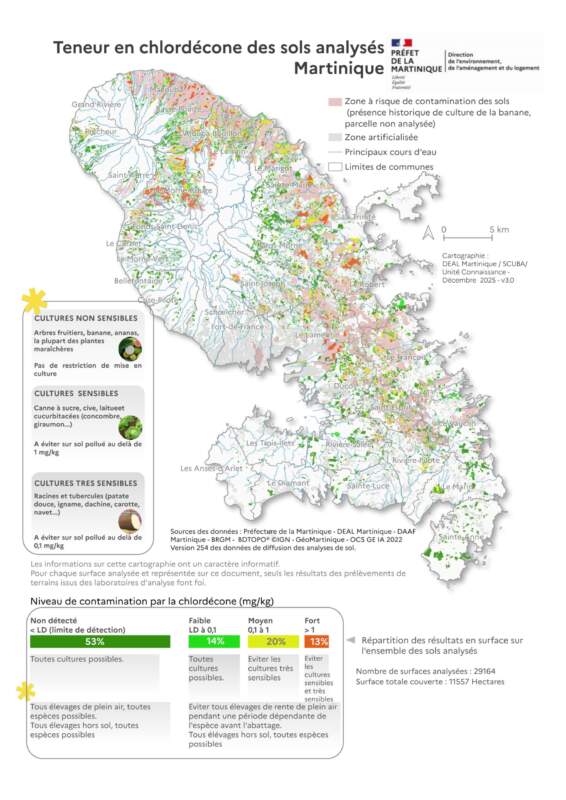
Finally, everyone knows that decontamination is a huge challenge. Scientists regularly point out that chlordecone can persist for several centuries in certain tropical soils. Under these circumstances, announcing a decontamination goal without presenting a detailed operational strategy risks raising new hopes that could ultimately be dashed.
This law therefore represents an important step, but it should not be viewed as the end of the fight. It opens a door. Now we must walk through it.
Recognition is necessary. So is redress.
A reader from Antilla