



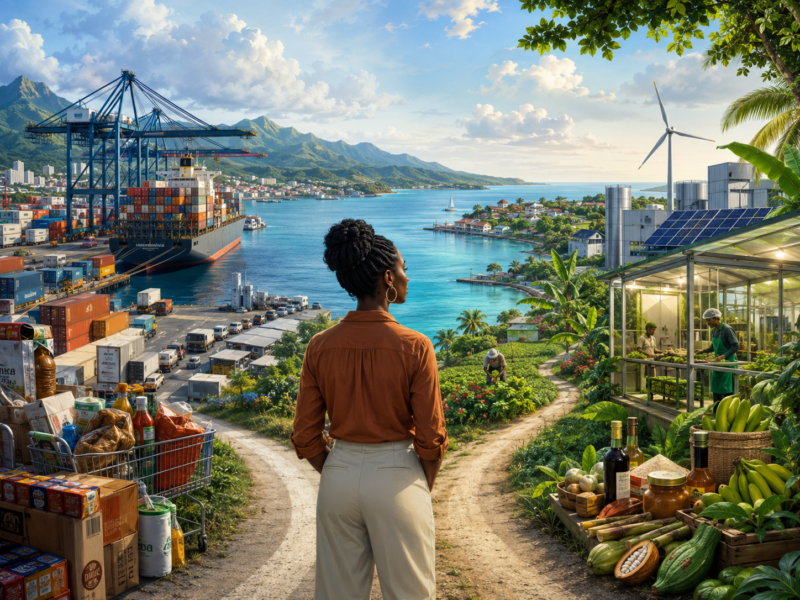
The debate over Martinique’s institutional future raises a question that is rarely addressed head-on: What role will the major capital holders play in a potential transformation of the island’s economic model?
POLL AT THE END OF THE ARTICLE
Some believe that large Martinican corporations would be better off preserving the current system, which relies heavily on imports, consumption, government transfers, and the stability of the French regulatory framework. Others, on the contrary, believe that capital adapts first and foremost to market rules and that it could invest heavily in local production, agricultural processing, energy, manufacturing, or new technologies, once these sectors become sufficiently profitable.
In this op-ed, Jean-Marie NOL calls for moving beyond accusations of ulterior motives and shifting the debate toward a more concrete question: Will Martinique be able to create an economic, fiscal, and regulatory environment capable of sustainably directing investment toward production and the creation of local wealth?
This point is worth discussing. Does Martinica’s big business really constitute an obstacle to the territory’s institutional and economic development? Will it adapt to a new model, or will it seek to preserve the current one? Can private interests, in the future, align with the collective interest?
We invite you to read this article and share your thoughts. The discussion is open.
The debate over Martinique’s institutional future is now accompanied by a fundamental question regarding the role of Martinique’s major business interests in the transformation of the island’s economy. For some political figures and activists, the prominent families that control this capital have an objective interest in preserving the current framework of departmental status, which is based on an economy largely oriented toward imports, large-scale retail, and financial transfers from the French government and the European Union. According to this view, any move toward a more autonomous institutional status would risk undermining an economic system from which they are the primary beneficiaries.
Conversely, other observers believe that this argument is based more on an ideological interpretation than on rigorous economic analysis. They point out that the history of capitalism in Martinique demonstrates a remarkable ability to adapt to economic changes and that it would be paradoxical to imagine that the island’s largest—and by far the most significant—holder of capital would permanently refuse to invest in the most profitable sectors of the future, particularly local production, the agri-food industry, the energy transition, or new technologies.
The first argument is based on a seemingly coherent line of reasoning. The economic model resulting from departmentalization has gradually transformed Martinique into a consumer-driven economy rather than a production-driven one. Imports meet most of the population’s needs, while income distributed by public administrations, social benefits, and pensions sustain significant domestic demand. Within this system, large-scale retail, import activities, and logistics play a strategic role. Maintaining the current institutional framework also guarantees legal, fiscal, and monetary stability, which is particularly reassuring for investors. Consequently, some conclude that the major economic groups would naturally have an interest in defending the status quo, given that institutional or even statutory changes could create a period of uncertainty likely to affect their traditional activities.
This analysis, however politically appealing it may be, has one major flaw: it assumes that economic behavior is static, whereas the history of capitalism in Martinique demonstrates precisely the opposite. Capital is not characterized by stagnation but by its constant ability to seek out the best investment opportunities. From this perspective, Martinique’s historical experience is particularly illuminating.
The prominent families that today dominate a significant portion of Martinique’s economy have never adhered to a single economic model over the centuries. During the colonial era, their wealth was based primarily on slavery, the plantation economy, and sugar production. When that industry entered a crisis, they gradually shifted their investments toward bananas, before diversifying their assets into wholesale trade, the automotive industry, retail, logistics, real estate, tourism, and services. This succession of transformations shows that their true constant is not an attachment to any particular economic sector but rather their ability to shift their capital toward activities offering the best prospects for profitability.
This flexibility is likely the defining characteristic of capitalism. Companies do not stick with a particular business out of historical loyalty; they are constantly weighing different investment options based on profit prospects, regulatory changes, and shifts in demand. Therefore, to imagine that Martinique’s major capital would remain permanently tied solely to imports if economic rules were to change is to misunderstand this fundamental logic of the doctrine of economic facts. .
If, tomorrow, a new institutional framework were to significantly promote local production through tailored tax policies, targeted subsidies, smart protection of the domestic market, or ambitious policies for food and energy self-sufficiency, there is no reason to believe that major capital holders would stay away from these new markets. On the contrary, they would likely have the financial resources, investment capacity, and management expertise necessary to become the leading investors in the industrial sectors, agricultural processing, renewable energy, the circular economy, and the logistics infrastructure essential to this new development strategy.
This observation shifts the focus of the debate. The key question may not be whether big business is in favor of or opposed to institutional change, but rather what economic rules will accompany that change. Capital generally adapts to the incentives it is offered. If the regulatory framework continues to favor imports, it will invest primarily in import-related activities. If, on the other hand, the government creates an environment where local production becomes more profitable, capital will naturally seek to expand in that area.
Another factor, often overlooked in this debate, nevertheless deserves consideration. Regardless of one’s opinion on Martinique’s institutional evolution, it will likely not depend solely on the will of economic actors or local political leaders. It could be largely shaped by a forward-looking strategy on the part of the French government itself. For several years now, France’s budgetary constraints, the continuous rise in public debt, the need to control public spending, and the search for new development models for its overseas territories have gradually led the French government to reconsider how the departmentalization system operates. From this perspective, the possibility of transforming Martinique’s economic model appears less and less as a mere local demand and more and more as a development that could be driven—or even organized—by the government itself.
The signing of a framework agreement between the French government and the Territorial Collectivity of Martinique on institutional reform sends a major political signal in this regard. Without prejudging its outcome, this agreement reflects the government’s desire to launch a process of reflection on the redistribution of powers and the development of a new model of development more firmly grounded in the territory’s productive capacities. This simple fact profoundly changes the terms of the debate. If the French government itself considers that the current economic model—largely based on imports and public transfers—is gradually reaching its limits, the question is no longer whether economic actors want change, but how they will prepare for it.
Under this scenario, it would be economically irrational for major capital holders to resist, over the long term, a transformation that would be encouraged—or even gradually mandated—by new government policies. History shows that large companies generally adapt to changes in regulations rather than fighting them indefinitely. If, in the future, public policies were to strongly favor reindustrialization, agricultural processing, food sovereignty, renewable energy, or export sectors, investors would naturally seek to position themselves in these new markets. Consequently, the real issue may not lie in some supposed principled opposition by big business to institutional change, but rather in its ability to anticipate a transformation that already appears to be underway at the highest levels of government. This economic—rather than ideological—interpretation of the debate thus puts into perspective the accusations of ulterior motives often leveled at major Martinican corporations and reframes the discussion within a broader context, where institutional and economic transformations may stem less from ideological confrontation than from a gradual adaptation to financial and strategic constraints that have become unavoidable.
The debate thus pits three different approaches against one another. Defenders of the status quo prioritize the economic security provided by government transfers and the stability of the French system, fearing that institutional change could undermine households’ purchasing power. Supporters of institutional reform seek new legislative tools to encourage an economy more focused on production and to reduce dependence on foreign markets. As for big business, it is guided above all by market logic: preserving the value of its assets and investing where the prospects for returns appear most favorable.
This distinction is fundamental because it prevents us from attributing exclusively ideological motivations to economic actors. Companies generally pursue neither a political agenda nor an identity-based agenda; they seek to optimize their investments within the economic, financial, and legal framework provided to them by the dominant model of capitalism. It is precisely this economic rationality that explains their remarkable ability to adapt throughout history—in contrast to Guadeloupe, where all the major capitalists were summarily sent to the guillotine during the revolutionary period. .
It would therefore be an exaggeration to portray Martinican big business as the main obstacle to any economic transformation. Such a claim does not entirely hold up to historical analysis. On the other hand, it would be just as naive to think that this transformation will occur spontaneously. The shift from a consumer-based economy to a production-based economy requires substantial investment, appropriate infrastructure, a coherent industrial policy, a skilled workforce, market opportunities, and a stable regulatory environment. Without these conditions, even the most willing investors will be unable to commit significant capital.
The real challenge, then, lies less in assigning blame than in building a credible economic framework capable of sustainably directing investment toward local wealth creation. It is likely in this arena that Martinique’s future will be decided. If public authorities succeed in creating the conditions for sustainable profitability in local production, capital—regardless of who holds it—will naturally follow this new dynamic. Economic history shows that capitalism rarely rewards stagnation; on the contrary, it favors constant adaptation to new market realities. This will certainly be the case in the future with the technological revolution driven by artificial intelligence and automation.
Ultimately, the criticism leveled at Martinique’s big business appears less like a definitively established economic truth than as a political hypothesis that deserves to be tested against the lessons of history. History shows that capital owners have consistently redirected their investments as economic conditions have changed. The real question, then, may not be whether big business will support a shift in the economic model, but rather whether Martinique will be able to create an environment that is sufficiently coherent, stable, and attractive to make local production more profitable than a simple import-based economy. If this condition is met, private interests could then align with the collective interest, paving the way for the island’s gradual industrialization and a reduction in its economic dependence—not out of ideological necessity, but because the very logic of the market will have made it economically rational.
And there is no doubt that, while the government has indeed launched a process of institutional reflection, the debate is no longer limited to the intentions of Martinican big business, but rather centers on its ability to adapt to a change that could become largely inevitable, since it is being imposed from above.
Jean Marie Nol, economist and lawyer
POLL