




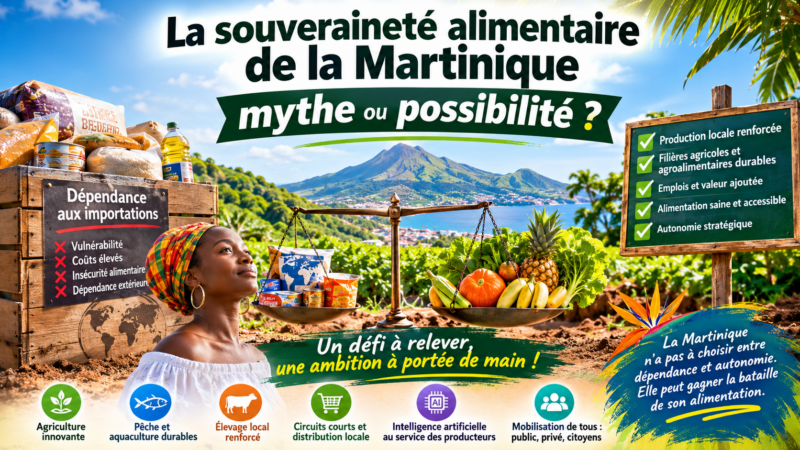
After demonstrating that French Guiana has become the only country in the world capable of meeting its needs for all seven major food groups through domestic production, Mikaël Glondu-Monnerviille asks: The question arises: why does Martinique, despite its favorable climate and agricultural land, remain so dependent on imports? The analysis highlights a series of economic, land-use, cultural, and institutional barriers that explain this vulnerability.
A Dependency That Has Become Structural
Martinique currently produces only a limited portion of its food supply. Vegetables, fruits, meat, fish, and feed for livestock are primarily sourced from outside the island. Depending on the sector, this dependence ranges from 76% to 98%, revealing an economic model that has developed over decades around imports rather than agricultural diversification.
The Impact of Eating Habits
Food sovereignty does not depend solely on production. The studies cited show that people in Martinique consume more processed foods and fewer fruits and dairy products than people in mainland France. Developing local production therefore also involves reconnecting consumers with local products by improving their accessibility, promoting their value, and increasing their presence in distribution channels.
Challenges, but also strengths
Unlike Guyana, a sovereign state, Martinique operates within the framework of French and European regulations. While this situation limits certain areas of flexibility, it also provides privileged access to significant funding sources such as POSEI, the EAFRD, and the ERDF. The real challenge, therefore, is not to replicate the Guyanese model, but to make more effective use of the tools already available to build a strategy tailored to the realities of Martinique.
A transformation that goes beyond agriculture
Beyond the numbers, this dependence raises questions about the island’s development model. Producing more locally requires rethinking land use, supporting producers, organizing supply chains, and changing dietary habits. Food sovereignty thus appears less as an agricultural goal than as a genuine economic, social, and cultural project for Martinique.