



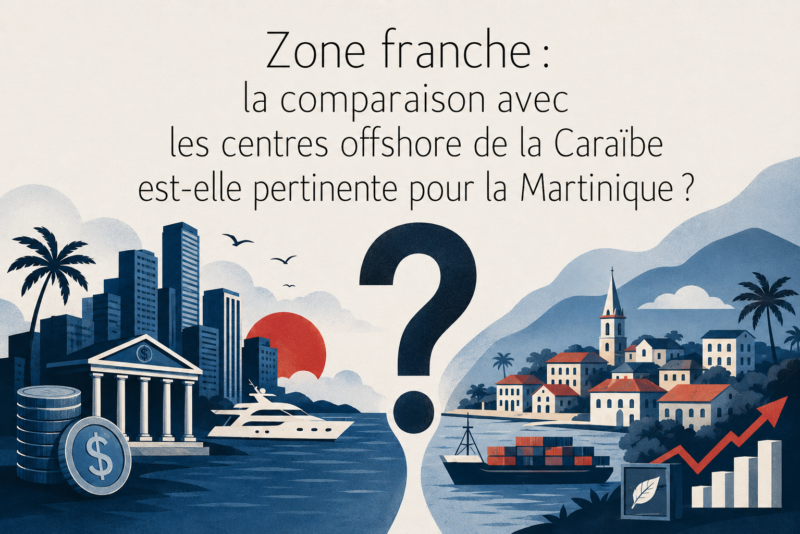
The argument is compelling: small islands with populations of just a few tens of thousands have become major players in the global financial system. Why couldn’t Martinique follow a similar path through the creation of a free trade zone?
The reasoning seems logical. However, it is largely incomplete.
The first bias involves comparing jurisdictions that do not operate within the same institutional framework. The Cayman Islands, the British Virgin Islands, and Bermuda enjoy a very high degree of fiscal and regulatory autonomy. They can establish their own corporate law, tax system, prudential regulations, economic immigration policies, and administrative procedures. It is precisely this freedom to make decisions that constitutes their main comparative advantage.
Martinique, on the other hand, is a department and a region of the French Republic, and is part of the European single market.
Its tax law falls primarily under the jurisdiction of the French Parliament, while many economic regulations stem directly from European law. It therefore lacks the tools that have enabled these territories to build their economic models.
The second misconception is to believe that taxation alone is a driver of development.
Major offshore financial centers also rely on a highly specialized ecosystem: international law firms, investment banks, asset management firms, recognized regulatory authorities, specialized courts, and global networks of investors. This environment cannot be created by decree.
The third bias is to overlook the economic reality of Martinique.
A shrinking population, an aging population, a small domestic market, dependence on imports, a structural trade deficit, and an insufficiently diversified productive sector. Even an ambitious free trade zone would not eliminate these constraints.
International experience shows that free trade zones are effective only when they are part of a comprehensive development strategy. Otherwise, their impact is often limited, while their fiscal cost can be high.
The real question, then, is less about the free trade zone and more about development strategy: Which sectors should be developed, what skills should be cultivated, how can local savings be mobilized, how can investors be attracted, and how can more value be added to the region?
Finally, Martinique’s status as part of France and the European Union also offers advantages: legal certainty, a stable currency, access to the European market, public funding, and social protection. The challenge is to turn these strengths into drivers of competitiveness.
The debate over the free trade zone is legitimate. But it cannot be separated from Martinique’s political and institutional framework..
The goal is not to imitate offshore centers, but to build an original model tailored to Martinique’s status, based on innovation, areas of excellence, regional openness, the mobilization of local capital, and the optimal use of the flexibility already provided by French and European law.
Gérard Dorwling-Carter