





Cayman Compass
The latest data Data from Workforce Opportunities and Residency Cayman (WORC) indicate a recovery in the Cayman Islands’ job market in November. A total of 1,554 job openings were posted in November 2025, compared to 1,286 a year earlier. These data provide insight into employment trends in the Cayman Islands, as current regulations require that every job application be published on the dedicated portal .
«Given that the Cayman Islands» economy has recovered from the pandemic, the number of job openings is expected to rise as the economy continues to grow,” said Reinaldo Fletcher, head of labor market demand at WORC and author of the organization’s November 2025 report on job openings.
Fletcher's remarks are also corroborated by the Cayman Islands Statistical Yearbook 2024 , published on December 5, 2025, which reports a tight labor market with an unemployment rate that fell to 2.4 % in 2024, compared with 5.1 % in 2020.
Low-paying jobs predominate
The construction sector dominated the job market in November, accounting for 22.4 % of job openings. This figure is up from the annual average of 20.4 %. Retail, public administration, and the hospitality and restaurant industry were the other major sectors for job openings, both in November and for the year as a whole.
– Advertisement –

This is important because they are among the lowest-paid workers. For example, the average advertised salary for a job in the lodging and food services sector is $24,822 per year, while GDP per capita reached $72,616 in 2024.
In theory, this wage remains above the minimum wage, since a person working 40 hours a week for 52 weeks at 8.75 $ per hour would earn approximately 18,200 $ per year. However, in practice, WORC’s figures are averages and do not reflect the lowest earnings in each sector. Furthermore, many people in low-skilled jobs work well over 40 hours per week.
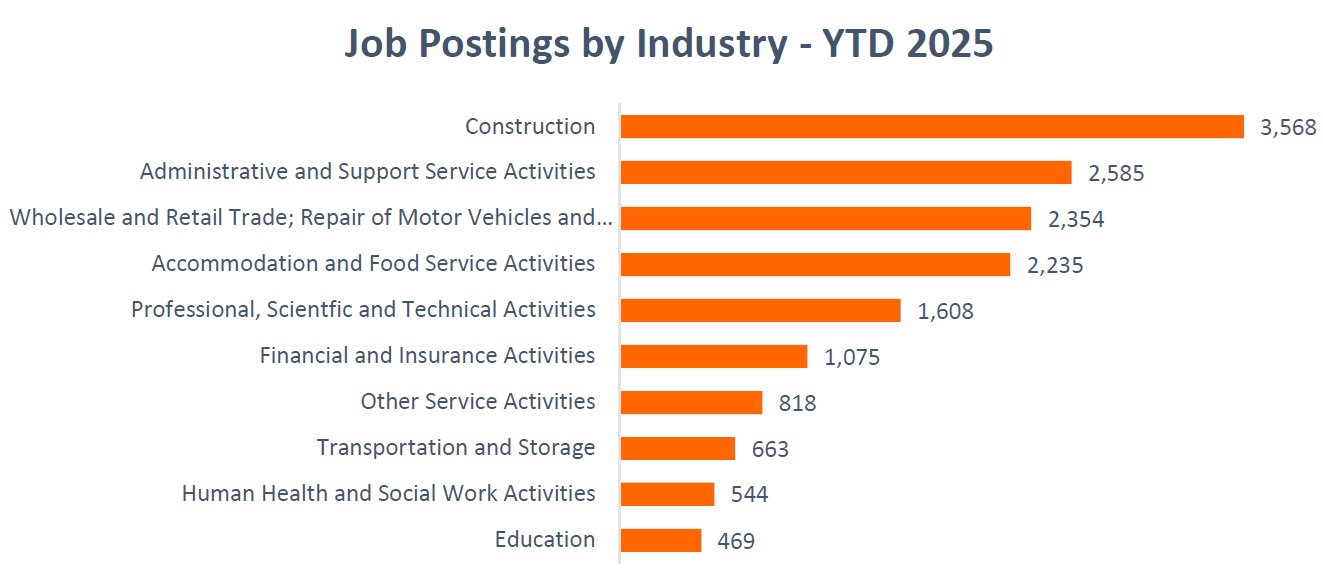
The report also identified the occupations with the most job openings. So far this year, the list has been dominated by low-wage jobs, such as construction workers, waitstaff, janitors, and estheticians.
Another factor confirming that the Cayman Islands primarily create low-paying jobs is that more than half of the job openings required only a high school diploma. This is significant because these positions offer the lowest average salary, at $24,905 per year.
The strong demand from employers for low-wage jobs suggests that the labor market will be able to absorb the increase in the minimum wage. In fact, the data in the report reveal a general trend of macroeconomic growth, with the private sector having greater access to credit amid rapid population growth.
For employers, the increase in the minimum wage, just like other non-wage employee-related costs such as the increase in the cost of work permits, means that any company with very low profit margins will have to cut costs or raise prices.
«The minimum wage will likely have several effects, including increased automation of low-skilled jobs; for example, stores could see the introduction of electronic price displays and automated checkout lanes,» said local economist Julian Morris.
«Owners of certain low-skill businesses could see their profits decline because they are passing on a larger share of the product’s marginal value to their workers—it is not uncommon for cleaning companies to charge 15 $/hour while paying their workers 6 $/hour —this will amount to a transfer from Caymanian owners to low-skilled expatriates,» Morris said.
He also noted that landlords who rent housing to expatriate workers in low-skilled jobs could be an unexpected group of beneficiaries.