




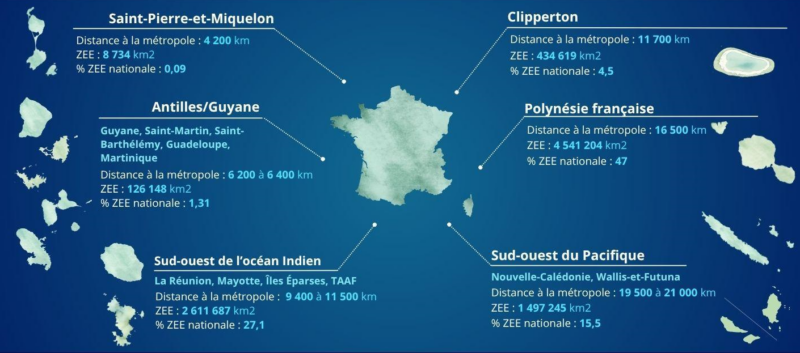
From the Caribbean to the Indo-Pacific, including the Indian Ocean and the South Atlantic, France’s overseas territories occupy areas that have long been considered remote in national policy. But in an international context marked by the resurgence of great-power rivalries, rising maritime tensions, and sovereignty issues, these territories are gradually changing their strategic status.
Trade routes, natural resources, maritime security, regional influence, access to space: a a report published in April 2026 by the Mediterranean Foundation for Strategic Studies (FMES) believes that France’s overseas territories could become major assets for France and Europe in an increasingly unstable world. The document sums up this idea in a powerful statement: «France is an archipelago that doesn’t realize it.».
A French presence in nearly every ocean
One of the report’s key findings centers on France’s unique geographical situation. Thanks to its overseas territories, France has a a dominant presence in several major maritime areas : the Atlantic, the Caribbean, the Indian Ocean, the Pacific, and even areas near Antarctica. This global presence gives it access to one of the largest exclusive economic zones (EEZ) worldwide, spread across three oceans and largely driven by the overseas territories.
For the FMES, this geographical dispersion now represents a rare strategic advantage in a context of heightened international competition. France’s overseas territories offer the country diplomatic, military, and economic footholds in regions that have become sensitive, particularly in the Indo-Pacific, which is now considered the world’s primary geopolitical and economic center of gravity.
The report also points out that this presence enables France to participate in several regional organizations and to foster cooperation with neighboring countries in a variety of fields: maritime safety, humanitarian aid, maritime surveillance, and natural disaster management.
This maritime dimension becomes all the more important given that international trade routes remain essential to today’s economies. Energy, food, and industrial flows depend heavily on maritime transport. In this context, overseas territories emerge as Strategic surveillance and projection points for France, but also as potential channels for European influence in several regions of the world.
Regions long considered peripheral
This new geopolitical perspective stands in stark contrast to the way in which the overseas territories have often been perceived in mainland France. The FMES report emphasizes the persistence of a sometimes oversimplified view that associates the overseas territories with exoticism, economic dependence, or social crises.
The document also points to a profound lack of understanding of these territories among a significant portion of the French population. Their geography, economic realities, cultural characteristics, and regional challenges are often poorly understood in France.
This distance is not merely geographical. According to the report, French political concerns remain largely focused on the European arena, whereas Overseas territories are often treated as second-class territories in national policies.
The FMES also highlights the ambiguities that sometimes surround the relationship between the central government and the overseas territories. On the one hand, local authorities expect greater government involvement in essential areas such as security, infrastructure, and public services. On the other hand, some National or European standards are considered unsuitable for local conditions and hinder regional integration or economic development.
The Resurgence of Sovereignty Issues
If France’s overseas territories are taking on new strategic importance today, it is also because issues of sovereignty are once again coming to the forefront. The report highlights the rise in international tensions, illicit trafficking, and hybrid threats in several maritime areas.
In the Caribbean, the French West Indies also serve as important maritime hubs, centered around the ports of Fort-de-France and Pointe-à-Pitre, which are located along routes connecting Europe, the Americas, and the Caribbean.
The FMES believes that securing maritime areas is becoming a key issue for European nations, whose economies remain heavily dependent on international trade flows. Overseas territories, located near several strategic maritime routes, are thus taking on new importance in monitoring traffic, protecting supplies, and controlling maritime areas.
In several regions, particularly in the Indo-Pacific, the overseas territories are also portrayed as areas of competition for influence among international powers, focusing on maritime routes, strategic resources, and military capabilities. Submarine telecommunications cables, in particular, are major points of vulnerability in several overseas territories where redundancy capabilities remain limited.
The space issue also plays a significant role in this strategic analysis. The French Guiana is described as a territory «irreplaceable» for Europe's independent access to space through the Kourou Space Center, whose location near the equator represents a major technical advantage.
Under this approach developed by the FMES, the overseas territories are no longer viewed merely as remote regions, but as areas directly involved in contemporary issues of sovereignty, security, and influence.
Resources that remain largely untapped
The FMES also believes that the overseas territories have economic and strategic potential that remains underutilized, particularly in the maritime sector.
The report points out that France's overseas territories account for 80 % of the country's biodiversity, a large portion of protected natural areas, as well as significant fisheries and biotechnology potential.
The authors also discuss the mineral resources found in several overseas maritime zones, notably the polymetallic nodules or certain strategic minerals that are likely to become essential in the coming decades for the technology and energy industries.
The authors of the note thus advocate for a a broader discussion on the sustainable use of these resources, while acknowledging the strong environmental sensitivities associated with these issues. The protection of biodiversity and issues of economic sovereignty thus emerge as two imperatives that public policy must reconcile.
The issue remains particularly sensitive in several overseas territories, where environmental, land, and social issues already play a significant role in local debates.
Vulnerabilities That Remain Significant
However, this new strategic dimension does not eliminate the structural vulnerabilities of the overseas territories. On the contrary, the report emphasizes their high exposure to climate, economic, and social risks.
The overseas territories are particularly affected by rising sea levels, more intense hurricanes, coastal erosion, and seismic risks. In the Caribbean, the French West Indies are particularly vulnerable to hurricanes, seismic risks, and the fragility of coastal infrastructure.
The report also mentions the persistent economic imbalances : high cost of living, dependence on food and energy, limited economic diversification, and heavy reliance on imports and public funding. As a result, several overseas territories remain highly dependent on external sources despite their growing strategic importance.
In this context, the issue of food and energy self-sufficiency regularly comes up in strategic discussions about the overseas territories. The authors believe that these territories will need to strengthen their local capacities while ensuring the security of their supplies in an international environment that has become more unstable.
Beyond mere geopolitical issues, the report ultimately highlights a persistent paradox: France's overseas territories are becoming increasingly essential to French strategy, while continuing to grapple with long-standing vulnerabilities that are sometimes not given sufficient consideration.
In this emerging strategic framework, the overseas territories are no longer merely regions far from mainland France. They are now becoming areas where issues of sovereignty, security, resources, and influence intersect in an increasingly fragmented world.