




«We are placing an increasing public tax burden on a shrinking population, without clearly explaining to the people of Martinique what they are paying, why they are paying it, and how those funds are being used.»
Chairman of the SAFO Group, a major player in the food retail sector in Martinique and the French overseas territories; former Chairman of the SDGA, François Huyghues Despointes largely agrees with Cyril Comte’s assessment of the port tax. In his view, the role of businesses is not to make decisions in place of policymakers, but to demonstrate that the current system cannot continue without sweeping reform.
His analysis is based on trends in revenue, the decline in Martinique’s population, the actual breakdown of food prices, and the specific constraints on imports. Above all, he criticizes a tax that has become invisible to consumers, whose two objectives—financing local governments and protecting local production—may prove to be contradictory.
Beyond taxation, François Huyghues Despointes places demographics at the heart of the Martinique 2050 initiative. He believes that the departure of working-age Martinicans—some of whom have already established themselves professionally and have families—threatens investment, consumption, employment, and the territory’s very ability to fund its public services.
Antilla: Why did a business executive take up the issue of the port tax?
François Huyghues Despointes: Because, in our line of work, the system has become almost unbearable. That doesn’t mean we don’t know how to manage it. We’ve learned to navigate the customs nomenclature, product classifications, declarations, and procedures. We have the teams and professionals to do it.
The main challenge is not merely administrative. It is both economic and democratic. For years, revenue from the dock dues has been rising even as Martinica’s population has been declining.
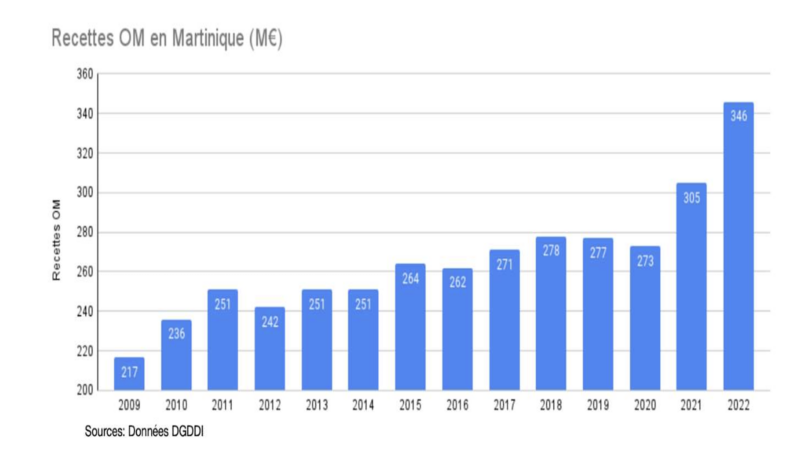
Customs data show that revenue rose from approximately 217 million euros in 2009 to 346 million in 2022. The increase between 2021 and 2022 is largely due to higher tax rates resulting from the new dock dues system in effect since 2021 and to post-COVID inflation, which has increased the value of imported goods.
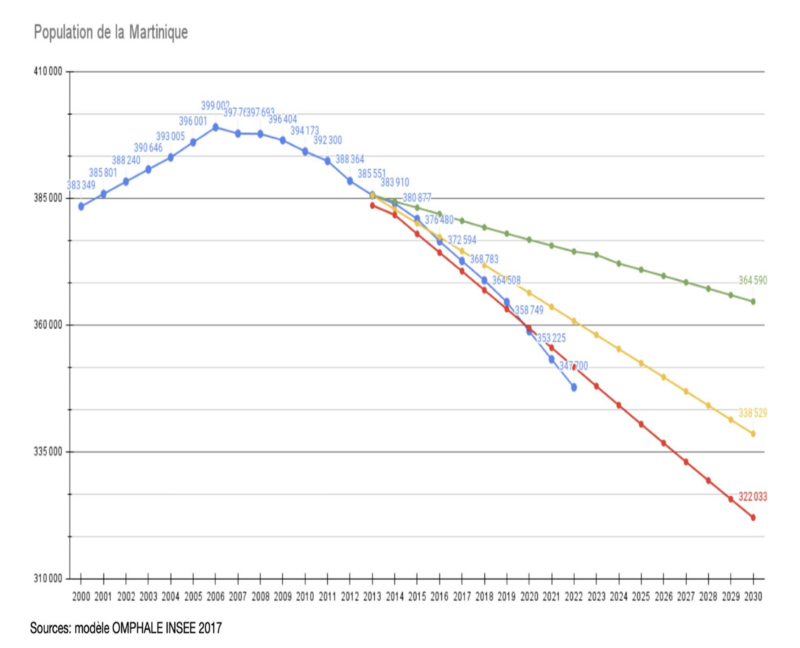
At the same time, according to INSEE data, the population fell from approximately 399,000 in 2006 to 361,000 in 2022. There is therefore a scissor effect: revenue is increasing while the number of residents supporting it is decreasing.
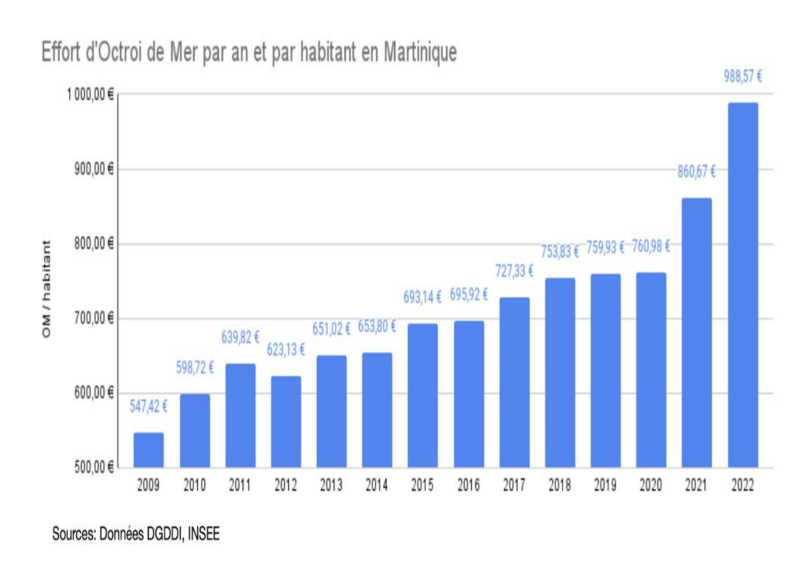
The average per capita amount is a theoretical calculation, since people obviously do not all consume in the same way. But it reveals a troubling trend: we are relying on an increasingly smaller population to support a growing public resource.
So you believe the system is no longer sustainable?
The problem is that the needs of local communities are not growing at the same rate as the population. These needs are increasing due to rising operating costs, an aging population, urban sprawl, and the need to maintain infrastructure designed for a larger population.
If revenue is to continue growing while the population declines, the theoretical contribution of each Martinican automatically increases. That is why I say we are reaching the end of a cycle.
We can keep raising rates and imposing higher taxes on goods, but that will eventually bleed consumers dry. Yet businesses find themselves on the front lines, because they pay the tax, factor it into their costs, and are then blamed for being solely responsible for price levels.
Per capita port tax revenue has doubled since 2009 due to the combined effect of rising revenue and a declining population.
In your opinion, what is the main problem with the dock dues?
Its opacity.
The general public hears about it during crises, reform initiatives, or occasional media debates. But they are almost never given a clear explanation of what the dock dues are used for, who sets the rates, how much revenue they generate, and what percentage they represent of the products they buy.
Consumers see the sales tax on their receipts. They may also see an environmental fee. However, they do not see the port tax. This tax was paid earlier in the supply chain and then factored into the cost price.
We could list the tax rate applied to a particular category of goods, but it would be incorrect to say that this rate represents exactly the same proportion of the final price. Between the time of import and the time of sale, the tax is mixed in with handling fees, logistics costs, intermediaries’ margins, and other expenses.
It’s not necessarily because companies are opposed to transparency. It’s because the very structure of the dock dues system doesn’t allow for as clear an understanding as that of the VAT.
Those who advocate keeping the dock dues as they are are not the ones who present the bill to the end consumer.
Port tax: What is it, and who collects it?
The “octroi de mer” is a tax levied in France’s overseas departments and regions. Today, it serves two main purposes: to finance local governments and to allow for tax differentials between certain local products and the imported goods that compete with them.
For imported goods, the dock dues are paid to the customs authorities when the goods enter the territory. The government collects the tax and then transfers the revenue to the Territorial Collectivity of Martinique, which redistributes a portion of it (approximately 75 %) to the municipalities.
Local production is also subject to the (domestic) port tax, which is reported by the producers concerned. The rates and exemptions vary by product category and are determined locally without any real impact assessment.
Unlike VAT, the dock tax does not appear separately on the consumer’s receipt. It is included in the cost price of the merchandise, making it difficult to determine its exact share of the final price.
This tax must be distinguished from customs duties applied to products originating from countries outside the European Union. Depending on its origin and category, a product may be subject to both customs duties and the octroi de mer tax.
You say that the port tax serves two objectives that may be contradictory. Why?
Historically (for three centuries!), its main function has been to finance local governments. Protecting local production became an objective much later.
According to the data we analyzed, approximately 77 % of the tariff lines do not correspond to any equivalent local production, compared with 23 % for which local production exists. This shows that the financing function remains largely dominant.
But the two objectives are not always compatible.
To maximize tax revenue, a significant value of goods must be imported. The higher the value of imports, the greater the tax revenue.
To protect local production, it would, on the contrary, be necessary to reduce competing imports. If an import substitution policy were completely successful, part of the tax base would disappear.
We are therefore asking the same tool to help reduce imports while also funding local governments through those imports.
In your opinion, is the port tax the main cause of the high cost of living?
It is not the only cause: transportation, logistics costs, additional construction and insurance costs, markdowns, …
But it is impossible to seriously claim that the port tax does not affect prices. The very purpose of a tax on a product is to increase its cost.
Another challenge lies in how we measure its impact. When we compare the port tax to a household’s total consumption—including housing and services that are not subject to the tax—we arrive at a relatively low average.
But when we look at the food basket, its weight is much greater. According to our estimates, it may be around 15 % for food, although this figure varies widely depending on the product.
This is essential because low-income households spend a larger share of their income on everyday consumer goods. Taxation is therefore focused on the purchases they make most regularly.
HISTORY
- 1670: First recorded mention in Martinique, under the name «droit des poids,» a tax levied on goods arriving by sea.
- 1819: Reinstated after the French Revolution in the form of a «seaport tax”».
- 1866: The official term «octroi de mer» first appears in legal documents.
- 1992, then 2004: a comprehensive reform of the system to bring it into compliance with European law. Since then, it has been regularly renewed with the European Union’s approval.
Why do some food products have particularly high levels of certain substances?
A large portion of the industrial activity in Martinique is in the agri-food sector. The historical approach has often been as follows: identify the most commonly imported products, then develop local production aimed at replacing a portion of those imports.
To protect this industry, higher taxes are imposed on imported products. This applies in particular to certain types of water, certain dairy products, beverages, packaged rice, and other food products.
This explains why the proportion of the dock dues tax can be much higher for food than the overall average for all household expenditures.
But we need to look at the results. Has protectionism led to the development of new industries? Has it increased the share of industry in Martinique’s economy? Has it led to a sustainable improvement in productivity?
Protection has likely prevented some companies from going out of business. But protection and growth are not exactly the same thing.
«A policy that prevents companies from going out of business is not necessarily a policy that enables them to grow and become more competitive.»
But you're not questioning the principle of local production, are you?
Absolutely not—we need more local production!
The debate is often oversimplified. As soon as you criticize the port tax, you’re accused of wanting to eliminate local production or deprive local governments of revenue. That is not our position.
On the contrary, we want to give serious thought to a policy aimed at developing local production.
But we must first define what we want to support. Does local production involve only packaging? Does it involve processing raw materials? Does it create related industries, skills, jobs, and significant added value?
The case of rice illustrates this debate. Rice is imported in bulk, then cleaned, sorted, and bagged locally. There is therefore indeed an industrial activity. However, the raw material does not come from Martinique, and according to the figures mentioned during our discussion, this activity covers only about 15 % of the territory’s needs. Yet all imported rice is subject to tax protection.
The issue is not to deny the work that has been done locally. The question is which sectors we want to develop by 2050 and what criteria should qualify for significant protection funded by Martinican consumers.
How might this protection affect local prices?
The mechanism involves raising the price of imported products to prevent them from being cheaper than locally manufactured products, in order to protect the latter. The problem is that this protection is financed by consumers, without this ever having been clearly explained to them.
If this policy is clearly explained and accepted by the public, it can certainly be implemented. The people of Martinique can collectively decide to accept paying more to preserve local businesses and jobs.
But this decision must be a conscious one.
There is also an economic risk. When the imported product becomes significantly more expensive, the local producer may have less incentive to lower its price. It may price its product slightly below that of the imported product without seeking to achieve all possible productivity gains.
That is why I prefer to talk about development rather than protection. Development involves reducing costs, investing, improving productivity, and creating new business opportunities.
Local governments need this revenue, though. What can replace it?
Economic actors should not be the sole decision-makers on tax policy. Our role is to explain why the current system cannot continue as it is and to set out the essential conditions for reform.
The first requirement is transparency. Taxes must be clear to the consumer and clearly shown on the receipt.
The second is recovery. A consumption tax should not permanently burden inventories, investments, or goods that will never be sold.
The third issue is the stability of local governments' resources. No one is proposing to eliminate daycare centers, schools, social services, or municipal investments.
Several options need to be considered and combined:
- a local consumption tax
- funding through the national equalization system that guarantees local governments' revenue
- support for freight, particularly for food products
- direct subsidies for local production
Would you support a greater contribution from national solidarity funds?
Yes. We already have a national solidarity system for electricity. Generating electricity in Martinique costs much more than in mainland France, but consumers do not pay the full amount of this additional cost. Instead, it is spread out across the country.
Why not consider a similar mechanism for certain acquisition costs or for certain essential goods?
Corsica benefits from a territorial continuity program. In the past, special freight rates also existed for certain products such as water, milk, oil, and potatoes.
This does not necessarily mean copying an existing system exactly. We need to explore ways to reduce the impact of distance on the most commonly consumed products without creating a profit windfall for carriers or distributors.
The basic idea is that Martinique’s insularity and remoteness constitute a national constraint. The costs associated with them should not be borne solely by Martinique’s consumers.
A bottle of water: from the ex-factory price to the shelf price
To illustrate how prices are determined, François Huyghues Despointes uses the example of a 1.5-liter bottle of water imported from France.
According to the breakdown presented during the interview:
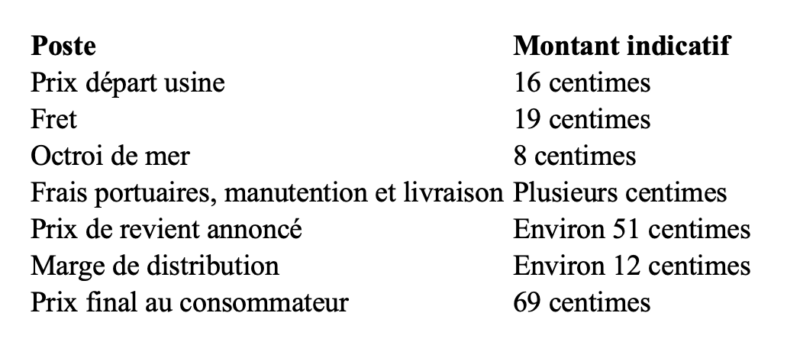
This example shows that a product purchased for 16 centimes ex-factory can end up on the shelf for 69 centimes, without the difference being entirely attributable to the retailer’s margin. In this case, transportation costs more than the product itself, and the dock tax is calculated based on a tax base that includes both the product and the delivery costs, including transportation.
Water is deliberately chosen as an extreme example. It is a heavy commodity that is undervalued and expensive to transport. It should therefore provide a natural advantage to local production, which does not have to bear the cost of maritime transport.
François Huyghues Despointes notes, however, that the price of local water can come close to that of imported water. He sees this as an illustration of the risk associated with excessive protection: a rise in the price of the imported product does not automatically guarantee that the local product will be sold at the lowest possible price.
You say that companies sometimes serve as a «firewall» for tax decisions. What do you mean by that?
Port tax rates are set at the local level. However, it is the importers and businesses that pay the tax and then pass it on in their prices.
When prices rise, consumers turn to the store, retailer, or importer. They may not necessarily realize that part of this increase is due to a local tax policy.
Political accountability is therefore diluted. Local governments can raise certain rates without triggering the same immediate reaction as they would if they were raising a tax that appears directly on a tax bill or receipt.
That doesn't mean that every price increase is due to taxes. For example, we pass on the inflation on products that we import and then resell.
But the debate must address all aspects of price formation. Today, taxation is still too often left out of the discussion or mentioned only in general terms.
You specifically mention some recent increases that haven't been very noticeable. What are you referring to?
We have observed an increase in the maximum regional dock dues rate from 2.5 to 3 %. This represents a 20 % increase in the maximum rate.
Several dozen tariff lines have also been modified. However, a tariff line does not necessarily correspond to a single product. It may encompass dozens or even hundreds of product codes.
Presenting a decision as affecting about 60 items may therefore lead one to believe that it applies to only about 60 products, whereas its actual impact may affect several thousand product lines.
What I regret is the lack of accessible documentation. With each update, the following should be published:
- the previous rates; ;
- the new rates; ;
- the categories in question; ;
- the number of affected products; ;
- the expected return; ;
- the estimated effect on prices; ;
- the economic reasons behind the decision.
This would allow consumers, businesses, and elected officials themselves to engage in debate based on clear facts.
Doesn't local tax autonomy justify Martinique setting its own tax rates?
I understand the argument. Elected officials fear that a national allocation will be reduced through successive budget bills. They dread the infamous budget «cuts» and increased dependence on the central government.
This concern is legitimate.
But fiscal autonomy must go hand in hand with transparency and accountability. If tax rates are set locally, the public must know who sets them, when, on what grounds, and to fund which policies.
Fiscal autonomy cannot mean the ability to raise an invisible tax without the consumer knowing that he or she is paying it.
I would have no problem with a local tax that is clearly explained and accepted. What bothers me is that it is collected indirectly through the prices of goods, without any real democratic debate.
So you're calling for a major conference on the dock dues?
At the very least, there must be a debate involving opposing viewpoints, with the data and conclusions made public.
Workshops and consultations have already taken place. The prefecture, professional organizations, and local governments have addressed these issues. However, some of the reports and conclusions have received little attention.
The government sometimes seems to wait for a local consensus before implementing reforms. Such a general consensus will never exist, because local governments, manufacturers, importers, distributors, and consumers do not all share the same interests.
We need to manage disagreement rather than avoid it.
A public conference is expected to bring together:
- representatives of the municipalities
- the CTM
- local producers
- importers
- retailers
- labor unions
- consumer organizations
- the OPME
- the government
- independent and objective economists and tax experts
Several scenarios should be presented, along with their effects on prices, employment, government revenue, and local production, and then the public should be allowed to make an informed decision.
Would opening up to the Caribbean help lower prices?
Trade with the Caribbean is already taking place. Our group has long been importing fruits, vegetables, and seafood from countries in the region or from the Americas.
When there is a competitive supplier, available volumes, and acceptable regulatory conditions, companies do business. The market does not wait for a political mandate to develop.
But we need to remain cautious.
Not all European standards are merely administrative hurdles. Some protect consumer health, the environment, and producers from products that do not meet the same health or social standards.
We should therefore promote trade within the Caribbean where appropriate, but we must ensure that:
- health standards; ;
- the plant protection products used; ;
- veterinary treatments; ;
- the consistency of supplies; ;
- available volumes; ;
- customs duties; ;
- quotas; ;
- the applicable standards.
Regional integration is not a magic solution to the high cost of living.
What, ultimately, is the connection between this tax debate and Martinique 2050?
The key factor is demographics.
Forecasting is valuable because it forces us to look at long-term trends. Martinique is a small territory. We can therefore gain a relatively good understanding of the factors that will shape its future.
The decline in population should be the primary concern.
The problem is no longer just about young people who leave to study and don’t come back. We are now seeing people in their forties leave—people who have jobs, homes, families, and are truly established in the area.
Leaving Martinique comes at a huge cost: you have to move, uproot yourself, rebuild a social network, find a new place to live, and sometimes start a new career.
When people are willing to bear this cost despite everything, it means they believe their future will be better elsewhere and that they have lost hope of being able to build a comparable life here.
«Demographics are the beating heart of the economy. They drive employment, housing, investment, consumption, and government revenue.»
What impact will this population decline have on business?
There will be fewer consumers, but consumption patterns will also undergo a profound transformation as the population ages.
We are already seeing an increase in certain products aimed at older adults. Local stores will also play an increasingly important social role. They will not only be places to shop, but also places for social interaction, service, and care for people who may be isolated.
Tourism has helped offset part of the decline. A tourist staying in a bed-and-breakfast or vacation rental buys groceries, dines at restaurants, and uses certain services just like a local resident during their stay.
But this consumption is only temporary.
«Tourists can help offset a decline, but they will never be a lasting substitute for the local population.»
A region cannot build its economy, public services, schools, healthcare system, and infrastructure solely on the basis of a transient population.
How can companies respond to this economic downturn?
They will need to seek ways to increase productivity.
This involves information systems, logistics, procurement, store operations, inventory management, and the use of all available modern tools.
These gains will help offset part of the market decline. However, they will not be enough to reverse the demographic trend.
The government will also need to work on its own efficiency, its priorities, and the sustainability of its spending. This transformation will be difficult, because it will require making choices and will inevitably cause tensions.
But we cannot expect a miracle. As long as Martinique continues to lose its workforce, all other policy areas—taxation, housing, employment, transportation, local production, and tourism—will be undermined.
"Martinique 2050" must therefore enable us to move beyond managing one crisis after another. We need to examine the data, engage in open debate, and decide what kind of region we still want to be able to sustain in twenty or thirty years.
In closing, what would be your final thoughts on the dock dues?
We need to move beyond caricatures. Saying that the port tax needs to be fundamentally reformed does not mean that we want to deprive local governments of their resources, nor does it mean that we are hostile to local production.
First and foremost, we want the people of Martinique to know what they’re paying, who sets the rates, how the revenue is used, and what alternative solutions exist. Today, this tax is built into prices, but it remains invisible to consumers. Businesses collect it indirectly on behalf of local governments and are then the first to face backlash when prices are contested.
If, after a transparent debate based on comprehensive and shared data, the people of Martinique choose to retain this system, it will be a democratic choice. But this choice has never truly been presented to them.
We cannot continue to discuss the high cost of living without seriously examining the port tax. We cannot change the rates without clearly explaining the impact on prices. Nor can we claim to protect local production without verifying whether such protection actually helps businesses grow, improves their productivity, and creates new industry sectors.
Local governments must be funded, and local production must be supported. But we need to find a more transparent, fairer, and more sustainable approach, particularly in Martinique, where the population is declining.
Interview by Philippe PIED