




From June 16 to 18, 2026, a groundbreaking symposium will bring together researchers, protected area managers, and students. The event will address invasive terrestrial vertebrates in the Caribbean islands. Our islands can no longer ignore this scientific and environmental emergency.
An archipelago vulnerable to invasive species
The Caribbean is among the major global biodiversity hotspots. However, this richness also reveals a major vulnerability. The region is one of the most vulnerable to biological invasions in the world. Exotic terrestrial vertebrates pose a major threat to island ecosystems.
The impacts are manifold: ecological, health-related, and socioeconomic. However, these impacts remain insufficiently documented at the regional level. In other words, science is lagging behind the urgency of the situation on the ground.
Islands are naturally prone to this vulnerability. Long-term evolutionary isolation creates unique conditions. High rates of endemism exacerbate this fragility. The absence of certain biological groups leaves the flora and fauna defenseless against intruders.
Native species have not had time to develop defenses. Predators such as rats, cats, and mongooses pose a direct threat to them. Competitors from other continents pose another threat. Once an invasive species has become established, the damage is often irreversible.
In Martinique: An Emergency for the Lesser Antilles Iguana
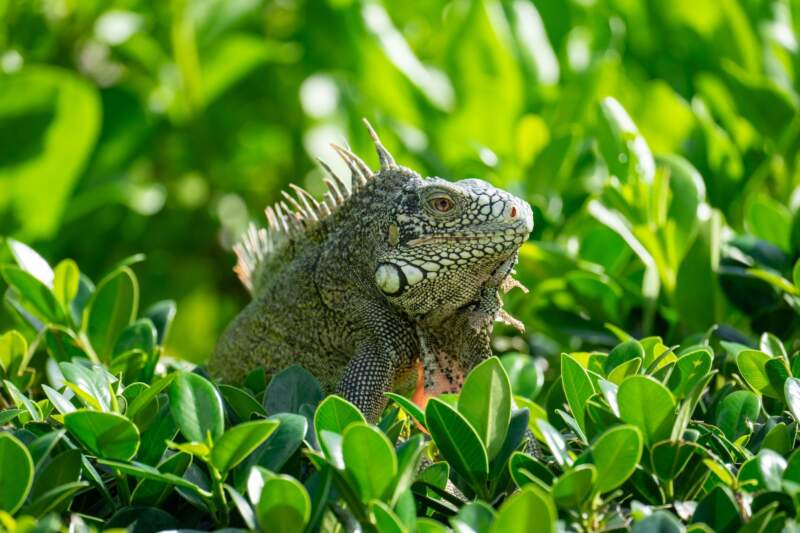
You don’t have to go far to see the damage it’s causing locally. The green iguana (Iguana iguana) has become one of the most problematic invasive species. This animal, native to Central and South America, was introduced in the 1950s.
Today, it poses a direct threat to the survival of the Lesser Antilles iguana. This native species (Iguana delicatissima) is protected by law. Unfortunately, the two species interbreed. This phenomenon is accelerating the loss of local genetic diversity.
The striped iguana is therefore the main long-term threat to the péyi iguana. The Capture of Common Iguanas is an urgent necessity.
Furthermore, the impacts extend far beyond biodiversity. By digging burrows, this animal causes cracks in roads. It also damages power lines. The damage to gardens and vegetable patches is mounting.
Even more serious: it carries salmonella and bacteria. These pathogens can be transmitted to humans when the iguanas enter homes. To address this issue, the DEAL Martinique is leading the Plan to Combat the Common Iguana (PLIC). The French Office for Biodiversity is partnering with this initiative.
2026 Symposium: Closing the Scientific Gap on Invasive Species
It is in this context that the June 2026 symposium takes on its full significance. The event brings together researchers, protected area managers, and conservation stakeholders. Students and regional experts are participating in a packed program.
The agenda will focus on the ecological impacts of invasive species. Monitoring and detection methods will be discussed. Management and eradication strategies will be a key focus. Insights will be shared from various Caribbean islands.
Participants are invited to submit oral presentations or posters. The event will be conducted entirely in English. This aspect underscores the regional and multinational scope of the initiative.
In addition, this training workshop strengthens local and regional capacity. Monitoring of invasive species is improving as a result of this cooperation. Scientific and technical collaboration among the regions is being strengthened.
The lack of data remains evident. New species of exotic reptiles have been reported in several countries. Scientists do not yet have the tools to predict their spread.
The MERCI Project: Concrete Regional Cooperation
The symposium is part of a broader collective effort. The MERCI project brings together several partners in the Lesser Antilles. Guadeloupe, Martinique, Saint Lucia, and Dominica are actively collaborating.
MERCI stands for «Management of Exotic Reptile Species in the Insular Caribbean.» The INTERREG Caribbean program co-funds this initiative. The European Regional Development Fund also supports this work.
The MERCI project studied four groups of target species: geckos, anole lizards, freshwater turtles, and iguanas. Practical tools were developed for fieldwork. A mobile app helps identify species at risk.
Local forestry officials have received specialized training. The University of the Antilles is contributing its expertise. The National Museum of Natural History is also involved. The French Office for Biodiversity rounds out this scientific partnership.
However, these advances remain insufficient given the scale of the challenge. Invasive species continue to spread. Greater efforts are needed.
The Global Cost of Invasive Species: A Call to Action
The issue extends far beyond the environmental sphere alone. It also has economic and health implications. Scientists from the CNRS, the IRD, and the Natural History Museum have quantified the impact.
Between 1970 and 2017, invasive species caused $1,300 billion in damage. This amount exceeds the damage caused by earthquakes. It also exceeds the costs of floods during the same period.
In France’s overseas territories, the situation is particularly striking. They account for 74 % of the invasive alien species found on the mainland. This proportion can be explained by their ecological richness and geographic isolation.
Prevention would save the cost of controlling these problems once they have taken hold. But it requires a solid scientific foundation. That is precisely what regional scientific cooperation plans to develop during the symposium in June 2026.