


On May 21 and 22, 2026, in Belize City, the central bank governors of CARICOM held their 66th meeting. The’Caribbean financial integration is taking two major steps forward: instant cross-border payments and a regional green taxonomy. Martinique, a new associate member, is closely monitoring these developments.
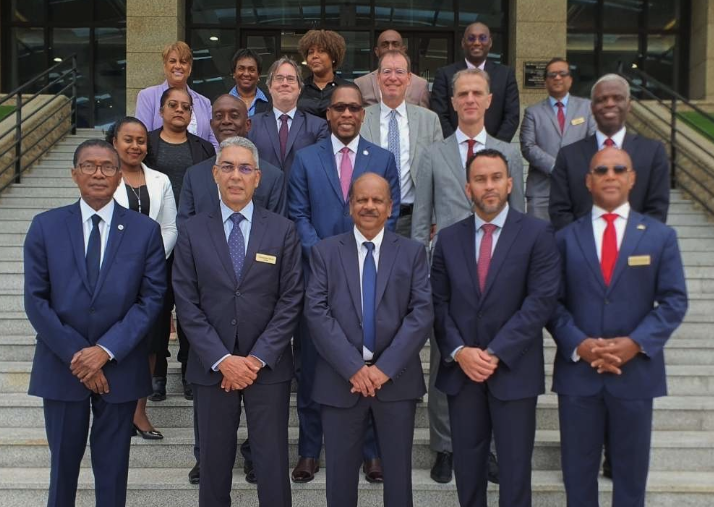
Photo: Group photo of the governors and senior officials of the CARICOM central banks during the 66th biannual meeting of the Committee of Governors, held on May 21 and 22, 2026, in Belize, chaired by Governor Kareem Michael. © Central Bank of Belize / Presslakay
The 66th semi-annual meeting of CARICOM central bank governors was chaired by Kareem Michael, Governor of the Central Bank of Belize. Governors, deputy governors, and regional representatives gathered in Belize City for two days. Their goal: to advance key initiatives in financial integration.
The international context is weighing on the debates. Geopolitical uncertainties, high energy prices, amid tighter financial conditions. Nevertheless, regional economies are showing remarkable resilience. The governors reaffirmed their commitment to further coordinating their policies to protect this fragile balance.
CAPSS: The Instant Payment System in the Pilot Phase
Moving Away from the U.S. Dollar for Regional Transactions
The major breakthrough involves the CARICOM Payment and Settlement System (CAPSS). This digital financial infrastructure system enables real-time cross-border payments. Local currencies are replacing the U.S. dollar in intra-regional commercial transactions. A merchant in Port-of-Spain can now pay a supplier in Barbados in that supplier’s own currency. Central banks handle the clearing in the background.
Financial integration is based first and foremost on a technical success. In February 2025, a «proof of concept» validated the system. The central banks of the Bahamas, Barbados, Suriname, and Trinidad and Tobago confirmed CAPSS’s ability to process instant payments. No external intermediaries were required.
Then, in November 2025, the 65th meeting approved the launch of the pilot program. It involves the Bahamas, Barbados, Trinidad and Tobago, and the Eastern Caribbean Currency Union (ECCU).
Official Launch of the Operational Pilot Phase
In Belize City, the governors approved CAPSS’s entry into its operational pilot phase for financial integration. Discussions focused on the system’s governance, its technical deployment, and the central objective: to build a faster, more secure, and less expensive infrastructure.
The issue is structural. Currently, cross-border transactions involve an «invisible tax»—dollar conversion fees and commissions charged by correspondent banks outside the region. Consequently, CAPSS aims to significantly reduce this cost. It also expands financial inclusion. Foreign exchange reserves are freed up for productive uses. The Central Bank of Barbados and the ECCU see this mechanism as holding the promise of new regional trade flows.
The Caribbean Green Taxonomy for Climate Resilience
A Common Framework to Guide Private Capital
At the same time, the governors made progress on the Caribbean Regional Green Taxonomy. It was developed with the support of international technical partners. This tool defines common criteria for classifying «green» economic activities. Energy transition, climate adaptation, and marine conservation are priorities. It helps private investors direct their capital. Projects must be aligned with regional resilience.
This initiative has a strong political dimension. By developing their own taxonomy, CARICOM countries are no longer merely recipients of standards defined elsewhere—in Europe or the United States. They are asserting normative sovereignty in the climate finance. This is crucial for island nations that are bearing the brunt of climate change.
Martinique and Regional Financial Integration
A recent status that opens up real opportunities
Martinique holds a unique position. The island has just been granted associate member status in CARICOM. This recognition grants it the right to participate in regional bodies and initiatives. However, this status does not yet confer full integration into the financial mechanisms currently being established.
However, the CAPSS and green taxonomy initiatives represent concrete levers for financial inclusion. First, a gradual connection to the regional payment system would facilitate trade. Martinique could interact more effectively with its English-speaking neighbors—Saint Lucia, Trinidad and Tobago, and Barbados. Real banking friction is currently hindering these exchanges. Furthermore, the adoption of the Caribbean green taxonomy would enhance the credibility of Martinique’s projects in the eyes of regional and international donors.
Translating commitment into concrete economic actions
The Territorial Collectivity of Martinique (CTM) and local economic stakeholders are closely monitoring these issues. Financial integration is no longer just a topic for high-level discussions. It is now being built into digital payment infrastructures and green standards. For Martinique, this is where financial integration through CARICOM truly comes into its own.