




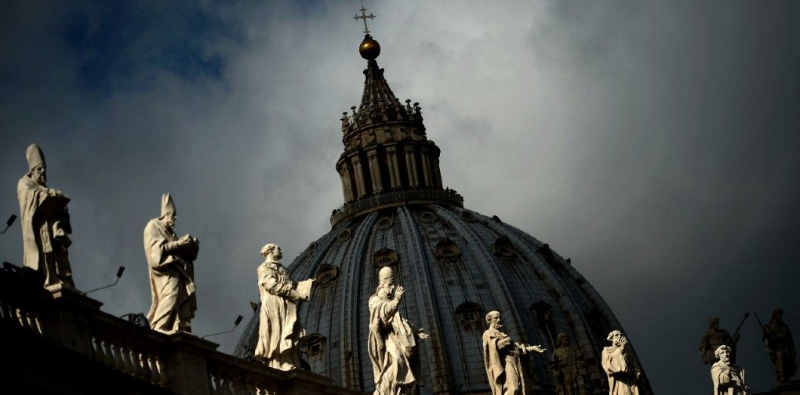
The decline in the number of worshippers is prompting some religious leaders to address controversial issues.
Many Catholics are breaking away from the Church, largely because of the lack of reform. | Filippo Monteforte / AFP
On Monday, May 10, 2021, in Germany, about 100 priests blessed same-sex couples as part of an initiative called «Love Wins». In addition to LGBTI+ couples, these priests also offered to bless heterosexual couples, divorced and remarried couples, and unmarried couples—in short, to show «All the diversity of k, love».
In defiance of the Vatican, about 100 Catholic religious services across Germany are being held that include blessings for same-sex couples # Love Wins

This initiative is a response to the responsum published by the Congregation for the Doctrine of the Faith (formerly the Holy Office) and approved by Pope Francis last March, which prohibits the blessing of same-sex couples. This Roman document has, in fact, sparked much debate within the Church itself since its publication—something that is not all that common in an institution that fears schism above all else and is not accustomed to debate.
«Reevaluating Same-Sex Unions»
It is no coincidence that this initiative comes from Germany: a few months ago, Christians across the Rhine began a collective reflection process called «synodal path.». Thus, clergy and laity are coming together to reflect on issues such as the blessing of same-sex couples, the ordination of married men and women to the priesthood, and intercommunion between Catholics and Protestants… The Church in Germany—one of the wealthiest in the world alongside that of the United States, and a direct financial supporter of the Vatican—is facing a decline in its membership as parishioners now refuse to pay the church tax. In 2018, there were more than 200,000 such individuals. to unsubscribe from Catholic mailing lists. Many of them are breaking away because of the numerous scandals involving rape and abuse committed by priests, but above all because of the Church’s failure to reform, particularly on controversial issues such as blessings for same-sex couples and ordinations…
François, under pressure from his Curia, which fears this synod, wrote in June 2019 a Letter to the People of God on Their Journey in Germany, in which he more or less asks German Christians not to go too far and «to keep the communion with the entire body of the Church alive and effective.».
But this ultimately had little effect, since the synodal process does not preclude any discussion. Furthermore, some German bishops—the chair and vice chair of the Bishops' Conference, the Cardinal Archbishop of Munich, Reinhard Marx, a close associate of the pope, among others—have also expressed their support for blessings of same-sex couples, publicly expressing their hope for a change on this issue in Rome. The Vatican’s response to these expectations was the «responsum,», which led to the «Love Wins» initiative.
However, no prelate supported this initiative; the president of the German Bishops’ Conference, Georg Bätzing, felt that it was «not a useful sign or a path to follow». But at the same time, that same president asked the Congregation for the Doctrine of the Faith to «to reevaluate same-sex unions and to continue developing the Church's sexual ethics.».
A backward-looking view of the Church
He is not the only one calling for a new ecclesial approach to these issues. In Belgium, the Bishop of Antwerp, Johan Bonny, speaking on behalf of his colleagues, is undoubtedly the most outspoken. Regarding the responsum, he denounces her «theological weakness,», a «standard level of quality» unthinkable coming from this administration, which should, on the contrary, be «»at the pinnacle of biblical and theological scholarship.". In his diocese, since the publication of the Roman document, the bishop of Antwerp has lamented the departure of more than 700 people, mainly young people; in the Flemish Region, more than 2,000 people have canceled their baptism registrations. The Church’s backward-looking stance on issues related to homosexuality is weakening Western local churches, which are already severely depleted, and is prompting comments that would have been unimaginable just a few years ago.
In Switzerland, a lay theologian who provides pastoral care to gay and lesbian people in Zurich blessed ten couples. The newly appointed local bishop, Joseph Bonnemain—despite being a member of Opus Dei (an ultraconservative organization «of a sectarian nature»), did not punish him. He even stated that «l’instruction du Vatican était une provocation». Jusqu’à présent, Rome n’a pas réagi formellement à l’initiative «L’amour l’emporte» et à ces propos épiscopaux, prenant acte des bénédictions accordées dans les différentes dépêches de Vatican News tout en rappelant la teneur du responsum. Mais quelque chose est en train de changer dans les églises occidentales.
Un schisme digne du protestantisme
La Curie romaine redoute en effet un schisme qui, après celui provoqué par Luther en 1517, partirait une fois encore d’Allemagne. Cette crainte a été pour partie alimentée par les secteurs conservateurs outre-Rhin emmenés par le cardinal-archevêque de Cologne, Rainer Woelki. Ce prélat a attiré l’attention dernièrement en raison d’un rapport établissant que plus de 200 clercs de son diocèse ont abusé et violé plus de 300 mineurs entre 1975 et 2018.
Pédophilie dans l’Église: 314 victimes, 202 responsables dans le diocèse de Cologne, selon un rapport #AFP
Beaucoup avaient réclamé sa démission après qu’il avait tenu secret un premier rapport accablant. La Curie semble donc prêter l’oreille à ceux qui voient dans la démarche synodale allemande une œuvre de Satan. Et, fidèle à ses méthodes, comme il y a 500 ans, elle estime que la meilleure façon de discuter avec les récriminateurs est de réaffirmer la doctrine. Elle sait que dans les églises en Afrique et en Asie, le responsum a été bien accueilli, l’homosexualité étant vue comme un mal propagé par l’Occident.
Mais il faut aussi s’interroger sur la motivation du pape: pourquoi avoir laissé passer un tel texte? François, dans son attitude et ses paroles, semble aux antipodes de ce responsum. Peu de temps après sa publication, l’un de ses plus fidèles cardinaux, l’archevêque dominicain de Vienne Christoph Schönborn, déclarait que les couples de même sexe demandant à Dieu une bénédiction «ne seront pas refusés». Sans doute le pape argentin est-il dans ce même état d’esprit. On oublie trop souvent que peu de temps après son élection le pape affirmait être «un po’ furbo» (un peu rusé). Il laisse passer des textes aux antipodes de sa propre approche, sachant pertinemment que, loin de clore les discussions, ils créeront des débats dans l’Église. Il montre aussi à sa propre Curie que le caractère définitif qu’elle donne à certains de ses documents ne fonctionne plus dans une Église synodale qu’il appelle de ses vœux.
Dans cette perspective, le pape jésuite a déjà commencé un travail de décléricalisation de l’Église en ouvrant aux femmes les ministères du lectorat et de l’acolytat.
Toujours dans cette optique, le 11 mai 2021 il a institué un ministère de catéchiste ouvert aux hommes et aux femmes. Cette année, il devrait promulguer une nouvelle constitution régissant la Curie qu’il veut au service de l’évangélisation. Pour mener cette réforme, il souhaite auprès de lui à des postes à responsabilités des partisans de ses vues rénovatrices, à la fibre pastorale et ouverts sur ces sujets brûlants que sont l’homosexualité, l’ordination presbytérale… Il compte sur cette méthode pour faire évoluer les mentalités et changer l’Église profondément, de l’intérieur. Une Église qui écoute sa base et se fait proche de tous, quelle que soit l’orientation sexuelle de chacun.