




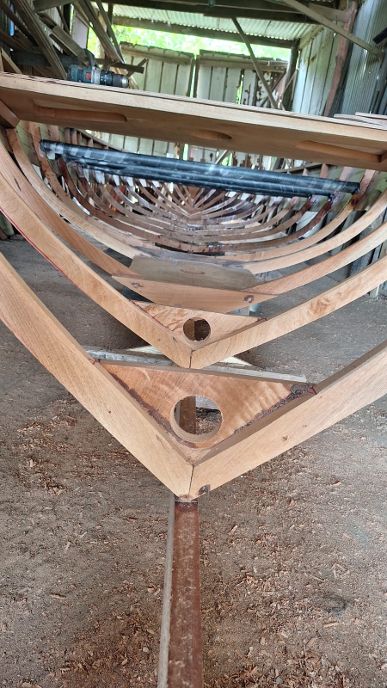
The construction of the yole is one of the most remarkable expressions of Martinique’s maritime heritage. Rooted in the traditional skills of the island’s fishermen, it is distinguished by an exceptional feature: the yole is built without any plans. This practice, based on observation, muscle memory, and intergenerational transmission, reflects an empirical art form whose practitioners are shipwrights.
Mastery of this art depends above all on experience gained at sea. Many boatbuilders have themselves been coursiers or skippers of yoles. Among them are the great names in yole racing… They learned to anticipate the winds, understand the boat’s behavior, and heed the teachings of their elders. From this intuitive knowledge comes the ability to design a high-performance yole tailored to the expectations of its future crew. The templates used to define the boat’s shape are made of wood or metal, crafted solely «by eye.» Depending on the order, the yole will be higher at the bow to better navigate troughs, rounder or flatter in the midsection for greater stability, feature higher sides to stabilize the heel, or have a narrower stern to improve speed.
Technical Feats
Building a 10.50-meter yole weighing between 600 and 800 kilograms is a tremendous undertaking. Traditionally made in the past from mahogany, cedar, and angelica wood, its construction still requires between 700 and 800 hours of work for two craftsmen, not including finishing touches. The first step is to install the keel, the central component supporting the bow and stern. Next come the frames, strakes, ribs, and templates, which gradually reveal the boat’s final shape. The planking is then precisely fitted before the numerous adjustments necessary for the boat’s proper performance at sea are made.
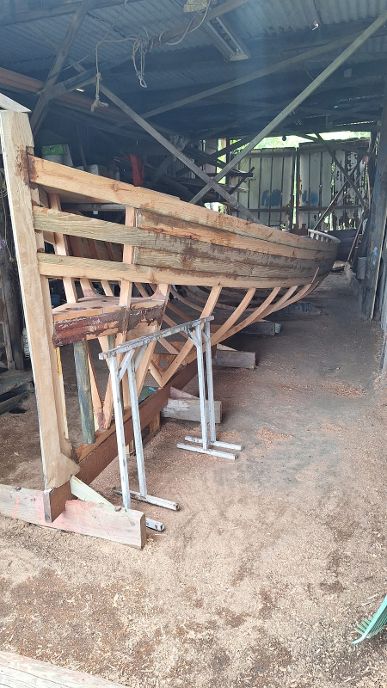
The yole is also a complex assembly of parts and accessories. Its mast, which was once made of solid wood, is now often constructed from laminated wood. The yard is traditionally made of bamboo. The upright timbers, the “tôlé,” the “tôtes,” the keel, and the “taille-mer” each serve a specific function, contributing to the boat’s strength, maneuverability, and performance. The quality of the materials is essential, as the stresses imposed by the wind and the sea demand unfailing strength. Long ago, yole sailors would go to the northern forests to gather their construction timber, a practice that is now prohibited.
Technological progress comes at a cost!
Although the yole has evolved over the decades, it has never strayed from its heritage. The boats that competed in the first Martinique races in 1966 were no longer than 7.50 meters and carried five or six crew members. Today, yoles are up to 10.50 meters long, carry sails of up to 80 m², and have crews of fourteen. This shift toward professionalization has been accompanied by technical innovations and significant investments, without, however, breaking with the founding principles of this tradition.
The Martinican round yole is thus a true living heritage, at the intersection of craftsmanship, sport, and collective memory. Behind each boat lie hours of work, knowledge passed down orally, and an intimate understanding of the marine environment. By perpetuating this art of building without blueprints, Martinique’s shipwrights go beyond mere technique; they keep alive a cultural heritage that is an integral part of Martinique’s identity and contributes to its influence far beyond its shores.
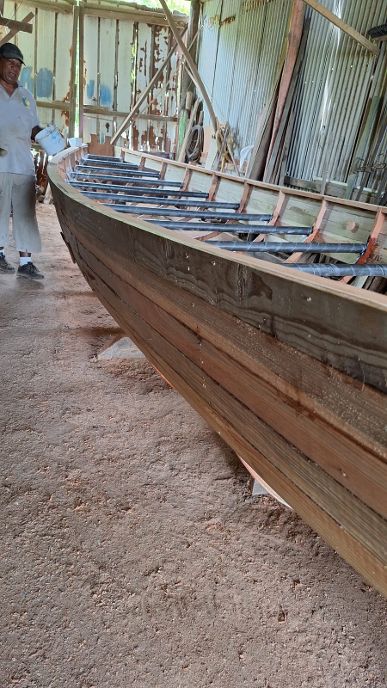
This year, a new yole has joined the fleet: Aprant’s boat, from the La Dupré neighborhood in Le Marin, built by Mr. Melchior. It will take over from the Ti Louis yole—named after its builder—and hasn’t been named yet! The crew will christen it before the Tour. Its sponsor, Bimini—which is particularly committed to the yole’s heritage—is supporting this new addition. Let’s wish it a great first Tour!
Nathalie Laulé