





The following data and analyses, based on the latest figures from INSEE, paint a troubling picture of the demographic situation in Martinique. For the fourth consecutive year, the island has seen a decline in its population, marked by negative natural and net migration rates. This observation once again highlights the challenges associated with the exodus of young people, the aging population, and Martinique’s ability to attract new residents. How can we retain our young and dynamic population and encourage graduates who studied elsewhere to return and contribute to local development? The figures, tables, and trends presented here offer crucial insights for the territory’s future.
In 2023, Martinique remains the region with the highest proportion of seniors.
By Gwenaëlle Taupe and Bénédicte Chanteur (INSEE)
In 2023, in Martinique, the population decline continued, with negative natural and net migration balances for the fourth consecutive year. Birth rates are declining, and the fertility rate is lower than that of metropolitan France. The number of deaths is falling, and life expectancy is rising following the excess mortality observed in 2021 and 2022 due to the COVID-19 health crisis. The exodus of young people continues, and Martinique remains the region with the highest proportion of people aged 60 and older. The number of marriages continues to decline, confirming a trend observed over the past twenty years.
The population decline continues
As of January 1, 2024, the population of Martinique is estimated at 349,900, which is 3,500 fewer than the previous year. The population decline continues, and over the past decade, the region has lost an average of 0.9 % of its population per year. Since 2014, the island has lost 34,000 residents—the equivalent of the combined populations of the municipalities of Schoelcher and Sainte-Marie. Over the past ten years, the population decline has been more pronounced than in Guadeloupe (an average of -0.6 % per year), while in French Guiana the population has been growing steadily (an average of +1.6 % per year). Over the same period, the population of mainland France has grown by an average of 0.3 % per year. The combination of a negative natural increase and a net outflow of migrants explains the decline in Martinique’s population.
The number of births continues to decline
In 2023, 3,340 children were born in Martinique, 160 fewer than in 2022. After a rebound in 2021, the decline in births continues. While all French regions recorded a decline in births between 2022 and 2023, the decline in Martinique was less pronounced than in mainland France (-4.5 % versus -6.9 %). The birth rate fell by 0.3 percentage points to 9.5 births per thousand inhabitants. This rate, lower than that of metropolitan France (9.7‰), is the lowest among the overseas departments and regions (DROM).
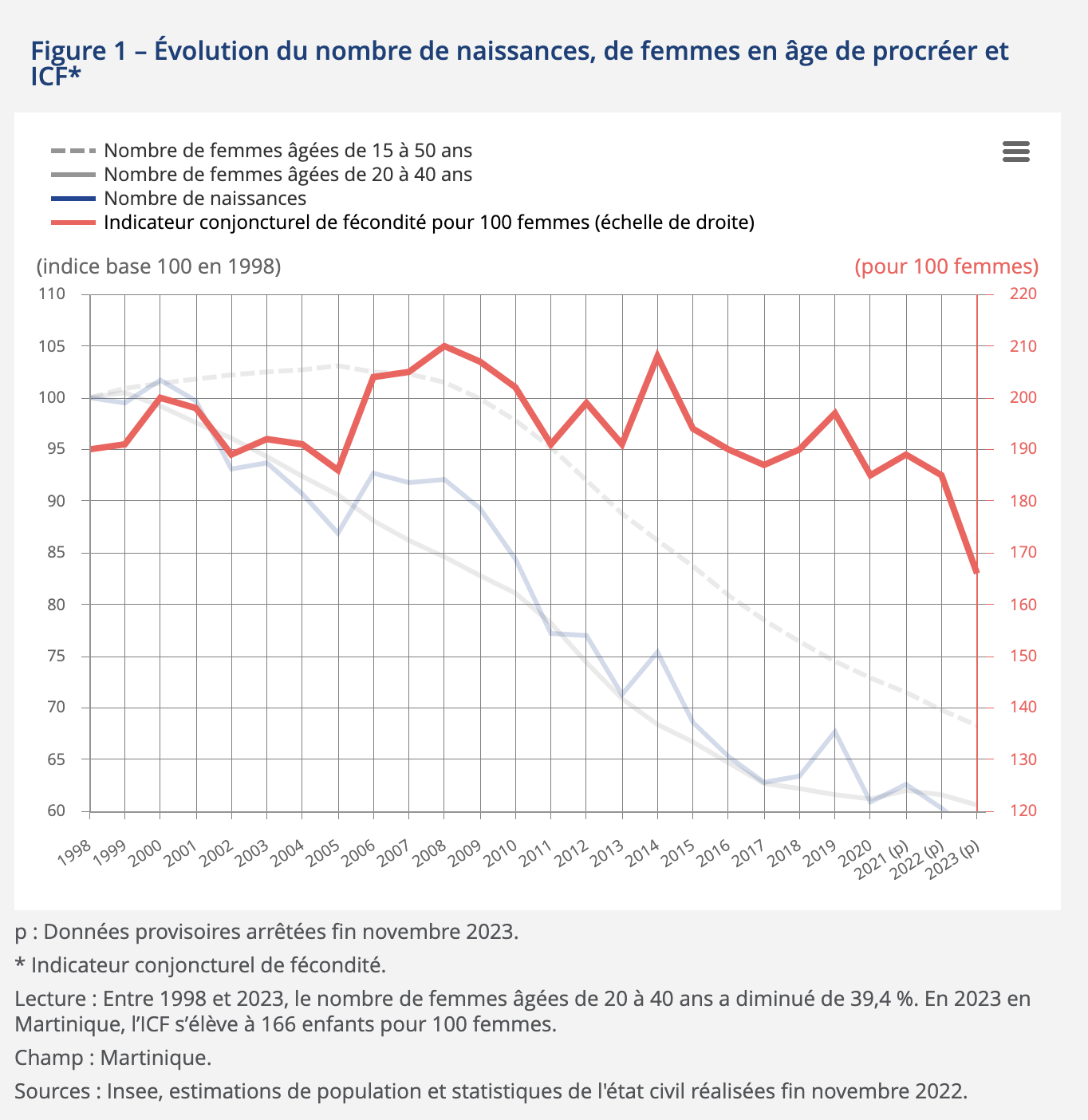
Over the past decade, the fertility rate among women aged 15 to 44 has remained stable in Martinique (5.8 children per 100 women). However, it varies by age, reflecting the trend toward later childbearing. In fact, the fertility rate among the youngest women is declining, falling from 4.9 children per 100 women aged 15 to 24 in 2013 to 4.0 in 2023. It is also decreasing for women aged 25 to 34 (10.0 in 2013 versus 9.2 in 2023). Conversely, the rate for older women is increasing: in 2013, 3.5 children were born per 100 women aged 35 to 44, compared to 4.4 in 2023. Women in Martinique are having fewer children than in the past. Consequently, the total fertility rate is declining (Figure 1). It stands at only 1.66 children per woman in 2023, down from 1.91 in 2013. It remains slightly higher than that of mainland France (1.64). At the regional level, as at the national level, it is nevertheless moving further and further away from the replacement rate, estimated at 2.1 children in developed countries.
At the same time, the number of women aged 15 to 44 is declining, just like the rest of the population of Martinique. There were 71,000 of them in 2013; ten years later, there were only 57,300. This has resulted in a 19.2 % decline in the number of births between 2013 and 2023. The decline is even steeper for women under 30, particularly those under 20 (-57.9 %). Births to mothers under 30 thus account for 85.4 % of the overall decline in births over the decade.
For older women, the decline is more moderate: -5.0 % for those aged 30 to 34, and -9.3 % for women aged 40 and older.
The average age of mothers in Martinique at childbirth is 30.3 years in 2023, close to that of women in Guadeloupe (30.5 years). On average, women give birth earlier in French Guiana (29.1 years) and later in France (31.1 years).
In 2023, 30 babies were born to underage mothers in Martinique, compared with 37 in 2022, representing 0.9 % of all births. In 2013, they accounted for 2 % of all births. Births to teenage mothers are more common in French Guiana (5.0 %) but less so in metropolitan France (0.3 %).
In 2023, 2,300 induced abortions were performed in Martinique, which is 120 more than in 2022 [Drees, 2024; for more information (6)]. With 33.1 abortions per 1,000 women aged 15 to 49, the abortion rate rose slightly compared to 2022 (31.3 ‰). In metropolitan France, this rate is half as high (16.3 per thousand). The rate varies significantly across the overseas departments and regions. In Guadeloupe and French Guiana, it is higher, at 41.5 per thousand and 48.9 per thousand, respectively.

The number of deaths has decreased year-over-year but remains at a high level
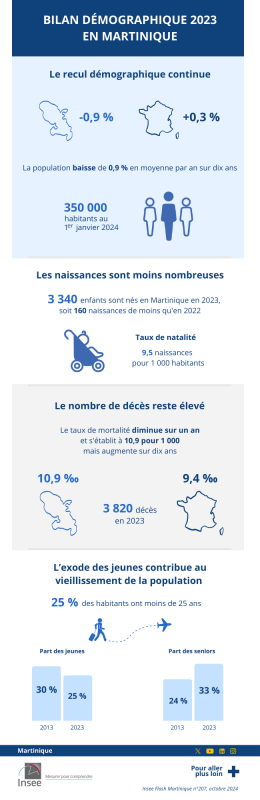
In 2023, 3,820 people died in Martinique, 370 fewer than the previous year. The years 2021 and 2022 had in fact been marked by excess mortality linked to the COVID-19 pandemic. The mortality rate stood at 10.9 per thousand in 2023, 0.9 percentage points lower than the previous year. However, it is 1.0 percentage points higher than in 2020, before the health crisis significantly affected the number of deaths in the region. In mainland France, where the pandemic’s effects on the number of deaths were felt earlier, the mortality rate also declined in 2023 (9.4 per thousand) compared to 2022 (10.0 per thousand) but remains slightly above the 2019 rate (9.2 per thousand). Despite the decline in the number of deaths in 2023, the trend over the past three decades remains upward in Martinique. The pace even accelerated between 2013 and 2023 as the population continued to age. The mortality rate stood at 7.5‰ in 2013, 3.4 points lower than it was ten years later.
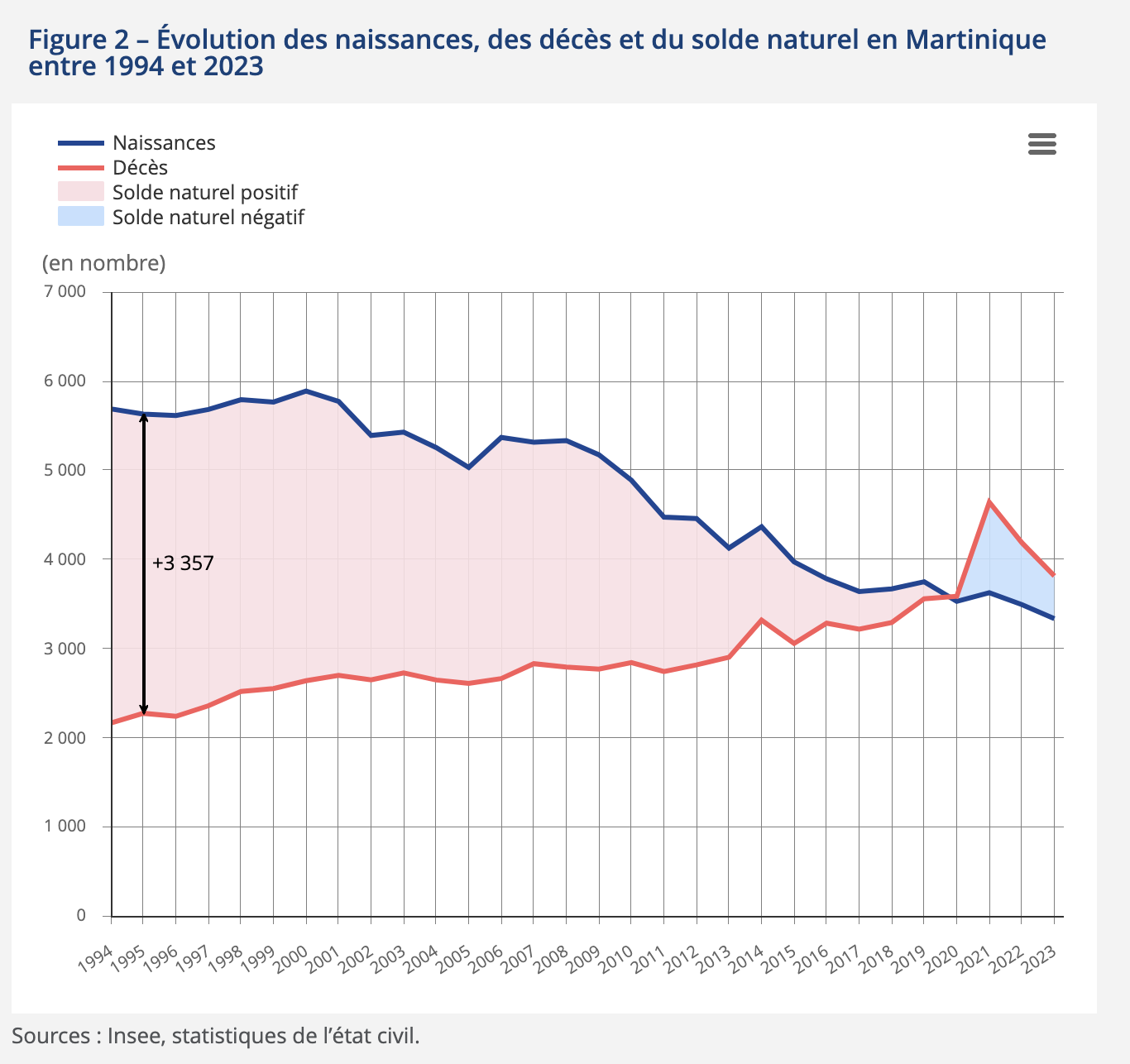
The high number of deaths and the decline in births since 2008 have resulted in a negative natural increase (-480) for the fourth consecutive year (Figure 2). Martinique is the only DROM with a negative natural balance in 2023, while Guadeloupe recorded slightly more births than deaths (+200). The natural deficit in Martinique is, however, less pronounced than in the previous two years (-1,020 in 2021, -700 in 2022).
Life expectancy at birth is rising again in Martinique. In 2023, it stood at 78.2 years for men (+1.1 years compared to 2022) and 83.8 years for women (+0.9 years). This increase in life expectancy, combined with that of the previous year, offsets the pandemic-related decline observed in 2021 for men. For women, life expectancy remains below the 2020 level (84.4 years). In metropolitan France, life expectancy for both men and women—after falling in 2020—has once again exceeded pre-crisis levels. It stands at 80.1 years for men and 85.8 years for women in 2023.
Furthermore, infant mortality remains high: in 2023, 30 infants died before their first birthday in Martinique, representing 7.5 deaths per 1,000 live births. The rate in metropolitan France stands at 3.7 per thousand.
 The migration deficit adds to the natural deficit
The second component of demographic change is net migration, that is, the difference between the number of people moving into the territory and the number moving out. Martinique will continue to experience a significant net outflow in 2023 (-3,040 residents), as it has since 2006. This adds to the more recent natural population decline. The net migration deficit contributes to a 0.9 % decline in Martinique’s population between 2022 and 2023 and has a greater impact than the natural deficit (-0.1 %). The outflow of young adults from the territory—whether in search of employment or to continue their studies—remains significant, and their share of the population thus continues to decline. Martinique once again ranks first among French regions with the lowest share of young people under 25 (25 %), on par with Corsica. They accounted for 30 % of Martinique’s population in 2013.
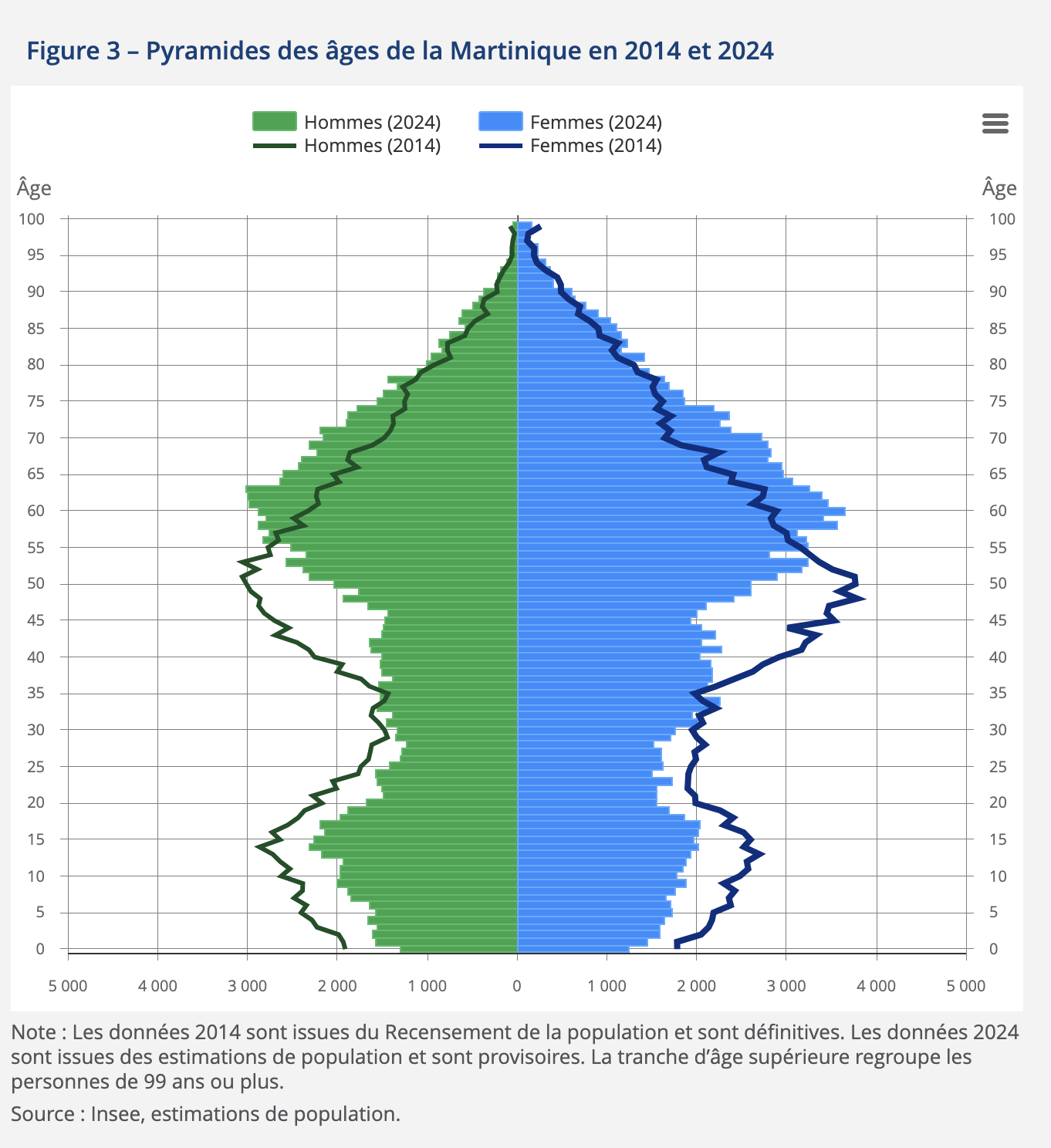
Conversely, the number of seniors is growing (Figure 3). In 2023, for the second consecutive year, Martinique remained the French region with the highest proportion of people aged 60 and older (33 %), ahead of Nouvelle-Aquitaine, Corsica, and Bourgogne-Franche-Comté (32 %). In 2013, seniors accounted for 24 % of the population. Thus, the population continues to age at a faster rate than in mainland France. Martinique’s aging index rose from 0.71 (71 people aged 65 or older for every 100 young people under 20) to 1.18 between 2013 and 2023, while the mainland index rose from 0.75 to 0.95.
In Martinique, 900 weddings were held in 2023 (estimate as of late November 2023), which is 90 fewer than in 2022. Excluding the direct impact of the COVID-19 health crisis, this decline confirms the trend observed over the past twenty years.
DOWNLOAD ALL THE NUMBERS IN EXCEL FORMAT