



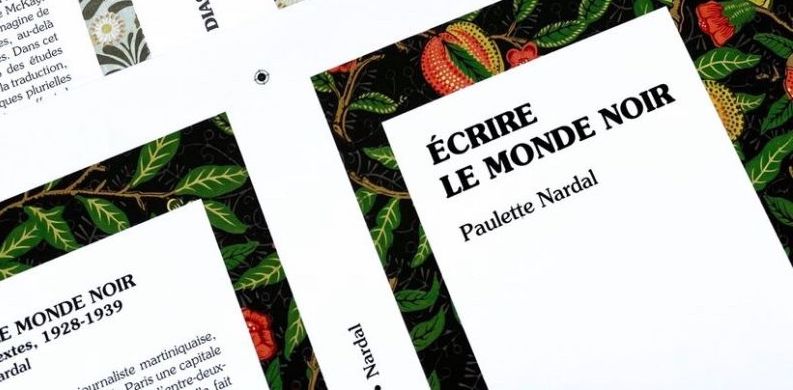
At last! Paulette Nardal’s influential writings on French Black identity have been compiled into a book available in bookstores. It was high time to recognize the importance of this pioneer, and of her thinking, steeped in the legacy of the struggles for freedom and equality in both the old and new French colonies in the Americas and Africa, but also by the spirit of the figures of the Harlem Renaissance whom she knew and introduced to France. Here is her profile, taken from the FME website.
Paulette Nardal, a native of Martinique, is a journalist, writer, activist, English teacher, champion of the Négritude movement, and even a musician; she is regarded today as a leading figure in the cause of Black people in France and around the world.
Born on October 12, 1896, in Martinique, Paulette Nardal was the eldest of seven sisters. From a middle-class family, she was the daughter of Paul Nardal—whose parents had been slaves and who became the first Black Martinican civil engineer—and Louise Achille, a schoolteacher and piano instructor. She was raised to admire the great works of Western classical culture, but also to take pride in being Black, defying the stereotypes of the time in Martinique.
After becoming a schoolteacher, she went to study in Paris. She was the first Black woman to enroll at the Sorbonne, where she studied English and wrote her thesis on Harriet Beecher Stowe, a staunch abolitionist and author of Uncle Tom's Cabin.
Upon arriving in Paris—where, in 1921, René Maran became the first Black author to win the Prix Goncourt, and where Joséphine Baker would soon electrify the capital—she said to herself, « happy and proud to see how people from the West, Parisians, and the French could be so moved by these Black productions ». Together with her sisters Jane and Anne, she runs a literary salon at 7 Rue Hébert in Clamart, south of Paris, to promote the ’Black internationalism».
The entire diaspora of people of African descent passing through Paris converged there: French people from Guadeloupe, French Guiana, and Martinique, such as Félix Eboué, René Maran, René Ménil, and Louis-Thomas Achille (his cousin); Africans from the new French colonies, such as Léopold Sédar Senghor, and African Americans such as Langston Hughes and Claude Mac Kay, whose language Paulette Nardal speaks and with whom she corresponded.
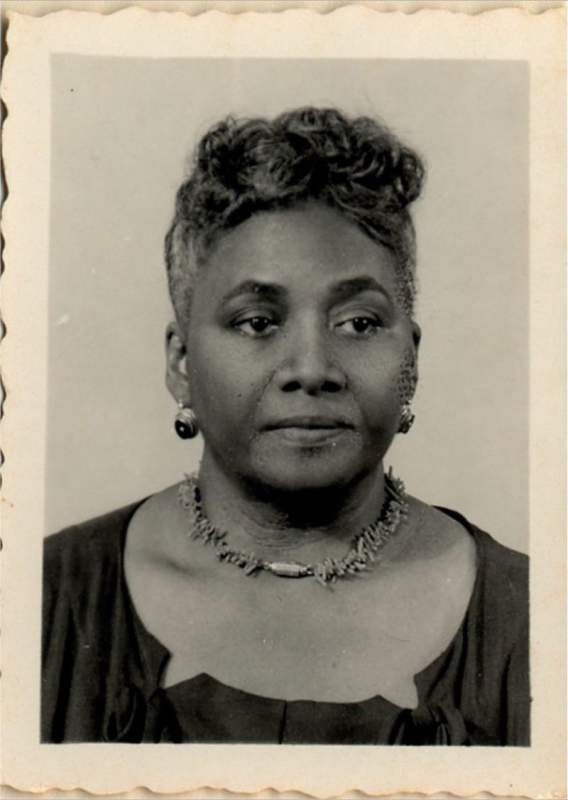
In 1931, after contributing about ten articles to the Parisian periodical The African Dispatch, the official publication of the Committee for the Defense of the Interests of the Black Race (CDIRN), she founded, together with Léo Sajous, a doctor of Haitian descent, « The Black World Review », a bilingual French/English magazine that serves as a natural extension of its trade show and opens its pages to the Harlem Renaissance as much as to the early writings of authors from the colonies. Over the course of six issues, the journal features poems, press reviews, current affairs articles, and reflections on the place of Black people in the world and in colonial society, including texts by Paulette herself in which she discusses the importance of restoring Black people’s pride and the experiences of Black women in mainland France.
In 1935, she took a stand against Italy’s invasion of Ethiopia. That same year, she was the only woman to sign an article in The Black Student, alongside the young Aimé Césaire and Léopold Sédar Senghor, who were then in the midst of developing the concept of Négritude. A pioneering theorist of French Black consciousness, she was nonetheless erased from the movement’s history, even though its founders paid her a few discreet tributes—Césaire by having a square in Fort-de-France named after her, and Senghor by writing « She guided us in our struggle to revive the Negritude movement ».
After returning to Martinique during World War II—having been seriously wounded while attempting to cross the Atlantic—she entered politics following the Liberation, when women were granted the right to vote.
As an activist with the Women’s Alliance, she encourages women in Martinique to exercise their right to vote, while also editing the newspaper she founded, Women in the City.
After spending 18 months at the United Nations in New York, where she represented the West Indies in the late 1940s, she devoted herself to promoting music—a subject on which she had always written extensively, following in the footsteps of W.E.B. DuBois—by leading a choir and popularizing the art of Negro spirituals in Martinique. She passed away at the age of 89 on February 16, 1985, having lived through the entire century as a free and committed woman.
Rediscovered in the 2000s, she is now recognized as a major figure in French «Black» thought and as a key bridge within the diaspora of people of African descent—the one who connected the Harlem Renaissance and Negritude.
Speaking of herself and her sisters, Maryse Condé wrote: « They wanted to be intellectuals. It was, in fact, a field reserved for men. So they weren't allowed to enter this field that fascinated them ».
A square named after Paulette and Jane Nardal was dedicated in Paris in 2019. The great opera singer Christiane Eda-Pierre, who passed away in 2020, was his niece.
Sources of Information
For Read *Revue du Monde Noir*
(essential for understanding the development of Black thought in France during the interwar period)
Two portraits of Paulette Nardal:
https://la1ere.francetvinfo.fr/longs-formats-paulette… https://www.liberation.fr/…/paulette-nardal…
A lot of information about the Achille-Nardal family can be found on this dedicated website On the life of Louis-Thomas Achille, cousin and fellow traveler of Paulette Nardal.
Finally, the most detailed references in French on Paulette Nardal can be found in Eve Gianoncelli’s dissertation: « Conquered Thought – A Contribution to a Transnational Intellectual History of Women and Gender in the 20th Century »