


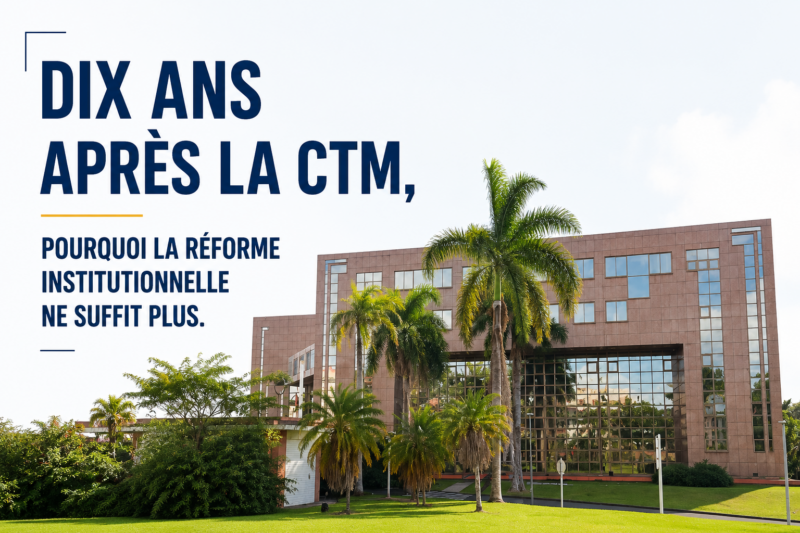
Ten years after the creation of the CTM, why has institutional reform failed to produce the expected results?
This article is the first in a series of three analyses devoted to the Martinican paradox. Over the course of these three installments, we will examine, in turn, the limitations of the 2016 institutional reform, the demographic and financial constraints currently weighing on the Territorial Collectivity of Martinique, and the proposed policy responses, particularly through the call for enhanced legislative authority. This first part revisits the original goals behind the creation of the CTM and the reasons why this reform has not produced all the expected results.
How can a territory with a budget of more than 1.5 billion euros, a single local government, and some of the broadest powers granted to any French local government, give the impression that it is struggling to control its own destiny? How can we explain that an institutional reform presented as historic has failed to remove the main obstacles to Martinique’s development?
Ten years after the creation of the Territorial Collectivity of Martinique (CTM), these questions are more pressing than ever.
On paper, all the ingredients seemed to be in place. The merger of the General Council and the Regional Council was intended to simplify the institutional structure, clarify responsibilities, eliminate administrative overlaps, and enable Martinique to speak with one voice to the national government. This reform promised a more transparent, efficient, and cost-effective administration.
However, the picture today appears much more nuanced. While the reform has profoundly transformed the organization of institutions, it has not been enough to resolve the structural challenges facing the region. Behind a modernized administrative structure lie financial, organizational, and democratic weaknesses that severely limit the local government’s ability to act.
The year 2026 thus holds symbolic significance. It marks the tenth anniversary of the CTM and provides an opportunity to compare the initial ambitions with the realities observed on the ground. This analysis draws in particular on various documents related to public policies implemented in Martinique, including calls for proposals from the Department of Economy, or the integration programs developed by the Espace Sud Urban Community. All point to the same conclusion: institutional reform alone is not enough to address the profound changes facing the region.
A reform aimed at ending institutional confusion
The creation of the CTM, which took effect on January 1, 2016, is one of the most significant institutional reforms Martinique has undergone since it became a department.
Until then, two local government bodies had coexisted: the general council and the regional council. Each exercised specific powers, but their areas of responsibility frequently overlapped. This overlap sometimes fueled political rivalries, complicated the implementation of certain projects, and made public policy difficult for citizens to understand.
The single local government was intended precisely to put an end to this dual leadership. The goal was simple: a single executive branch, a single development strategy, and a unified administration capable of acting with greater consistency.
The model that was adopted drew heavily on the Corsican model. It was based on a balance between two distinct bodies: an Executive Council responsible for implementing public policies, and an Assembly of Martinique entrusted with deliberative functions and democratic oversight.
In principle, this structure was intended to combine the efficiency of the executive branch with political oversight.
A Gradual Concentration of Power
Institutional practice, however, quickly altered this theoretical balance.
Over the years, the Executive Council has gradually established itself as the true decision-making body of the local government. In contrast, the Martinique Assembly has faced greater difficulties in fully carrying out its oversight role.
This development is not solely the result of legislation. It is also linked to the political power dynamics that characterized the early years of the CTM’s operation, particularly during the period of tension between the presidents of the Executive Council and the Assembly. These rivalries sometimes contributed to blurring the division of responsibilities and undermining the balance envisioned by the reform’s architects.
Furthermore, the Assembly does not always have the independent expertise needed to evaluate public policies with the necessary depth. This weakness limits its ability to serve as a true institutional counterweight.
Thus, without calling into question the principles of the reform, in practice this has gradually led to a form of hyper-presidentialization of the executive branch.
The Clash of Two Administrative Cultures
The creation of the CTM was not merely a matter of merging two institutions. It also involved bringing together nearly 4,000 employees from two agencies with profoundly different work cultures.
The staff of the former General Council focused primarily on social policies, support for vulnerable populations, and local administration. In contrast, the departments of the former region were more specialized in economic development, land-use planning, infrastructure, and training.
Bringing these two worlds together required much more than a simple legal merger. It was necessary to build a shared administrative culture, harmonize work methods, redefine responsibilities, and completely rethink the organization of the departments.
Such a transformation required time, resources, and significant support for the staff.
Costly Harmonization
One of the most sensitive issues naturally concerned compensation schemes.
Harmonization was largely achieved by aligning pay with the most favorable conditions. This choice may have been politically difficult to avoid. Maintaining pay disparities over the long term among employees who were now part of the same government agency would undoubtedly have fueled significant social tensions.
However, such harmonization would have required a reorganization ambitious enough to offset its cost through productivity gains and a tangible improvement in service.
It is precisely on this point that criticism has grown over the years.
Payroll costs have gradually come to account for a significant portion of operating expenses, yet citizens do not always feel that this has been accompanied by a corresponding improvement in administrative efficiency.
In other words, the merger resulted in a unified administration, but not necessarily a more effective one.
A reform that has not been adequately explained to the people of Martinique
Beyond the financial and organizational aspects, the creation of the CTM undoubtedly suffered from a lack of democratic education.
The discussions focused largely on the transfer of authority, organizational charts, staff status, and governance mechanisms. While these topics were essential, they remained largely technical in nature.
The public, for its part, has not always been fully involved in understanding this new institutional framework.
Ten years after its creation, many citizens still have difficulty pinpointing the CTM’s specific responsibilities or understanding how its various bodies operate.
This distance fosters a sense of opacity that undermines trust in public policy. However, institutional reform can only be fully effective if it is understood, embraced, and recognized by those it is intended to serve.
The creation of the CTM has undoubtedly helped modernize Martinique’s institutional structure. However, it has not, on its own, resolved the territory’s deep-seated imbalances.
For behind the administrative difficulties, another reality has gradually come to the fore: a demographic crisis of exceptional magnitude that is now disrupting the island’s entire economic, social, and financial balance.
Coming up in Part 2: “When Demographics Strain the Finances of a Local Government That Appears to Be Wealthy.” We will see how an aging population, the exodus of young workers, and the surge in social spending are gradually trapping the CTM in a budgetary squeeze that further reduces its room to maneuver each year.
Gérard Dorwling-Carter