


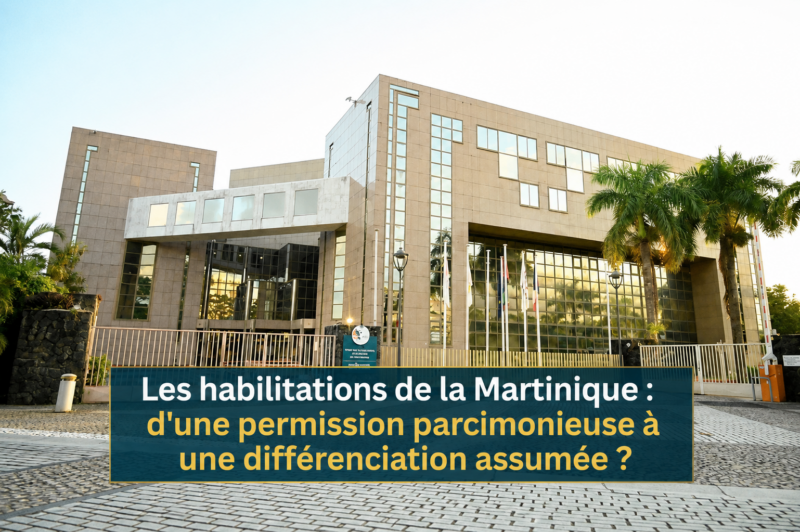
Under Law No. 2026-574 of June 30, 2026, the Territorial Collectivity of Martinique is granted, for the first time through a dedicated piece of legislation, the authority to establish its own rules regarding energy, water, and sanitation. A look back at twenty years of an underutilized mechanism—and at the divisions created by this fourth authorization.
Authorization: A Delegated Regulatory Power, Never Transferred
The starting point is the constitutional amendment of March 28, 2003. Article 73 distinguishes between two mechanisms: the authorization and adaptation of paragraph 2, which allows for the local adaptation of national standards within the areas of jurisdiction of local governments, and the authorization-and-establishment provision of paragraph 3, which authorizes local governments, in a limited number of areas, to establish certain standards themselves.
The process is demanding : The request for authorization is adopted by a reasoned resolution of the assembly, passed by an absolute majority of its members; it specifies the subject matter in question, outlines the local circumstances justifying it, and details the purpose of the proposed measures.
The validity period, Originally set at two years, it was extended by the Organic Law of July 27, 2011, to the term of office of the petitioning assembly, renewable once.
Two characteristics underpin a critical analysis of the mechanism.
First, unlike a transfer of authority, this authorization is not accompanied by any financial resources to cover the resulting expenses—the Guadeloupe region incurred costs of approximately four million euros for its energy-related adjustments.
Furthermore, this is a delegated, limited, and temporary authority: nothing comparable to New Caledonia’s laws.
Martinique's track record leading up to 2026: three authorizations in twenty years
The headcount is done in no time. In 2011, the local government is granted authorization in the field of energy, which is renewed in 2015 as part of the Energy Transition Act.
In 2013, the law grants it regulatory authority with respect to domestic land and maritime transportation ; three years later, the CTM adopted a resolution establishing Martinique Transport as the sole organizing authority for mobility, putting an end to the fragmented governance structure between the local government and the intermunicipal associations.
A certification obtained in 2014 in the Field of Vocational Training finally enables the creation of a regional public career guidance service tailored to the local market.
The procedural costs associated with these achievements are documented. Claude Lise, then president of the Martinique Assembly, lamented the cumbersome nature of the process, noting that Martinique did not obtain its transportation authorization until after ten years, while Alfred Marie-Jeanne called the procedure «incomprehensible.».
As for the energy authorization — originally provided for in Article 18 of the Act of July 27, 2011, and extended by Article 205 of the Act of August 17, 2015 —, it expired in 2021 upon the renewal of the assembly, leaving Martinique, for five years, without the ability to enact legislation in a sector in which it had nevertheless been active.
2026: The Procedural Break
Law No. 2026-574 of June 30, 2026, changes both the form and the substance. This is the first time in the history of the Fifth Republic that a dedicated enabling bill has been considered for an overseas department and region: previous authorizations had always been included as provisions within larger pieces of legislation.
It is worth reviewing the timeline: two requests made by the Martinique Assembly in December 2023 and July 2024, government approval in July 2025, presentation to the Council of Ministers on January 19, 2026, unanimous adoption by the Senate on March 31, 2026, and final adoption by the National Assembly on June 15, 2026, without amendment.
In substance, Article 1 concerns energy. The Assembly is authorized, until its next general election, to adopt specific provisions regarding energy demand management, building energy efficiency standards, the development of renewable energy, and sustainable mobility, within the limits set forth in its Resolution No. 23-569-1 of December 21, 2023—with the exception of provisions that have an impact on public energy service costs taken into account in the calculation of tariff equalization.
Background : electricity production costs nearly six times higher than those in mainland France, an energy mix that remains overwhelmingly carbon-based (27 % of renewable energy in 2025), and the requirement to transpose the 2023 directive on energy efficiency and the 2024 directive on perforEnergy performance of buildings.
Article 2 is the most political.
It authorizes the assembly to create and establish a single authority for water and sanitation, in a context where management is fragmented among three metropolitan communities and the CTM itself —which operates a plant accounting for approximately 15 % of local production (Vivé)—and where this multiplicity of stakeholders leads to recurring conflicts over resource allocation, infrastructure ownership, and governance. This mandate runs until the next election of the assembly, scheduled for 2028.
The Fault Lines
Three key themes shape the rest of this report.
The first one is democratic. The unanimous parliamentary vote masks a real local division. Serge Letchimy hails «a vote of clarity and responsibility,» while Daniel Chomet, third vice president of Cacem and former president of Odyssi, denounces the bill as «disastrous» and raises a procedural question: Why wasn’t the debate held in Martinique before the bill was introduced, given that the three presidents of the EPCIs are all members of the CTM — and why were the lessons learned from Martinique Transport regarding the preparatory phase for the transfer of responsibilities, personnel, and financial obligations not taken into account? The Senate itself has put in place a safeguard: the CTM must refrain from adopting an organizational structure for the single authority that would effectively lead to the establishment of a form of oversight by one local government over another.
The second is capacity-related.
The enabling legislation! is a powerful legal tool, provided that the CTM equips itself with the technical and institutional resources to use it effectively—this is precisely the issue of effectiveness: the enabling legislation exists; the question remains whether the legislation it authorizes will be enacted, enforced, and monitored. The 2028 deadline leaves barely two years to establish a single water authority, whereas the transportation enabling legislation required ten years of proceedings and three years of implementation.
The third is financial.
The sequence of events is striking: on June 30, the government delegated regulatory authority without providing the necessary resources; the very next day, it signed a framework agreement with the CTM even as the local government’s budgetary margins were shrinking. We see the now-familiar asymmetry: the expansion of responsibilities precedes—and perhaps replaces—the expansion of resources.
The authorization thus serves a dual purpose: to address specific needs and to demonstrate the inadequacy of general law, with Martinique advocating for the inclusion of Article 73-1, which would establish a general authority to enact local regulations—perhaps a stepping stone toward a new constitutional framework.
The question remains: Does the law of June 30, 2026, mark the beginning of Is this a system of deliberate differentiation, or simply the refinement of a permitting process? And will elected officials be able to ensure that the single water authority does not become another Martinique Transport—with all its achievements and crises?.
Gérard Dorwling-Carter