




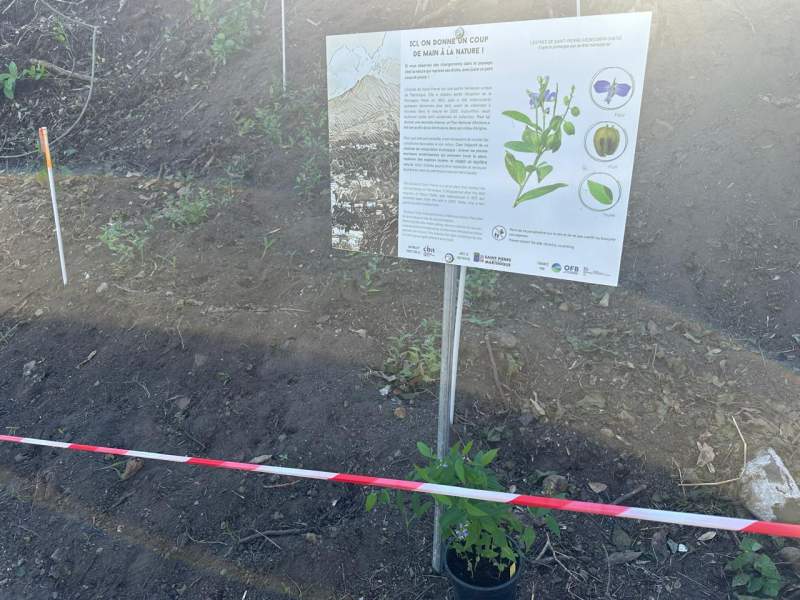
The planting of the Saint-Pierre estrée—which nearly disappeared—is the final step in a national action plan. The plan began five years ago. Today, the plant with purple flowers has returned to its historic site in Saint-Pierre.
The slope of a hill not far from the center of Saint-Pierre has become a refuge for a plant that nearly went extinct. The Saint-Pierre estrée has found a new home.
To wrap up the month of October, the conservatory launched a project to restore the Estrée de Saint-Pierre to its natural habitat. As its name suggests, the plant is native to the former capital city, the only known location where it has been recorded in Martinique. Just like the city itself, the Saint-Pierre estrée has endured its share of hardships. After the 1902 eruption of Mount Pelée, it was believed to have disappeared until the 1970s, when botanists rediscovered it. To ensure the species’ survival, seeds were then sent to the National Botanical Conservatory. The goal was to ensure a seed supply in the event of natural extinction. Time would prove the botanists’ precautions to be wise. As the years passed, the Saint-Pierre estrée became increasingly rare and was ultimately declared extinct in the wild, according to scientists at the laboratory.
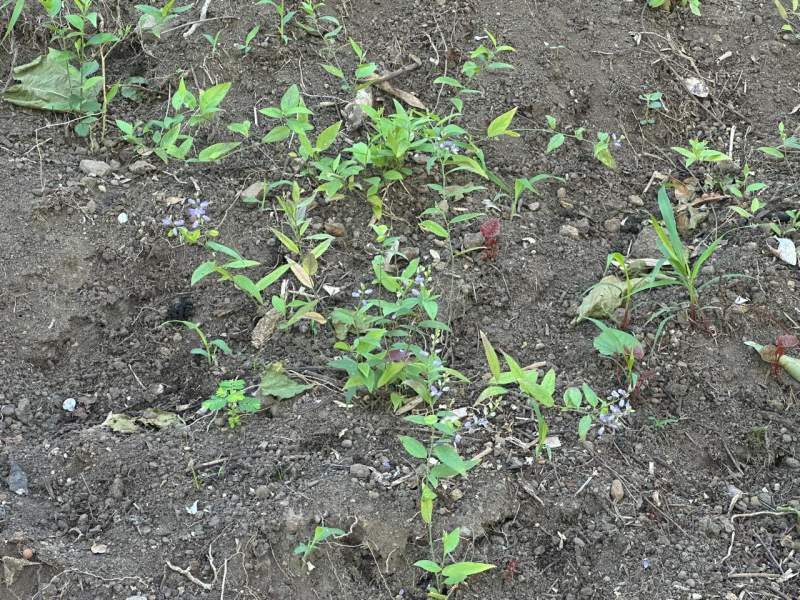
An action plan led by the Martinique Botanical Conservatory aims to reintroduce the species to its original habitat at Morne d’Orange in Saint-Pierre, very close to the lookout point. But it wasn’t enough to simply dig a hole and plant a seed. Reintroducing the estrée required ambitious logistics. Many invasive alien species had taken root on the hill. «We couldn’t simply replant the species as is because there are species that aren’t naturally found in Martinique and were introduced by humans. They disrupt the ecosystem because they take the place of our native Martinican species,» explains Irais Loiseau, project manager for national action plans at the Martinique Botanical Conservatory.
After clearing the site of invasive species, technicians from the botanical conservatory replanted native species with the goal of creating a balanced ecosystem to reintroduce the Saint-Pierre estrée. A total of 375 trees were planted. «These are common species, but they will help structure the environment so that its functions can be restored,» explains Irais Loiseau. The plants were planted in plots using different methods to understand how they function. «The basic idea is more about reintroducing the species to its original habitat than about gathering scientific data.»
No future reintroduction project for the Saint-Pierre sprat is planned. In fact, the goal was to reintroduce the species to its historical range.
On the other hand, from a more experimental perspective, the estrée was introduced elsewhere—also in the northern Caribbean—in the municipality of Carbet. «This was done at a site with an ecosystem different from that of Morne d’Orange, though with some similarities, so that the two populations could be compared.»
These reintroduction efforts do not prevent the botanical conservatory from maintaining a seed bank of *Estrée*. «Our goal is always to maintain stocks of the most endangered species so that we have the resources to reestablish populations in the event of extinction. In this case, this species is covered by a national action plan that calls for the establishment of ex situ stocks in a nursery to ensure that individuals are available.»
The Martinique Botanical Conservatory’s collection contained more than just Saint-Pierre estrée seeds. Many strictly endemic species are threatened with extinction. The barrel vine has already been reintroduced in Carbet. You can spot it along the roadside on the way to Bellefontaine. «There are a great many rare and endangered species in the territory that we’d like to focus on in our projects.»
Laurianne Nomel