




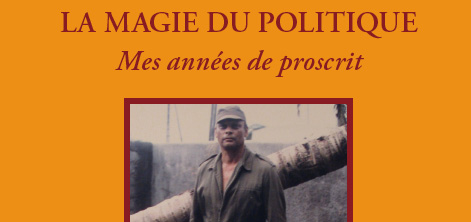
The team at CERCAM, the Caribbean-Americas Research Center, has informed us of the publication of two New works by Oruno D. LARA, in collaboration with Inez FISHER-BLANCHET: – The Magic of Politics: My Years in Exile – Interviews with Inez FISHER-BLANCHET (Paris: L’Harmattan, 2011); – Slave owners in 1848: Martinique, French Guiana, Saint Barthélemy, Senegal (Paris: L’Harmattan, 2011). This latest book is part of the series *Slave Owners in 1848*; the first volume, devoted to Guadeloupe, was published in 2010. Oruno D. LARA and Inez FISHER-BLANCHET, who are from Guadeloupe and are historians, are co-founders of the Caribbean-Americas Research Center (CERCAM).

Propslave owners in 1848 Martinique, French Guiana, SSaint-Barthélemy, Sénégal
On February 25, 1848, the eleven members of the Provisional Government decided, at Paris City Hall, to abolish slavery. The decree, which was finally signed on April 27, freed all slaves held in the French colonies. But who were these slave owners? A list of lawsuits filed against them for illegal mistreatment of their slaves reveals, in this book, some of these Békés from Martinique.
A law passed in 1849 granted «dispossessed colonists» compensation for the emancipation of their slaves. A well-known law, you might say. Except that it’s all too often overlooked that these planters—owners of men, women, and children—continued to live comfortably in the colonies. They maintained and strengthened their economic dominance by taking advantage of the benefits granted by the creation of colonial banks. Some of them left the colonies to live off their income; many invested in central factories and sugar production, and later in the banana industry and large retail chains.
After Guadeloupe, Oruno D. LARA and Inez FISHER-BLANCHET set out to compile a list of slave owners in Martinique, French Guiana, Senegal, and the Swedish colony of Saint Barthélemy. On this island, where slavery was abolished on October 9, 1847, the authors compiled a list of newly freed people in addition to that of the slave owners. A register of Black people that debunks the myth of a «white» Saint Barthélemy.

 The Magic of Polpolitics My Years in Exile
The Algerian War (1954–1962) inspired some to become draft resisters. Conscientious objectors, who refused to answer their call to arms; deserters who illegally left their military camps in France or Algeria. Among the first—no more than a few dozen—was a young conscript, Oruno D. LARA, originally from Guadeloupe, a paratrooper with the Transport Corps. Stationed in Auch, he refused to fight against those he considered his brothers and chose to desert on the eve of his departure for Algeria.
This account by a native of Guadeloupe describes the situation of students from the colonies during that period (AGEG, AGEM, and UEG) and their efforts to unite. He attended the Congress of the Union of Antilles-Guyanese for Autonomy, which in 1961 brought together France’s last remaining colonies: Guadeloupe, French Guiana, and Martinique.
With the help of Inez FISHER-BLANCHET, he discusses the reasons that led him to refuse to go to Algeria. It was a carefully considered political decision, followed by six years of wandering during which—without being granted asylum or political refugee status—he lived in Switzerland, Germany, Belgium, the Netherlands, and the United Kingdom, subjected to police repression and constant threats of deportation.
His account is also based on previously unpublished documentation that recalls earlier colonial wars: Indochina, Madagascar in 1947, and Ruben UM NYOBÈ’s *Kamerun*, before he revisits the fifty-year-old case of Algeria’s struggle for independence in 1962.
A short note from Henri Pied
Regarding this latest book, which focuses in particular on the pivotal years from 1959 to 1963, it is important to note that two men from Martinique were directly involved; they deserted, refusing to fight against the Algerians: Guy Cabort-Masson (who has since passed away, but who produced a prolific body of work, including analytical books and articles in Antilla (among others) and Daniel Boukman, who lives in Martinique, a poet and writer who has devoted much of his energy to promoting the Creole language. Let’s not forget the people of Guadeloupe either Sonny Rupaire (poet), now deceased, as well as Roland Thesauri…
Furthermore, in the afterword to the book on slave owners, Oruno D. Lara emphasizes, once again, how the «decision» to abolish slavery was made, as early as February 25, 1848 by the eleven members of the Provisional Government, while the propaganda (there is no other way to describe it) portrayed Victor Schoelcher alone as the sole hero of this historic event for France… To the detriment, moreover, of the even more arduous and severely repressed struggle of Cyrille Bissete and his fellow activists, condemned, banished, branded, and who had begun the decisive battle as early as 1823/1824, the only ones, in fact, who, on-sitee, set out to shape the relationship between slaves and free people of color—a relationship without which nothing could have happened in the country. It is worth noting that Guy Cabort-Masson wrote unambiguously about this period and that the book by Stella Pame dedicated to Bissette, is an indispensable work for restoring history and the truth—which have been distorted—to their rightful place, free from persistent manipulation…