




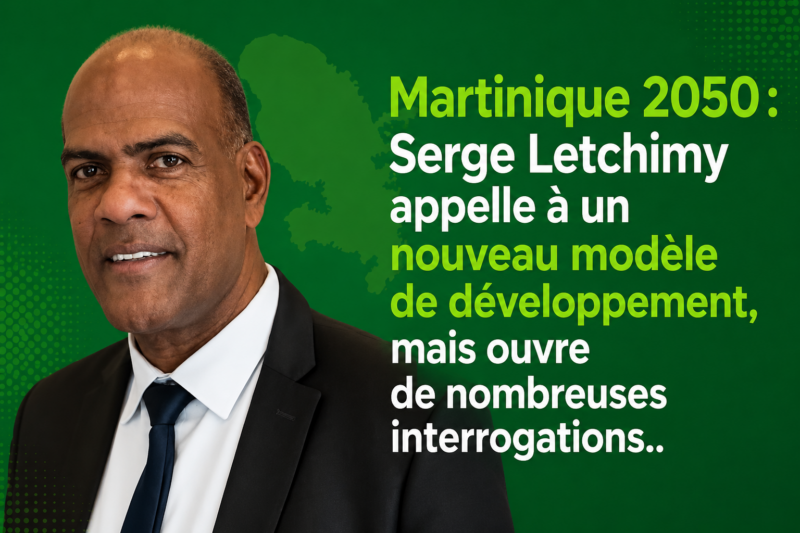
The foreword to *Martinique 2050*, written by Serge Letchimy, president of the Executive Council of the Territorial Collectivity of Martinique, sets the tone for what is intended to be much more than a planning document. The author presents this strategy as a genuine vision for society designed to prepare the island for the challenges of 2050.
The starting point is a blunt observation
The economic and social model that has shaped Martinique for several decades has reached its limits. An aging population, an economic slowdown, climate vulnerabilities, and dependence on public funding all call for, in his view, a profound change in direction.
This transformation is part of a continuity of policy.
Serge Letchimy highlights the work undertaken by the CTM over the past several years, the role of the Congress of Elected Officials, and the symbolic link to 1848, presented as the starting point for a new quest for emancipation. The stated goal is to build a Martinique that is better able to «think, decide, and act» for its own development.
The strategy is based on a central idea
From now on, wealth creation will need to come more from local production, innovation, and private investment than from public transfers alone. Businesses, artisans, farmers, merchants, and investors are invited to become full partners in this transformation, alongside the government.
The author also emphasizes the evolving nature of the approach.
The document is presented as a first draft open to consultation, intended to be enriched by contributions from economic stakeholders and Martinican society. Finally, Serge Letchimy asserts that “Martinique 2050” should not be the project of a single term of office, but rather that of a territory committed to a long-term vision.
This preface, however, raises several questions that will be crucial in assessing the strategy's credibility.
The first concerns resources : How can such an ambitious transformation be funded when local government finances remain severely constrained?
The second section focuses on institutional levers : Will the ability to «decide and act» be reinforced by the commitment to skills development outlined in the framework agreement?
The third one affects the private sector : Do businesses in Martinique currently have the size, funding, and human resources needed to become the main driver of development?
Finally, one last question concerns governance.
How can we ensure that a strategy designed to last twenty-five years will withstand changes in political leadership and continue to engage local stakeholders over the long term?
This preface thus sets an ambitious course and launches a major debate. The rest of the document must now demonstrate that this vision can be translated into operational decisions that are funded, measurable, and capable of bringing about lasting transformation in Martinique’s economy.
Gérard Dorwling-Carter