




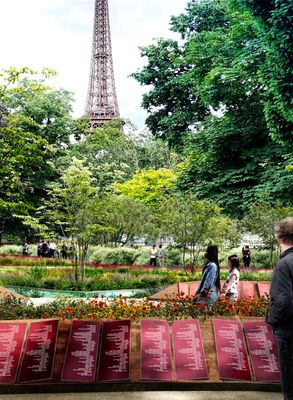
A presentation developed by Serge Romana during his stay in Martinique, where he traveled to give two lectures explaining the project
Why a memorial at the Trocadéro commemorating the emancipation of slaves in 1848?
The abolition of slavery in 1848 marked one of the most powerful, seminal, and transformative acts in the history of the French Republic. With a single decree, France transformed the status of nearly 250,000 women, men, and children from that of non-persons to citizens. Yet, There is no national site dedicated to those whose freedom was proclaimed. For more than two decades, Serge Romana has pointed out that France has honored the abolitionists, but It has never honored the freedmen themselves.
This shortcoming is all the more significant given that abolition—far from being a gift—is the result of a long history of resistance. Yet, in the national narrative, The figure of the released prisoner has never taken center stage. The memorial aims to bring those whose lives have been transformed back into the spotlight by highlighting their names, their families, and their stories: the restored dignity of hundreds of thousands of citizens.
Serge Romana emphasizes a fact that is often overlooked: 1848 marked the reestablishment of overseas branches. Slavery destroyed family lines, erased surnames, and tore families apart. The decree established a new civil registry, assigning each freed person a name, often the first written record of his lineage's existence. Carving these names into stone would serve as a significant symbolic act of reparation.
Choosing the Trocadéro is a powerful political statement. This venue, associated with the 1948 Universal Declaration, affirms that The memory of slavery is part of the universal history of human rights. It places the history of the overseas territories at the heart of the Republic: The history of the freedmen is at the heart of the nation's collective memory.
Romana points out that abolition is a rare moment when the Republic makes amends. The memorial would serve to explain that this is a collective achievement, the result of struggles, mobilizations, and a moral transformation of French society. It would become a civic landmark, an educational space.
Contrary to fears, the memory of emancipation is not a source of conflict: It is a peaceful memory, a memory that brings people together. It celebrates rebirth, resilience, and the rebuilding of post-slavery societies: It is a memory that promotes peace.
The memorial is not a static monument. It should be a vibrant space that hosts exhibitions, school groups, genealogy workshops, and official ceremonies. It would demonstrate that 1848 is not just a date, but a long process of humanization and reconstruction.
Ultimately, the memorial addresses a historical necessity, a social necessity, and a republican necessity. He would claim that «We are the children of 1848», and that France fully acknowledges this part of its history.
Gérard Dorwling-Carter