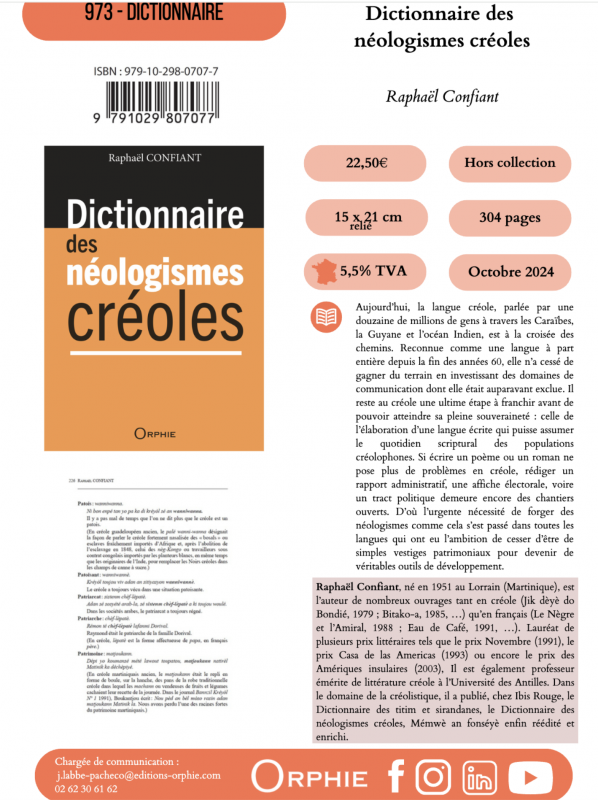



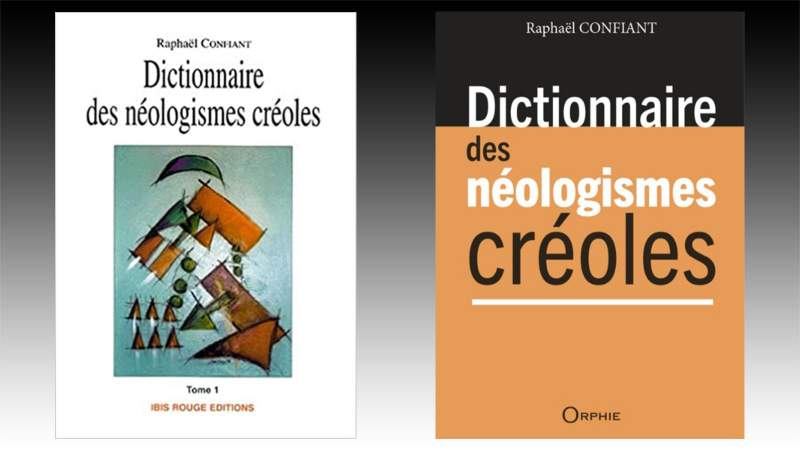
In 2001—23 years ago—I published the very first *Dictionary of Creole Neologisms* with Ibis Rouge (French Guiana). Today, I am publishing a revised and expanded edition with Orphie (Reunion Island). Source: www.raphaelconfiant.com
The fact is that no lexicographical work is ever finished—and can never be—for the simple reason that all languages evolve, grow richer, or, conversely, disappear. Language is a kind of living organism, strangely invisible except when it is written down on paper or displayed on a computer screen—but even then, it remains elusive. This has never stopped linguists, lexicologists, or dictionary compilers from devoting themselves to its study and description. It is in fact thanks to their invaluable work that we are able to read texts from the past.
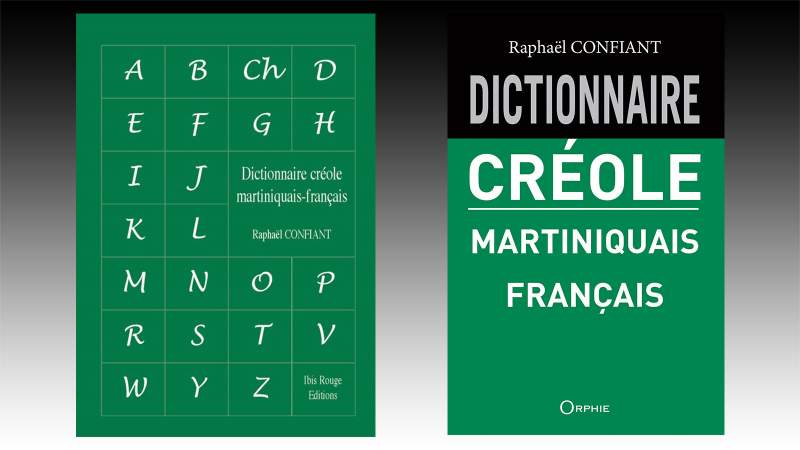
Every dictionary must therefore be «revised and expanded,» as the saying goes, which requires self-sacrifice and diligent work on the part of the person who undertakes to compile it—even though the general public does not fully appreciate the true value of these two demands. I had, in fact, published my *Dictionary of Martinican Creole* in 2007 with Ibis Rouge and republished it with Orphie 15 years later, in 2022.
That’s exactly what I’m doing today for my Dictionary of Creole Neologisms. The issue of neologisms or new words has become crucial for Creole today, for two reasons: first, the phenomenon of translating major literary works into Creole (Camus, Montherlant, Céline, Flaubert, Lewis Carroll, Le Clézio, etc.), which compels Creole to open up to worlds beyond its own and thus to adopt new terms and expressions; second, the need for Creole to be able to express the modern world.
Here, it’s worth clarifying something: my neologisms are by no means limited to those from Martinique alone. It also includes those from Guadeloupe, Haiti, Réunion, French Guiana, the Seychelles, Saint Lucia, Dominica, and so on… because written Creole, unlike spoken Creole, is not—and should not be—limited by dialectal boundaries. This written Creole must be able to draw on all varieties of Creole, which will facilitate its attainment of «scriptural sovereignty» (Jean Bernabé).