




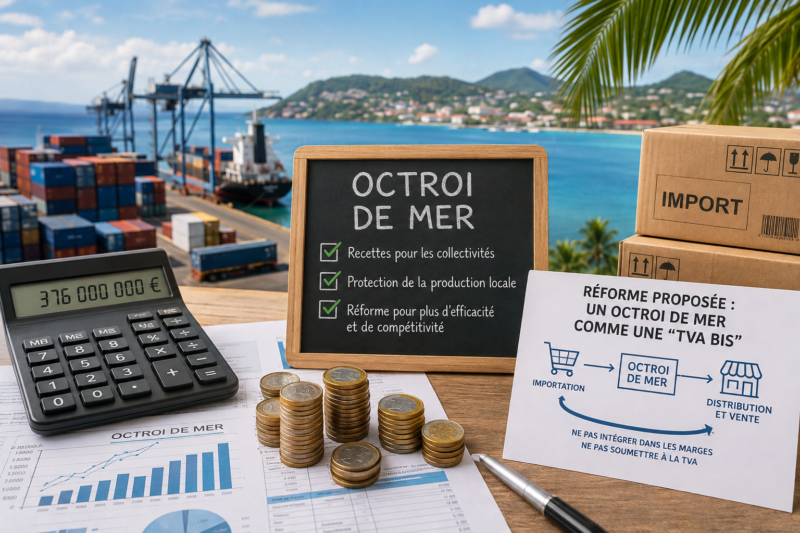
The debate on the future of the dock dues continues in these pages. Following contributions from Cyril Comte and François Despointes, Didier Payen*, an importer and industrialist based in Guadeloupe, first vice president of the MPI, and member of the board of directors of Medef Guadeloupe, wished to offer a different perspective. In this op-ed, he challenges the notion that the «octroi de mer» has run its course and advocates not for maintaining it as is, but for reforming how it operates. In his view, part of the problem lies in the conditions for applying Article 45 of the 2004 law and in the incorporation of the “octroi de mer” tax into the cost price throughout the supply chain. He therefore proposes evolving the system into a mechanism comparable to a “second VAT,” in order, according to his analysis, to preserve local government revenue and protect local production while limiting its impact on prices. We are publishing his contribution in its entirety as a new contribution to a debate that directly concerns taxation, the cost of living, and the financing of overseas local governments.
At the end of his op-ed, Didier Payen also answers five of our questions to clarify the conditions for implementing his proposal.
The debate over the dock dues regularly revolves around the same question:
«Is this tax system still suited to the economic realities of the overseas territories?»
For Didier Payen, portraying the port tax as a measure that has «reached its limits» amounts to framing the issue in the wrong way. On the contrary, he believes that this tool continues to serve an essential function, both in financing local governments and in protecting local production.
He points out that the “octroi de mer” is a specific tax system that allows for differentiated rates based on the type of product. Its alignment with the customs nomenclature enables fine-tuned tax adjustments. In his view, this flexibility is particularly important in island economies, where local production must bear higher structural costs.
Eliminating the dock dues would immediately raise the question of how to replace them
For Didier Payen, the elimination of the dock dues cannot be considered in isolation from another issue: the financing of local governments.
In Guadeloupe, revenue from the “octroi de mer” and the regional “octroi de mer” is estimated to have totaled 376 million euros in 2023. Their elimination would therefore require finding an alternative source of revenue capable of guaranteeing local governments a comparable level of funding.
If this replacement were to involve a tax system more closely aligned with the national VAT system, Didier Payen believes it would also alter the current balance, particularly the region’s ability to tailor its tax system to the products and needs of its economy.
Above all, he disputes the idea that simply replacing the dock dues with another tax would necessarily lead to lower prices. According to him, everything would depend on the tax base chosen, the rates, the exemptions, how local production is treated, and how this new tax system would be integrated into the supply chain.
The problem is not so much the tax itself as its inclusion in the cost price
This is where the core of his argument lies.
Didier Payen believes that the real debate should not automatically pit the retention of the dock dues against their elimination, but rather focus on how this tax is currently factored into pricing.
In particular, he highlights Article 45 of the 2004 law. According to his analysis, the port tax should not itself be increased by the commercial mechanism when it is included in the cost price and then subject to successive markups before VAT is added.
Under the system he describes, a tax initially paid upon entry into the country becomes part of the cost price. Participants in the supply chain then apply their margins to an amount that includes this tax. The tax is thus gradually incorporated into the final price.
From 376 million euros in revenue to nearly 600 million borne by consumers
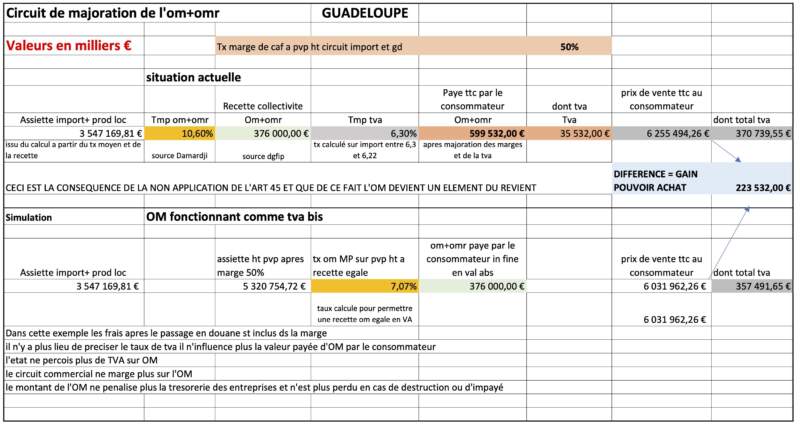
To illustrate his reasoning, Didier Payen draws on a simulation involving Guadeloupe.
For 376 million euros in revenue from the dock dues and regional dock dues, the corresponding amount ultimately borne by consumers would amount to approximately 599 million euros, according to his calculations.
The difference would therefore be in the range of 223 million euros.
According to Didier Payen, this difference does not represent additional revenue collected by local governments. It is said to result from the cumulative effect of the margins and taxes applied throughout the price formation process.
This estimate is a central element of his argument, but it also deserves to be considered as such: a simulation that should be confirmed and documented in detail. If these figures were verified, the issue would no longer be merely the level of the dock dues, but rather how they are factored into prices.
Treat the port tax as a «second VAT»
Rather than eliminating the port tax, Didier Payen therefore proposes to reform how it operates in order to bring it more in line with the principle of VAT neutrality.
He refers to a port tax that functions as a «VAT bis».
The idea would be to pass this tax along the entire supply chain without it itself becoming part of the cost price to which successive markups are added.
The port tax would thus retain its role as a source of revenue for local governments and as a means of protecting local production, but, according to Didier Payen, its operation would become more transparent and more neutral for both businesses and consumers.
His proposal is based on a clearly defined tax base and a collection mechanism comparable to that of the VAT. The dock dues would no longer be incorporated into the cost price in the same way, and the goal would thus be to eliminate the cascade effect which, according to his analysis, currently amplifies its impact on the final price.
The simulation he provides shows that, with port tax revenues remaining constant, the overall price paid by consumers is lower than under the current system.
The challenge is therefore twofold: to preserve local governments’ resources while seeking to reduce the impact of the tax on the price formation chain.
If the estimate of approximately 223 million euros were confirmed, Didier Payen believes that the reform could generate significant purchasing power or free up funds to finance infrastructure investments, particularly in water, roads, and infrastructure.
Another challenge: enabling companies to actually export duty-free
Didier Payen adds to his argument a dimension that is less often mentioned in the debate on the dock dues: that of exports.
According to him, a tax system that has become neutral within the commercial chain could allow goods intended to leave the country permanently to be sold tax-free.
Today, he explains, when local taxes are factored into the cost price, they can become a hindrance for a company that wants to re-export a product to another market.
Under the mechanism he proposes, a merchant could purchase, store, distribute, and then re-export goods without the port tax factored into the cost price affecting the merchant’s competitiveness in foreign markets.
This development would therefore no longer concern only the issue of purchasing power. It could also change the way businesses in Guadeloupe and Martinique view their market.
Bringing an Economic Dimension to Caribbean Integration
For Didier Payen, this opportunity to export under more favorable tax conditions could also help give Caribbean integration greater economic substance.
Martinique and Guadeloupe have port and airport infrastructure, businesses, skilled workers, a well-developed banking system, and access to the European market. According to him, these strengths should enable them to play a greater role as hubs for trade, distribution, and possibly processing between Europe and the Caribbean.
However, the tax system must not penalize companies when they want to sell to neighboring islands.
The reform of the dock dues would then take on a new dimension: it would no longer be merely a matter of correcting a mechanism that may contribute to the high cost of living, but also of creating the conditions that would enable local businesses to expand their trade, exports, and re-exports within their regional environment.
Reform Rather Than Eliminate
Didier Payen’s position is therefore not one of defending the status quo.
He does not believe that the port tax should be maintained in its current form. He does, however, believe that its elimination could undermine local governments’ finances, reduce the means available to protect local production, and eliminate a tax instrument specifically tailored to the constraints of overseas economies.
Conversely, he argues that defending the principle of the dock dues does not mean rejecting changes to it.
His argument can ultimately be summarized as follows:
Before eliminating the port tax, we should first prevent it from becoming a factor to which markups and taxes are added at various stages of the supply chain.
But his proposal now goes a step further. If reformed, the dock dues could, in his view, become not only a tool for financing and protecting local production, but also an instrument of competitiveness that would enable overseas companies to produce, trade, and export more within their Caribbean region.
Five Questions for Didier Payen: How Do We Move from Proposal to Reform?
Beyond the analysis and the reform he advocates, several questions remain: Who has the authority to decide on such a change? Why hasn’t this proposal been implemented yet? How can we ensure that lower costs are actually reflected in prices? And what would the consequences be for businesses? Didier Payen answers five of our questions.
Who is responsible today for deciding to change the way the dock dues are administered, as you propose?
The implementation of changes to the system falls under the authority of the executive branch. It is the responsibility of the government—and more specifically, the Ministry of Finance—to propose the implementing decree necessary for the enforcement of Law No. 2004-639 of July 2, 2004.
You mention that you have already presented this argument to the Ministry of Overseas Territories and that it has met with broad support in Guadeloupe. What responses did you receive, and why hasn’t anything changed yet?
Representatives of the Ministry of Overseas Territories, the prefects, and the director of the HAC have been fully briefed on this proposal, which has been well received in Guadeloupe. However, successive changes in government have halted the work that had begun and put the necessary steps toward regulatory adaptation on hold.
How can we ensure that a reduction in costs along the supply chain will actually translate into lower prices? In other words, who can guarantee that the 223 million euros identified will benefit consumers?
Within the European framework, where price freedom is a fundamental principle, no direct legal guarantee can be provided. Competition, government action, and media scrutiny therefore have a vital role to play in driving prices down.
Under the reform I am proposing, the dock dues would be excluded from the tax base for profit margins and VAT, and would then be calculated based on the pre-tax retail price. It would then be up to elected officials to adjust the rates in order to maintain a stable level of revenue for local governments.
This is a key point. Without this adjustment, the 223 million euros identified could become additional revenue rather than an increase in purchasing power. It will therefore be necessary to strike a balance between purchasing power, competitiveness, and the stability of local governments’ revenues.
Would your reform have any impact on the balance between imported products and local production?
The expected impact should remain limited. A decline in the prices of imported goods may put moderate pressure on local production, but port taxes are set at the local level and can be fine-tuned through the customs code.
The reform does not alter the tax differential approved by the European Union in any way; it remains fully intact. Furthermore, the resulting increase in purchasing power could also benefit local production.
In your opinion, what would be the main obstacles or risks to implementing your proposal?
There are two factors to consider.
The first is a decrease in VAT revenue for the government.
The second issue concerns profit margins. Even though the dock dues are no longer included in their tax base, there is no legal guarantee that profit margins will remain stable in absolute terms, given the principle of free trade.
In return, this reform would, in my view, free up purchasing power and boost investment capacity in essential infrastructure, particularly to improve access to water in Guadeloupe.
It could also promote Caribbean integration by allowing companies to actually sell tax-free for export. This would also open up new opportunities for mail-order sales and, more broadly, for business expansion beyond the local market alone.
Interview by Philippe PIED
* Didier Payen is an entrepreneur and industrialist from Guadeloupe. As the CEO of West Indies Pack (WI Pack)—best known for producing Karuline water—he has extensive experience in import-export, local production, and price-setting mechanisms in overseas economies. A former head of the Association of Small and Medium-Sized Industries of Guadeloupe (AMPI), he has also held several positions within Guadeloupe’s Regional Economic, Social, and Environmental Council (CESER), particularly on economic issues. He has long been involved in debates on overseas taxation, business competitiveness, and the development of local production