


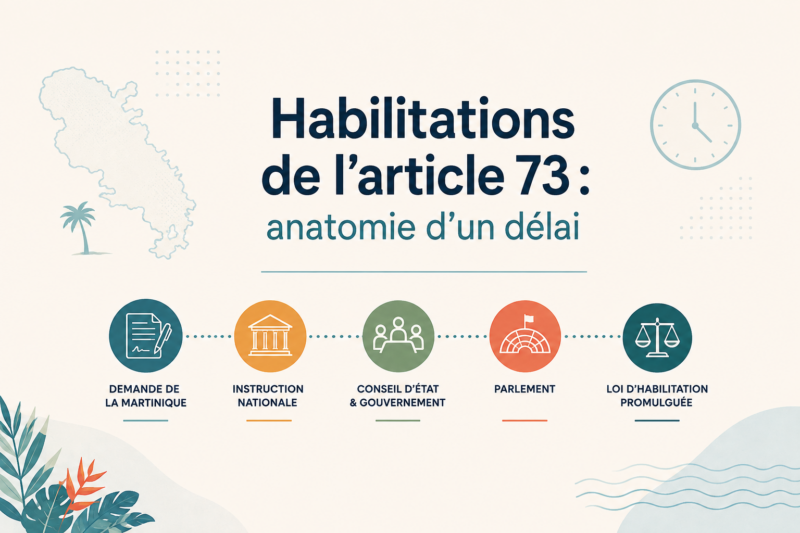
Recent developments in the energy, water, and sanitation sectors provide a clear illustration of the limitations of the authorization procedure set forth in Article 73 of the Constitution. Law No. 2026-574 of June 30, 2026, published in the Official Journal on July 1, finally met Martinique’s expectations. But it took nearly two years for water and two and a half years for energy before the territorial collectivity obtained—not the reform itself, but the right to set its own rules. A textbook case, just as the debate over Martinique’s regulatory authority is beginning.
First, we need to clear up a misunderstanding. Article 73 of the Constitution does not prohibit Martinique from enacting rules tailored to its specific circumstances; on the contrary, it empowers the territory to adapt certain national standards and, in a limited number of areas, to establish its own rules applicable within its territory. The local government has already done so in the energy sector—from the Martinique energy performance assessment to the regulation of ground-mounted solar power plants, including the inspection of air conditioning systems. The problem, therefore, is not the inability to act. It lies in the process that must be followed before action can be taken. And the history of the law of June 30, 2026, is particularly illuminating in this regard.
Thirty months for energy, twenty-three for water
On December 21, 2023, through Resolution No. 23-569-1, the Assembly of Martinique requested new authority in the energy sector: energy demand management, building energy efficiency regulations, the development of renewable energy, and sustainable mobility. This request is by no means a political expediency. The authorization obtained in 2011 expired in 2021, when the Assembly was renewed, and, as the Council of State noted in its opinion, Martinique’s energy regulations could no longer be amended as of that date, even though two European directives—the one of September 13, 2023, on energy efficiency and the one of April 24, 2024, on the energy performance of buildings—apply to Martinique in its capacity as an outermost region. Martinique’s decision was therefore formalized in late 2023; national authorization will not be granted until June 30, 2026—approximately thirty months later.
On July 26, 2024, through Resolution No. 24-200-1, the Assembly made a second request: to obtain the authority to create a single water and sanitation authority, responsibilities that are currently divided among three urban communities. Once again, this is a long-standing issue that has been addressed at the local level, and it was adopted by the Assembly of Martinique without opposition. The legislative response arrived on the same day as the one regarding energy: nearly twenty-three months had passed.
Where has the time gone?
The timeline holds a surprise. The two resolutions—the one from December 2023 on energy and the one from July 2024 on water—were not published in the Official Journal until July 2, 2025, eighteen months after the first and twelve months after the second; they were then combined into a single bill. The Council of State was not referred the matter until December 12, 2025, yet it issued its opinion as early as January 15, 2026. The bill was introduced in the Senate on January 19, under the fast-track procedure, adopted by the Senate on March 31, and then approved by the National Assembly on June 15. It was enacted fifteen days later.
This observation calls for a correction of a few common misconceptions.
It was not the Council of State that held up the bill: its review lasted one month. Nor was it a drawn-out parliamentary battle, since both chambers approved the text without major conflict, and the National Assembly did so without changing a single comma. Most of the time had elapsed earlier. For the energy bill, 922 days passed between deliberation and promulgation, of which 722 had already elapsed by the time the case was referred to the Council of State; for water, out of 704 days, 504 had also already passed. In both cases, between seven and eight-tenths of the total time elapsed prior to the legislative process itself.
It would be unfair, however, to conclude that the government deliberately held up the applications. Public records do not allow us to attribute each of these months precisely to the various government agencies, interministerial deliberations, or prior consultations. One thing is certain, however: once its application has entered the national process, the local government no longer has control over the timeline.
And after two years, the reform still needs to be carried out
This is the most striking paradox. What does the law of June 30, 2026, do? It does not create the single water and sanitation authority; rather, it authorizes the Assembly of Martinique to create it. Nor does it contain the new energy standards for Martinique: it authorizes the local government to adopt them. Nearly two years for water and two and a half years for energy will therefore have been required—not to carry out the reforms, but to obtain the right to carry them out.
y
This is where the structural weakness of the authorization lies: one must first go through the process that grants the power to decide, and then go through the process of making the decision itself. And the process must be repeated at each election, since the authorization is granted until the assembly is renewed and can be extended by law only once.
A precedent dating back to 2013
One might consider the events of 2026 to be exceptional. Martinique’s energy history suggests otherwise. The first authorization, granted under Article 18 of the July 27, 2011, law on the local authorities of French Guiana and Martinique, was valid for only two years: it expired on July 27, 2013. Two months before the expiration date, on May 17, 2013, the Regional Council adopted Resolution No. 13-752-6 requesting a new authorization regarding energy matters. It would not obtain this authorization until Article 205 of the Act of August 17, 2015, on the Energy Transition for Green Growth—that is, twenty-seven months later—and after two years during which Martinique had no regulatory authority in this area.
At the time, the local government had already pointed out that a two-year authorization was too short to carry out all the necessary regulatory work: an energy policy, by definition, requires regular adjustments. Guadeloupe reached exactly the same conclusion and, like Martinique, had to wait for the 2015 law. Two applications from Martinique, submitted ten years apart, thus took twenty-seven and thirty months, respectively, to process. It is therefore difficult to view the current situation as anything other than a scheduling glitch.
The authorization process can also be quick
In 2011, the regional council’s plenary assembly voted on its request on April 18; authorization was granted by the law of July 27, a little over three months later. The legislative framework was already in place: the bill concerning the local governments of French Guiana and Martinique was under discussion, and Martinique’s request was incorporated into it. Article 73 therefore does not automatically require a two-year waiting period: when the legislative framework is in place and the timelines align, the process can move quickly.
The problem lies elsewhere.
Local governments depend on the national agenda to obtain the authority they seek: they deliberate without knowing when their request will be incorporated into a bill or legislative proposal, when the text will be placed on the agenda, or when Parliament will make a decision. It is this procedural dependence—rather than a specific statutory deadline—that constitutes the system’s vulnerability. From this perspective, the 2026 law marks a turning point: for the first time, a bill has been entirely devoted to granting authority to a single overseas department and region, rather than waiting for the passage of a broader law. This represents progress in methodology, not in timing.
What Regulatory Authority Would Change
It is in this context that the debate sparked by the State-CTM framework agreement of July 1, 2026, must be understood. This agreement does not currently grant Martinique any additional powers; rather, it opens the door to negotiations. However, one possible approach is to grant the local government regulatory authority in predefined areas, without the need to seek parliamentary authorization each time.
The difference would be fundamental.
If energy or water management were already part of such a domain, Martinique would still have to assess, consult, draft, and vote on its own standards; it would remain subject to the Constitution, European law, and judicial review. But it would no longer have to seek prior authorization to adopt them. The debate, therefore, is not between oversight and the absence of oversight: it pits two frameworks against each other—prior authorization followed by oversight of the standard, or prior delegation of authority followed by oversight of the standard.
Don't ask status for what it cannot give
This obviously does not mean that a single regulatory body would miraculously resolve the water crisis or energy challenges. Creating a single authority will remain a complex undertaking: it will require addressing finances, personnel, networks, assets, investments, and responsibilities. A bad local decision does not become a good one simply because it is local—and the criticism voiced in Martinique against the single authority proposal, including by former industry leaders, serves as a reminder that fundamental disagreements do not disappear simply because of jurisdictional authority.
In fact, there are several possible solutions to the issue of authorizations:
shorten processing times, impose a processing deadline on the government, streamline renewals, extend their duration, or directly delegate certain authorities. The experience from 2023 to 2026 does not, therefore, demonstrate on its own that the institutional reform currently under discussion is the only possible path. It demonstrates something else.
When No One Says No
Martinique makes the request. The government finally gives its approval. The Council of State finds no constitutional or treaty-based obstacles. The Senate approves. The National Assembly votes in favor. The fast-track procedure is initiated. And yet, it took nearly two years for water and two and a half years for energy before the local government obtained the authorization it sought. It is precisely because no one in the national system ultimately said no that this example is so revealing: the opposition—which was genuine—was voiced in Martinique and centered on the substance of the single-authority project, not on the principle of authorization itself.
The problem with these authorizations is therefore not that they prevent Martinique from making decisions: they have enabled the region to establish genuine local standards. The problem is that, in certain areas, they require Martinique to first request the right to make decisions—and to go through this process again at the start of each term of office.
Therefore, the real question regarding normative power can be posed without slogans or accusations of ulterior motives: In precisely defined, non-sovereign areas, and under judicial oversight, should Martinique continue to periodically seek authorization to establish rules tailored to its specific circumstances, or should this authority be granted to it on a permanent basis? The law of June 30, 2026, does not answer this question. But given the time it took to secure it, it plays a powerful role in raising it.
Gérard Dorwling-Carter –