


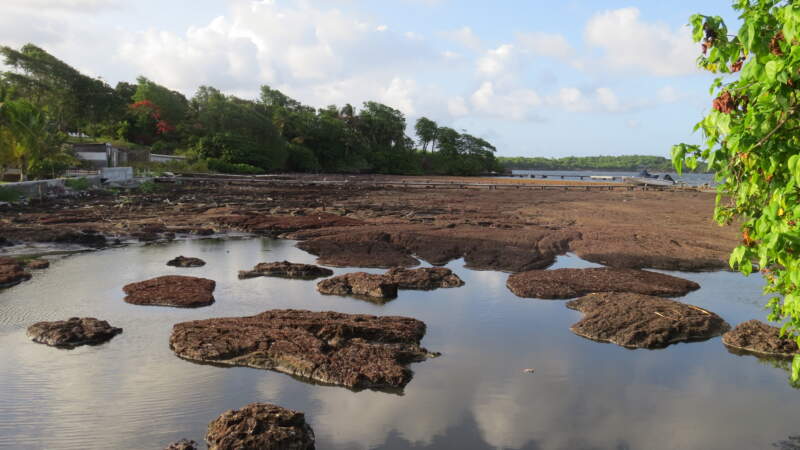
While the government is currently preparing the third National Plan to Prevent and Combat Sargassum and has been conducting a public consultation in Martinique for several weeks, many residents of the most affected areas continue to speak out against a situation they consider to have become unbearable.
In this op-ed, published under the initials MOB, a resident of the Atlantic coast of Martinique, the author draws on her own daily experiences, official data, and various scientific publications to express her concern about the health, environmental, and social consequences of massive Sargassum strandings. She calls on public authorities to make the protection of local populations a priority in the upcoming Sargassum Plan III.
Philippe Pied
On the eve of the publication a third Sargasso Sea plan,..
Ladies and Gentlemen,
This can't go on like this!
We can no longer continue to endure the situation we face day after day: falling asleep in H2S gas, waking up in H2S gas, living in H2S gas with headaches, stomachaches, nausea, vomiting, burning eyes, a sore throat, and lung irritation, and having to take antihistamines, vasodilators, and pain relievers all the time…
What I am describing to you here, ladies and gentlemen, is what the High Council for Public Health (HCSP) has been describing in its opinions since 2012—the chronic low-dose effects include (notably May 20, 2016):
- Digestive problems: nausea, vomiting,
- Abdominal pain
- Neurological symptoms: headaches, dizziness, fatigue, difficulty concentrating
- Irritation: eyes, nose, throat…
That’s exactly the triad: abdominal pain + dizziness + nausea. This has been termed the «Sargassum toxidrome,” as described in scientific publications by Professor Résière (CHUM, president of the CRPPE) and his team.
The Regional Health Agencies (ARS) of Martinique and Guadeloupe have published information in the «Sargassum and Health» fact sheets (available to the general public)
« H2S and NH3 emissions can cause: headaches, nausea, vomiting, dizziness, eye and throat irritation, and fatigue« … as well as the risk of much earlier—and therefore more severe—preeclampsia in the newborn… and many other symptoms…
They also talk about « symptoms that disappear upon moving away from the stranding site. So The link between exposure and symptoms is recognized by the ARS.
Exposure has been proven : Madininair recorded 913 instances in which the H2S threshold of 1 ppm (the level must be below 0.03 ppm) was exceeded in 2025, with peak concentrations of up to 11.73 ppm, which the network classified as « pollution spikes« .
The symptoms are well-known: The ARS and the HCSP list them.
The GOVERNMENT cannot say, «We didn’t know the effects.» The Regional Health Agency (ARS) has been informing the public since 2015. The medical professionals on the CHUM’s scientific committee have been calling for the application of the precautionary and preventive principles since 2018!
The causal link has been scientifically established.
The emergency is characterized by : The exhibition continues, and the unrest is escalating.
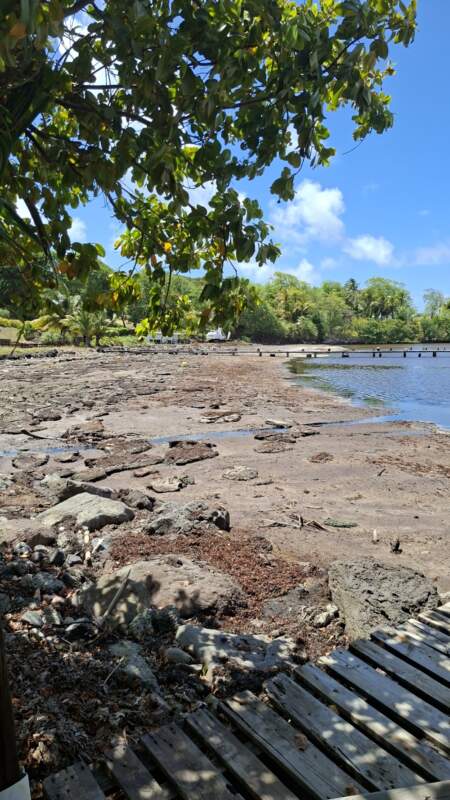
The government must take all necessary measures to put an end to the exhibition.
Now, however, the Chair of the Scientific and Technical Council—an advisory body composed of experts and affiliated with GIP Sargasses Martinique—publicly stated on the May 28, 2026, evening news that « »This year has seen an extremely high volume of Sargassum. We’ll have to get used to this kind of year, which is somewhat of a record"… We’ll need to put a number of measures in place to perhaps clear the coastlines and thus try, whenever possible, to shift activities inland… In Martinique, we have 34 municipalities, 27 of which are coastal. The Sargassum is forcing us to rethink our approach to coastal development… We need to fundamentally rethink the tourism industry…, placing much greater emphasis on eco-tourism and nature-based tourism”…
These comments are off-topic: the issue at hand is the lives and health of the people of Martinique today. The issue is the health and environmental crisis.
Let's now get to the heart of the matter :
Article L 541-1-1 of the Environmental Code defines waste as «any substance that the holder discards or intends to discard.».
According to Mr. SAFFACHE (who later wrote that this was the government’s position) «Sargassum seaweed is not considered true ”pollution» but rather waste; this means that when the sargassum rots on the ground, municipalities collect it, remove it, and bury it. They treat it as waste.”.
Therefore, for local governments, given their responsibilities: waste = an obligation to collect and treat it.
Gold The Court of Justice of the European Union holds that natural substances can constitute pollution if they cause harm to health and the environment. This is indisputable:
- Scientific studies show that Sargassum seaweed, which drifts near the coast, is contaminated with heavy metals (arsenic, cadmium, lead, etc.);
- The ARS recognizes the phenomenon as «air pollution.».
- Etc.,…
The government has an obligation to achieve specific results in the area of public health (Article L2211-1 of the General Code of Local Authorities).
Inaction, or action that is manifestly insufficient, on the part of the government may be deemed wrongful.
The government is trying to have it both ways here:
1) This is waste → municipalities are responsible for collection
2) This is not industrial pollution → therefore, the government is not liable.
However,
The government cannot make the highly questionable claim that «it’s natural, so it’s not pollution,» when in fact:
1) The organization it has accredited, Madininair, refers to «pollution peaks,»
2) monitors this as air pollution, using thresholds set by the HCSP (High Council for Public Health),
3) which acknowledges that it is a «toxic gas» with «health impacts.».
As for me, I say: they're seaweed that arrive contaminated, which, if left to wash ashore and rot where they land, become waste that generates a H₂S air pollution (and perhaps many other toxic gases) and whose leachate is a potentially long-term pollution the environment … and I say that the government is not providing adequate resources commensurate with the gravity of the situation to prevent this pollution, despite its obligation to protect the environment and public health.
The government must take appropriate measures to stop this pollution in every affected municipality in Martinique.
Indeed, this can't go on any longer:
- At the same time, municipalities are being strangled by the Sargasses budget;
- At the same time, fish populations are being suffocated by the lack of dams at many sites;
- At the same time, communities are being suffocated by waste stored in densely populated areas;
- At the same time, they are suffocated by the lack of current upstream of the dams, causing them to break free and wash up on the shore.
- At the same time, the on-site cleanup carried out by the Hommes et Territoire association resembles the Danaids’ barrel (a process ill-suited to large-scale cleanup)…. constituting a waste of resources and an indecent exposure of employees to toxic gases…..
The extreme public health emergency requires that H2S levels be reduced to virtually zero throughout the entire territory of Martinique.
The installation of barriers—the only solution for completely eliminating H₂S pollution at most affected sites—must be accompanied by upwind monitoring of the barriers and a health and technical monitoring system capable of responding 7 days a week.
Dams that aren't monitored or maintained are a FAILURE.
The people of Martinique are waiting for a third Sargassum plan that is commensurate with the health, environmental, social, and economic crisis they are facing day after day.
MOB, a frustrated and exasperated resident, June 5, 2026