



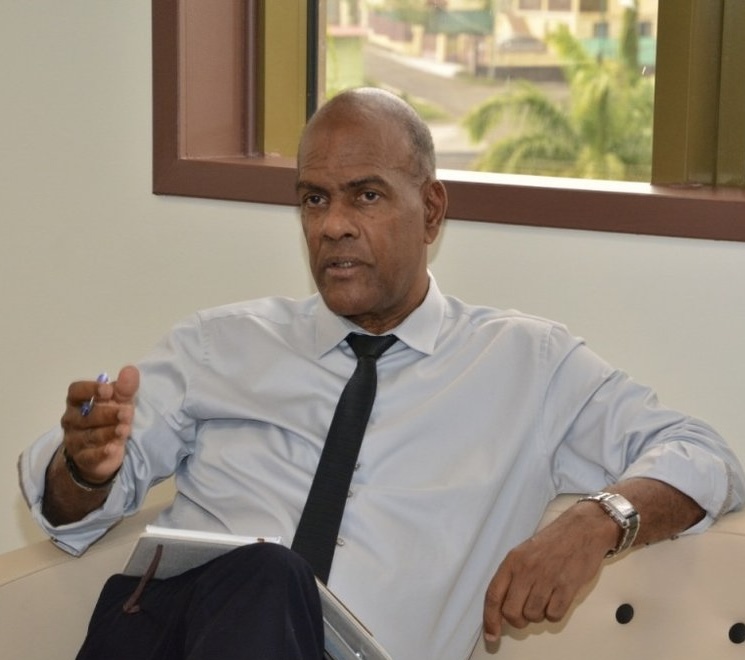
On the eve of Minister Retailleau’s visit, the president of the Executive Council of the Territorial Collectivity of Martinique (CTM), Serge Letchimy, once again sounded the alarm about the scale of drug and arms trafficking affecting the territory and, beyond that, the entire Caribbean region. While he acknowledges some recent progress by the French government—including the installation of maritime radar systems, the signing of agreements, and announcements of increased enforcement—he considers the measures «insufficient and out of step with the urgency of the local situation.».
Vulnerable entry points and inadequate controls
According to him, Martinique has nearly fifty potential entry points: fishing ports, marinas, and informal unloading areas. At the port of Fort-de-France, only 1,000 containers out of 188,000 are inspected each year—less than 1.%. «We can’t pretend to secure a territory with numbers like these,» he laments.
At Aimé-Césaire Airport, the promise of a «100 % screening» remains largely theoretical: the available human and technical resources do not allow for the screening of all aircraft or all passengers. A new scanner system is set to be deployed, but the president of the CTM fears these will be «empty promises.».
A Call for an Integrated Strategy
For Serge Letchimy, the answer cannot be limited to law enforcement: «We need to implement a comprehensive strategy that integrates security, the economy, education, and culture. » He emphasizes the link between illicit trafficking and underdevelopment: youth unemployment, the informal economy, educational deficits, and the loss of social norms. «As long as we fail to address the dignity and future of young people, we will remain trapped in the illusion of a »security-first’ approach.”
The Need for Regional Coordination
The president of the CTM is calling for an interministerial meeting to be organized, as well as the creation of an interregional body involving Guadeloupe, French Guiana, and neighboring Caribbean countries — Saint Lucia, Dominica, Trinidad and Tobago — in order to better coordinate efforts to combat cocaine trafficking routes from South America.
A political issue as much as a security issue
Behind this rhetoric lies a political strategy: Serge Letchimy is seeking to position himself as a regional spokesperson—beyond the confines of Martinique alone—while criticizing the sluggishness and centralization of Paris. He intends to make the CTM a key player in any future solution.
«Martinique cannot be an isolated island, at the mercy of criminal networks. This is a matter of sovereignty, but also of social and economic survival,» he concluded.
Jean-Paul BLOIS