



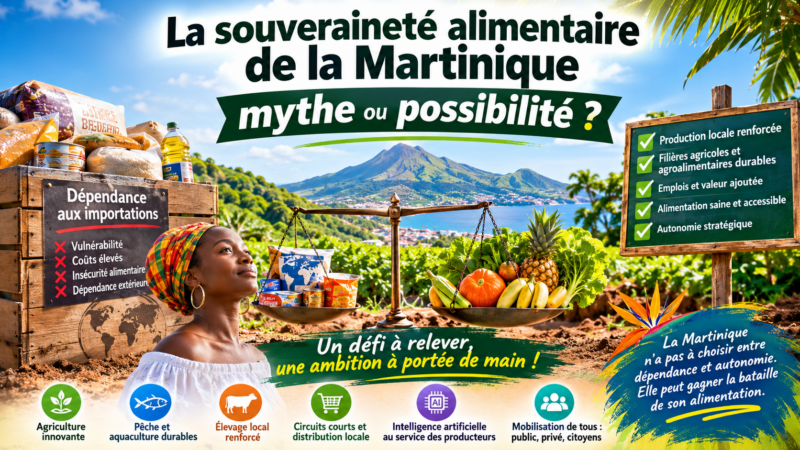
Producing more fruits and vegetables, expanding aquaculture, or bringing land back into cultivation will not be enough to bring about a sustainable transformation of Martinique’s food system. Behind the concept of food sovereignty lies a much broader question: what kind of development model do we want to build? Agriculture, employment, health, education, innovation, the environment, and Caribbean cooperation can all converge around a single goal—generating more value within the territory while reducing certain dependencies.
Moving the Debate on Food Sovereignty Beyond the Agricultural Context
When we talk about food sovereignty, the discussion almost immediately turns to farmers.
How many are there? How many hectares do they farm? What do they produce? What kind of subsidies do they receive?
These questions are essential. But they are no longer enough.
Because food affects the entire economy. Behind every agricultural product lie land, water, energy, transportation, processing, trade, the restaurant industry, research, training, and, ultimately, health.
An ambitious food policy therefore touches on virtually every aspect of territorial development.
This may be the main shift in perspective proposed by the Atelier du Chef Mika’s Discussion Paper: to view food sovereignty not as yet another sectoral policy, but as an initiative capable of coordinating various public policies around a single objective.
Creating More Value in Martinique
Food addiction is, first and foremost, a drain on one's value.
Every product that could reasonably be produced or processed in Martinique but is purchased elsewhere represents a portion of household spending that leaves the territory.
It would obviously be unrealistic—and economically undesirable—to try to produce everything locally. No modern region operates in a self-sufficient manner.
Food sovereignty does not, in fact, mean the end of trade.
The real question is determining what should be produced locally and what will still be more efficient to import.
Fruits, vegetables, tubers, certain animal proteins, seafood, and processed food products offer different opportunities. Not all of them have the same economic potential or face the same land-use constraints.
The objective must therefore be selective: produce here what we have a reasonable advantage in producing here.
Agriculture can once again become an industry with a bright future
This transformation immediately raises the question of who—men and women—will produce this food.
The aging of farmers is one of the main challenges facing agriculture in Martinique. Only 9 % of farm managers are under 40, according to data cited in the Discussion Paper.
Food sovereignty therefore depends directly on generational renewal.
But attracting young people to agriculture requires changing the profession’s image and economic conditions.
A farming sector that offers low pay, relies on complex subsidies, and faces ongoing land-related challenges will struggle to attract a new generation.
Conversely, agriculture that combines technology, processing, organized distribution channels, and predictable income can once again become an entrepreneurial venture.
In fact, the farmer of tomorrow won’t necessarily be just a producer. He or she could be a processor, a direct seller, a tourism operator, an energy producer, or an agricultural data manager.
A New Generation of Entrepreneurs
This is where food sovereignty ties directly into the issue of entrepreneurship in Martinique.
Many different industries can develop around agriculture, including food processing, cold storage, logistics, food service, packaging, agricultural software, equipment maintenance, aquaculture, and organic waste recycling.
The farm thus becomes the first link in a much broader economic ecosystem.
This approach also helps move away from the view that agricultural development depends exclusively on traditional farms.
Engineers, computer scientists, biologists, chefs, logistics professionals, and entrepreneurs can participate in this food economy without being farmers themselves.
Food sovereignty can thus become a policy for fostering entrepreneurship as much as it is an agricultural policy.
Digital Technology Comes to the Fields
This trend is already underway in many agricultural regions around the world.
Sensors that measure soil moisture, weather forecasting tools, yield analysis, drones, marketing platforms, traceability systems, and management software are helping to gradually improve productivity.
In a region where farmland is scarce, this optimization is particularly important.
The goal is not to produce more and more at any cost, but to use available land, water, and inputs more efficiently.
Artificial intelligence could, in particular, help predict certain harvests, better align supply with demand, or improve logistics management.
It will not replace either the farmer or the agronomist.
But it can help address one of the traditional weaknesses of small island economies: the lack of information needed to precisely coordinate production and consumption.
Martinique is not alone
Food sovereignty does not mean, however, that Martinique should turn in on itself.
On the contrary.
Its Caribbean environment can serve as a source of cooperation, technology, and complementarity.
Guyana holds a special place in the thinking of Chef Mika’s Workshop. Its food self-sufficiency and recent agricultural investments make it an interesting case to study.
But Martinique has neither the same land area nor the same land resources.
So this isn't about copying Guyana.
The value lies instead in the exchange of experiences: tropical rice cultivation, aquaculture, water management, climate-adapted seeds, the organization of smallholder farmers, and diversification policies.
European cooperation programs can facilitate this type of partnership between Martinique and its regional neighbors.
Caribbean cooperation thus takes on an extremely practical dimension: learning from regions facing similar challenges and working with them to develop certain industry clusters.
Improving Production in the Face of Climate Change
Any food strategy, however, will have to take into account a constraint that will become increasingly significant: the climate.
The Discussion Paper notes that in 2021, Martinique experienced its second-driest year since 1948, with precipitation approximately 30 % below normal.
He also notes that only a small proportion of vegetable crops are irrigated.
The issue of water is therefore inextricably linked to that of food sovereignty.
Increasing production without ensuring a reliable water supply would expose farmers to growing risks.
The selection of crop varieties, agroforestry, water conservation, sustainable irrigation, and techniques for preserving soil moisture should gradually become standard components of agricultural policy.
Food sovereignty can only be sustainable if it also serves as a climate adaptation strategy.
Agriculture and Public Health
The other aspect is health-related.
A food policy should not only aim to increase the quantity of locally produced food; it should also improve its nutritional quality.
Like many developed regions, Martinique sees a significant presence of processed foods in consumer habits.
Expanding access to fruits, vegetables, legumes, and other locally grown produce can therefore contribute to a prevention strategy.
Agriculture and public health share a common goal in this area.
This connection is particularly important in school meal programs, where food policy can simultaneously support producers and contribute to children’s nutrition education.
Measuring What We Really Want to Achieve
One key challenge remains: How can we tell if Martinique is truly making progress?
The target of 80 % proposed for 2036 in the Discussion Paper serves as a motivating goal, but it must be accompanied by much more precise indicators.
The overall food sovereignty rate can, in fact, mask very different situations depending on the specific food products.
It would be more useful to regularly monitor local production of fruits, vegetables, tubers, fish, meat, eggs, and other strategic agricultural products.
In addition to these data, the following should be included: the area of farmland actually under cultivation, the number of farms established by young farmers, the share of local products in institutional food service, available processing capacity, and trends in imports.
A strategy truly exists only when its results can be measured.
Making Food a Development Policy
Food sovereignty alone will obviously not solve Martinique’s economic difficulties.
It will not eliminate imports. It will not make it possible to produce all the food consumed locally. Nor will it transform, in just a few years, an economic system that has been built up over decades.
But it has a rare feature: it connects problems that are usually addressed separately.
Land. Agriculture. Employment. Training. Industrial transformation. The high cost of living. Health. The environment. Innovation. Caribbean cooperation.
They all come together around an extremely simple question: What percentage of what we eat do we want to be able to produce ourselves?
To answer this question seriously would require Martinique to set priorities, coordinate its funding, and measure the results achieved.
Food sovereignty would then become much more than just an agricultural goal.
It could become one of the driving forces behind a new phase of development in Martinique—one that is more productive, more innovative, and more deeply rooted in both its local community and the Caribbean region.
The climate data used are those included in the workbook: 1,482.5 mm of precipitation in 2021, which is about 30 % below normal, and only 5 % of irrigated vegetable crops. Chef Mika’s Workshop Discussion Paper_May 2026(1).pdf The document also explicitly explores the potential of digital technology and AI for crop forecasting, traceability, and irrigation optimization.
Primary source: Discussion Paper by Atelier du Chef Mika, «From Dependence to Food Sovereignty: Martinique Faces the Challenge of French Guiana—Strategy, Leverage Points, and Roadmap for 2036,» May 2026.