




Herodote Website
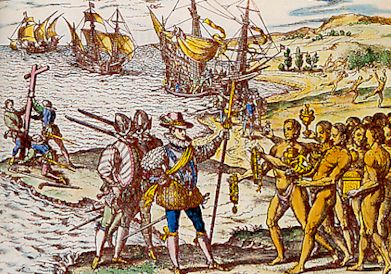
The current Republic of Haiti is the successor to the French colony of Saint-Domingue. Located in the Greater Antilles, it occupies the western third of the island of’Hispaniola, deformation of the noun Spanish Islandthat his discoverer had given him Christopher Columbus December 6, 1492.
As the first independent Black nation of the modern era, Haiti is also the poorest country in the Western Hemisphere today. As large as Belgium (27,750 km²) and home to 12 million people (2020)—not counting a large diaspora in North America and Europe—it suffers from a lack of stable state institutions and widespread insecurity. For lack of a better alternative, Western NGOs do their best to ensure the survival of the population, thereby discouraging them from taking charge of their own lives.
Click to enlarge
 The West Indies are a string of islands between North America (the Florida Peninsula) and South America. Between the archipelago and the Central American isthmus lies the Caribbean Sea, named after a Native American people—a name also used by the Anglo-Saxons to refer to the West Indies themselves. The Antilles are subdivided into the Greater Antilles (Cuba, Jamaica, Hispaniola, Puerto Rico) and the Lesser Antilles (Windward Islands and Leeward Islands).
Christopher Columbus founded Hispaniola
In 1496, Christopher Columbus's brother, Bartolomeo, founded the first permanent settlement on Hispaniola. He named it Nueva Isabela in honor of Queen Isabella of Castile. In 1502, the city was destroyed by a hurricane and rebuilt under the name of Santo Domingo de Guzmán, this time in tribute to Saint Dominic. Hence the names of Santo Domingo and Dominican Republic, which today shares the island with the Republic of Haiti.
The name ’Haiti" comes from’Ayiti, or Land of High Mountains, the name given to the island by its first inhabitants, a peaceful tribe of Native Americans Taínos, from the group of Arawaks. All of them tragically perished within a few years, victims of European colonization (forced labor, malnutrition, persecution, and disease) as well as the invasion by the fearsome cannibalistic Indians of the Caribbean who had come from the neighboring islands. From one million in 1492, the Native American population had dwindled to just about a hundred by 1570.
Hispaniola was brutally exploited from the moment the Spanish arrived. In 1493, Christopher Columbus went to the Canary Islands to obtain sugarcane seedlings and brought them back to Hispaniola. The island thus produced more and more sugar, reaching 1,000 metric tons in 1570, but competition from Brazil caused production to drop to just 125 metric tons by 1625…
In 1494, a Spaniard discovered gold nuggets in the Cibao Mountains, in the heart of the island. As a result, Christopher Columbus demanded that every Native American over the age of 14 turn over the equivalent of one gold coin every three months. Impossible. At most, the island managed to produce 276 kg of gold in 1501.
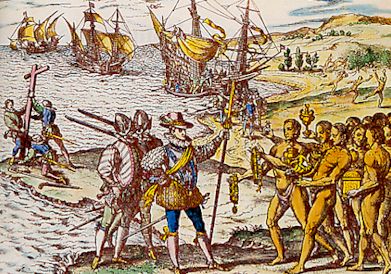
The Spaniards are settling in
In 1508, Santo Domingo became the seat of the Viceroyalty of the Americas and the center of Spanish colonization.
Eager to get rich as quickly as possible before returning home, the first Spaniards were granted land along with the right to put the indigenous people living there to work. This was the principle of the distribution. Gold mining in the subsoil and rivers proved to be very productive at first, yielding as much as 500,000 gold écus a year for Spain.
African slaves began arriving as early as 1502 to replace the Indigenous people on plantations and at gold mines.
Surviving Native Americans and Black people did not hesitate to revolt. Thus, a cacique (an Indian chief) named Henri took refuge in the mountains with his Indian and Black companions and managed to maintain his independence for 13 years. This marked the beginning of the slave run, the name given to slaves who fled into the forest (from the Spanish cimarrón, which means (fugitive Black slave).
The indigenous population disappeared within a few decades. A few Native Americans assimilated through intermarriage with newcomers from Europe and Africa.
In 1535, Governor Nicolas Ovando brought sugarcane seedlings from the Canary Islands and encouraged their cultivation to compensate for the depletion of gold deposits.
Without realizing it, we are living today, in part, off the legacy of the unfortunate Taínos. They have bequeathed to us part of their diet: cassava, yams, sweet potatoes, tobacco, and corn. They have also left us some beautiful examples of their art.
Finally, a lot of words Taínos have become part of our everyday vocabulary: barbecue (from barbacoa, a wooden rack for grilling meat), buccaneer (from noise, a place for cooking meat), hammock (from hammock), savanna (from savanna, treeless plain), hurricane (from huracan), tobacco (from tobacco), potato (from potato), guava (from guava), papaya (from papaya), corn (from corn) etc.
The buccaneers hand over the island to France
In the 17th century, French buccaneers began settling on the neighboring island of La Tortue. They pompously called themselves the «Brothers of the Coast». These are hunters who get their name from the fact that they eat noise, that is, smoked dried meat. They were also pirates and privateers who preyed on the precious metals that the wealthy Spanish galleons were transporting from Mexico to Spain. Their presence—numbering nearly 3,000—caught the attention of King Louis XIII and his minister Richelieu.
Until then, the French government had shown little interest in colonial conquests, with the exception of the exploration of Canada and the Occupation of Martinique. He merely encouraged his privateers, who attacked and plundered Spanish ships laden with riches from the New World or slaves from Africa (the «imports from India»).
On August 31, 1640, with the discreet support of their government, French buccaneers drove their English rivals off Tortuga and landed on the northern part of the island of Hispaniola. A few months later, the Huguenot Le Vasseur occupied Tortuga on behalf of France. In 1642, the Chevalier de Fontenay took possession of western Hispaniola in the name of King Louis XIII.
In the new French colony, plantations thrived in the island’s tropical climate: coffee, tobacco, cocoa, indigo… But sugarcane—the true “white gold” of the 18th century—tended to dominate over other crops.
A governor, Bertrand d’Ogeron, summoned some «committed» Europeans to work on the plantations alongside African slaves and under the same conditions. Unlike the Africans, these men, nicknamed «Bas-Rouges» are paid and set free after 36 months. But the planters soon give up on this workforce, which has a hard time coping with the tropical climate.
In 1697, King Louis XIV legally acquired the western part of Hispaniola under the Treaty of Ryswick, which ended the War of the League of Augsburg. This acquisition marked the true beginning of France’s colonial ambitions.

A thriving colony
Its official name is «The coasts and islands of Santo Domingo in Leeward America», the colony quickly became the most prosperous of France's overseas possessions thanks to its coffee, indigo, and sugarcane plantations and its large number of Black slaves.
 On the eve of the French Revolution, Saint-Domingue accounted for nearly three-quarters of the world’s sugar trade! It was also the leading exporter of coffee. In 1788, its foreign trade, valued at 214 million francs, exceeded that of the United States and accounted for one-third of France’s total trade.
The colony has nearly 600,000 inhabitants, including 40,000 freed people—mostly people of mixed race—and 500,000 Black slaves. Freed people do not have the same rights as the colonists but enjoy a certain degree of affluence and sometimes even own slaves.
Black slaves were brought to the island as part of the milkAtlantic, the term used to describe the slave trade carried out by Europeans. From 10,000 per year in the mid-18th century, the number of slaves arriving reached a staggering rate of 30,000 per year in the years leading up to the Revolution, peaking at 60,000 in 1787! As a result, the majority of the slaves in the «homes»(plantations) are still captives born in Africa…
The demographic ratio is becoming more favorable to the slaves than in any other colony, with only one white person for every ten slaves, compared to one for every seven in Guadeloupe and one for every six in Martinique.
At the same time, the Spanish part of the island, Santo Domingo, is in decline and has a population of barely a few tens of thousands.
From Insurrection to Independence
The French Revolution turned the island’s fortunes upside down. On May 15, 1791, in Paris, the National Assembly tentatively granted the right to vote to certain free men of color. This half-measure alarmed the white colonists of Saint-Domingue, who were considering declaring their independence. Nor did it satisfy the freedmen. The two sides clashed violently.
The French commissioners Sonthonax and Polverel reluctantly proclaimed the general emancipation of the slaves. Seeing this, some plantation owners called on the British for help.
Fortunately for France, the Black leader Toussaint Louverture defected from the Spanish side to join revolutionary France. With the rank of general, he fought the British and drove them off the island. Prosperity soon returned. It is true that the island’s new ruler forced his fellow Black people to work as wage laborers on the plantations where they had previously been slaves.
On July 8, 1801, Toussaint Louverture proclaimed the island’s independence and appointed himself Governor-General for life of the new Republic. The First Consul was not at all pleased with this move. He assembled a powerful expedition to put an end to it.
The Pangs of Independence
After Toussaint Louverture was handed over to the French and sent to die in a freezing fort in the Jura Mountains, it fell to one of his lieutenants, Jean-Jacques Dessalines, to drive out the French and proclaim once and for all the’the island's independence January 1, 1804. Haiti thus became the second independent nation in the Americas after the United States and the world’s first black republic. But it still had to gain acceptance by the international community «civilized»…
As early as September 22, 1804, the hero of the independence movement had himself proclaimed emperor under the name Jacques I in a pitiful farce modeled after Napoleon. His excesses sparked an uprising, and the emperor was killed in an ambush on October 17, 1806. This marked the beginning of a power struggle between the mulatto minority and the black majority that has continued unabated to this day.

Henri Christophe, himself a former Black slave, succeeded Dessalines in the north of the island, while the south fell under the rule of a mulatto, Anne Alexandre Pétion. Christophe, who had been crowned king as Henri I in 1811, was forced to commit suicide in 1820. He shot himself in the head… with a gold bullet!
Pétion reunified the island, except for the eastern part, which Spain had reclaimed in 1814 following the fall of the French Empire. Having learned from experience, he maintained the republican form of government. He also actively supported the Spanish-American Creoles at war against Madrid and allowed the foremost among them, Bolívar, to rebuild his forces in Haiti. Upon his death on March 29, 1818, another mulatto succeeded him: Jean-Pierre Boyer. He would govern the Haitian Republic for a quarter of a century, until his downfall in 1843.
After the white settlers in the Spanish-controlled part of the island declared their independence from Madrid on November 30, 1821, Boyer gave them no time to savor their independence and immediately annexed their republic. The republic would regain its independence for good after the fall of the Haitian president, under the name of Dominican Republic. The president continued to resolve the dispute with the former colonial power and, in 1825, agreed to pay a hefty indemnity (150 million gold francs) in installments.
After the Jean-Pierre Boyer's escape, on February 13, 1843, and following a new period of anarchy, a 65-year-old Black military officer, Faustin Soulouque, established himself in 1847 as… emperor under the name Faustin I. He, in turn, was overthrown and driven out in 1859. With the return of the Republic, the mixed-race plantation owners, who had grown wealthy through coffee cultivation, imposed their rule over small farmers and Black workers. Inequalities widened.
Poor agricultural practices accelerate deforestation and soil erosion on slopes, thereby rendering the soil infertile. Small farmers are becoming even poorer as a result. Social tensions are escalating as never before. Peasant revolts are on the rise…
The government in Washington was concerned about this chronic instability on its doorstep and decided to take action to remedy the situation. On July 28, 1915, the Marines arrive in Port-au-Prince. These troops would attempt to restore order on the island—not without resorting to brutality—while American civilians and businesspeople worked to rebuild the economy, infrastructure, and government. Having lost hope of completing their mission, the American troops left the island on August 21, 1934, on the orders of President Roosevelt.
The Return of Instability
After the Americans left, the island returned to its old ways, and coups d’état followed one after another. On December 12, 1956, President Paul Magloire left the country, leaving the state coffers empty and the nation once again on the brink of civil war.
 On October 22, 1957, the rise to power of François Duvalier, a 50-year-old Black country doctor and ethnologist, raised hopes of a way out of the darkness. But those hopes were soon dashed…
The new president establishes a bloody, nepotistic dictatorship with the support of a private militia, the «Tontons Macoutes.». Through sheer stubbornness, he secured from the Vatican the right to appoint the country’s Catholic bishops himself, and had no qualms about handing the bishoprics over to outright «macoutes» just as accommodating toward the dictator as they were toward the voodoo priests.
In 1971, upon his death, he handed over power to his son, the thoroughly mediocre Jean-Claude Duvalier (age 19). The new president for life, married to a member of the mulatto bourgeoisie, was driven out to France in 1986 by a popular uprising.
Betrayed Hope
On December 16, 1990, after several years of turmoil, the father Jean-Bertrand Aristide (age 37) was elected president. The democratic election of this human rights activist was greeted with enthusiasm by the global democratic community, which began to hope for a change of course in Haiti. But his missteps led to the priest being overthrown in a bloody military coup on September 29, 1991.
Aristide returned to power in U.S. Army trucks, with the blessing of the United Nations, on September 19, 1994. But no sooner had the U.S. military and UN peacekeepers left than the former «pastor of the »slums" is reviving the dictatorial and bloody practices of his predecessors. Stripped of his priestly status and married to a lawyer from the mulatto bourgeoisie, he shamelessly plunders the state coffers while the people rely on Western charities for their survival. One ends up longing for the Duvalier dictatorship and losing all hope in the Haitians’ ability to govern themselves!
Aristide, in turn, was ousted from power on March 1, 2004, as U.S. troops once again landed in Port-au-Prince. Aristide’s successors resumed his practices: corruption, nepotism, and incompetence.
A Future Cut Off
There is no reason to expect a bright future for a country with a population of about 10 million (the size and population density of Belgium), plagued by deforestation, AIDS, poverty, corruption, and the lingering pain of a tragic history.
The well-watered and once-fertile lands have been eroded and rendered barren by archaic agricultural practices (slash-and-burn farming). The situation has reached the point where agricultural production today is reportedly half what it was during the era of slavery. Seen from the air, the border separating Haiti from the Dominican Republic is striking: on one side, the ochre of leached, barren soil; on the other, the soft green of crops and forests.
The population is overwhelmingly illiterate, and the widespread use of Creole—which is primarily an oral language—discourages literacy campaigns.
Western countries—France foremost among them—are wondering how to come to the aid of this country, for whose misfortune they bear some responsibility. They waver endlessly between the duty support, the right to intervene, the placement under guardianship and a recolonization that nobody wants.
These same countries are tempted to shift the responsibility for maintaining order and ensuring the functioning of society onto the United Nations and charitable organizations (NGOs) at the very least state institutions. The island becomes, so to speak, a protectorate of the NGOs, which thereby justify their existence to their donors.
What remains is the warmth of a culture unlike any other: a language, the Creole, and a religion, the voodoo, which preserve—closely intertwined—memories of French colonization and African origins; a matriarchal society where women often raise children by different fathers on their own; colors that adorn the walls in naive paintings of immense creative richness.
Bibliography
There are few books in French on the history of Haiti, no doubt because historians and citizens in France are reluctant to address this inglorious chapter of their own history.
The most interesting book is the one by Jean Metellus, a Haitian writer in exile: Haiti, a pitiful nation (250 pages, Denoël, 1987).
Above all, Haiti suffers from the absence of a state. Its bourgeoisie (one hardly dares to speak of’«elites») doesn't know what the’«national interest» and the «public good». Shamelessly plundering foreign aid, this foreign-educated bourgeoisie harbors a deep contempt for the people. It has no interest in investing in tourism, agriculture, or industry, unlike the Dominican Republic neighboring country, with which it has long shared a common history (slavery, wars, etc.).
During the devastating earthquake of January 12, 2010, government officials and even most Haitian doctors were nowhere to be found. They left it to foreigners to rescue the victims, all the while rubbing their hands in anticipation of international aid: $11 billion in aid pledges—a very high ratio of $3,000 for each of the 3 million Haitians affected by the earthquake.
Ten months after the earthquake, and with a cholera epidemic ravaging the country, this windfall—which has evaporated or been squandered within the administrative structures of NGOs and donor nations—has yet to bring relief to anyone. And the population, rooted in a culture of dependency and accustomed to receiving aid, does not even bother to clear away the rubble or begin rebuilding homes with their own hands. They remain at the mercy of mafia clans, which make and break governments. It was one of these gangs that assassinated President Jovenel Moïse—who was himself in their pay—on June 7, 2021.
The administration relies entirely on foreigners. Thus, the NGO Doctors Without Borders Does it run health services with Western volunteers, even though most Haitian doctors go to Europe or North America in search of the comfortable lifestyle they feel they are entitled to?.


 From Hispaniola to Haiti
- Toussaint Louverture

- • August 23, 1791 : Slave revolt at Bois-Caïman
- • November 18, 1803 : Haiti Expels the French
- • January 1, 1804 : Haiti's independence

- • July 11, 1825 : France Orders Haiti to Pay Compensation
- • February 13, 1843 : Jean-Pierre Boyer's escape
- • February 27, 1844 : Secession of Saint-Domingue
- • July 28, 1915 : the naval arrive in Port-au-Prince
- • October 22, 1957 : Dr. Duvalier's rise to power
- • December 16, 1990 : Aristide, President of Haiti
- March 1, 2004 : the naval arrive in Port-au-Prince
- • January 12, 2010 : Haiti Hit by an Earthquake