



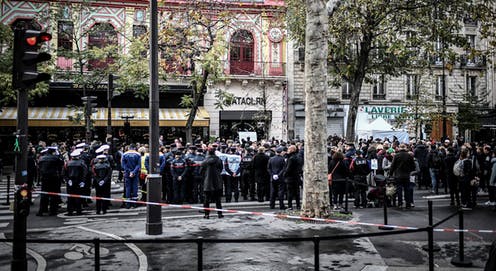
Francis Eustache, Director of Studies at the École pratique des hautes études in Paris, heads the Inserm research unit «Neuropsychology and Imaging of Human Memory» at the University of Caen-Normandy. In 2016, this specialist in human memory and memory disorders, together with historian Denis Peschanski, launched the November 13 Program, dedicated to understanding traumatic memories. He presents the initial findings of this ambitious transdisciplinary research project, which will continue through 2028.
The Conversation France: How did the November 13 Program ?
Francis Eustache: It all started with a meeting with the historian Denis Peschanski and, gradually, through numerous interactions with the teams we were able to build around us. A neuropsychologist by training, I was at the time the director of Cyceron, a major biomedical imaging center, in addition to heading a clinical and cognitive neuroscience research unit; both of these organizations were located in Caen.
I had been working for years on memory disorders, particularly using brain imaging, while Denis Peschanski was studying collective memory related to World War II. As our discussions progressed, we realized that the mechanisms of collective memory and individual memory were very similar: the fact that some information is emphasized while other information is «forgotten,» and that certain memories resurface in response to a specific event…
It then occurred to me that studying this connection would be of considerable interest for understanding certain pathological phenomena. With Pierre Gagnepain, who is now a researcher at Inserm, we set up a research project related to the memory of World War II at the Caen Memorial Museum.
These initial collaborative studies, which used brain imaging, showed that collective memory interferes with individual memory, and had an extremely significant impact on the latter.
When the attacks of November 13, 2015, occurred, encouraged by these initial findings, we decided to move beyond simply looking to the past and instead develop tools to understand how memories would be formed and evolve over time.
The goal was to begin collecting data immediately by launching coordinated studies involving sociologists, historians, physicians, scientists specializing in brain imaging, and experts in the treatment of big data, etc.
Our goal was not to capture the memory of the event itself, but to analyze how these perceptions would evolve over time—not only among individuals who experienced the attacks or were very close to them, but also among others, as well as within society as a whole. We wanted to determine what the collective perceptions of the event were, using surveys and epidemiological studies.
TCF: In practical terms, what does the project involve?
FE: The 13-Novembre program began in April 2016. Scheduled to last 12 years, it is structured around two main studies: the 1000 study (involving 1,000 participants) and the Remember study.
We divided the participants into four circles based on their proximity to the event. Circle 1 consists of people who were directly exposed to the attacks. Circle 2 consists of people who live or work in the targeted neighborhoods but were not present at the time of the attack. Circle 3 consists of people who were living in the Paris region at the time (excluding those in the first two circles). Finally, Circle 4 consists of people who lived outside the Paris region, specifically in three cities: Caen, Metz, and Montpellier. People in Circles 2, 3, and 4 learned about the attack on the radio, on television, by phone, etc.
Specifically, the participants first took part in Study 1000, which consisted of filmed interviews; then 200 of them—all from Circles 1 and 4—joined the Remember study. This second study involves medical, psychological, and brain imaging (MRI) examinations. Its primary goal is to understand why some people, when faced with such an event, develop post-traumatic stress disorder while others remain resilient. The goal is to identify the mechanisms at work, as well as the factors that reinforce or mitigate them.
TCF: Could you remind us what post-traumatic stress disorder is?
FE: Post-traumatic stress disorder occurs after an event during which the victim perceives that they are in danger, that their physical well-being (or that of someone close to them) is potentially threatened. Faced with this situation, the person feels completely helpless.
Arbitrarily, based on current criteria, a diagnosis of post-traumatic stress disorder is made if symptoms persist for one month after the traumatic event. Before this period, the condition is referred to as acute stress. This is more similar to the stress that anyone might experience (without necessarily being linked to a traumatic event): such as an important job interview or a thesis defense… Its effects generally subside within a few days. In post-traumatic stress disorder, on the other hand, the consequences of stress are long-lasting.
The main symptom that characterizes this disorder is what is known as flashbacks (or «intrusions»): people relive images (or hear sounds again, smell odors, etc.) associated with the traumatic event.
TCF: How do these intrusions differ from memories?
FE: These intrusions should not be confused with memories: a memory is something that is constructed. You remember what you did last Sunday; you replay the images in your mind, but you are aware that those images belong to the past. A memory is contextualized: you know how you got there, what happened before, after, and so on.
Intrusions, on the other hand, are disparate, disorganized, and chaotic. They are highly sensory and highly emotional. And, unlike a memory, they occur in the present: the person experiencing them perceives them as if the event were happening all over again. This is why we speak of psychological wounds: the wound caused by the trauma remains wide open due to these incessant intrusions.
In the face of these intrusions, the person develops avoidance mechanisms to protect themselves. But these protective mechanisms eventually become so overwhelming that they, in turn, become symptoms. For example, following attacks like those of November 13, which occur in the presence of large crowds, the victim will tend to avoid crowds, interact with few people, and steer clear of theaters and enclosed spaces, and their social life will shrink as a result.
Added to all this are autonomic reactions—startle responses, nightmares—which are further hallmarks of this trauma. Finally, other symptoms and comorbidities may sometimes accompany this «core»: depression, anxiety, addictions, difficulties with social interactions… But in any case, the core of the syndrome is indeed this ability to regulate intrusive thoughts. They are at the center of the disorder; everything else revolves around them, manifesting differently from one person to another.
TCF: The Remember study specifically examined the mechanisms that control these intrusions. How was the study conducted?
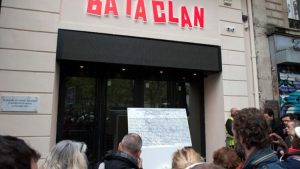
FE: The greatest strength of this study lies in its overall design and the large number of participants. The study focuses on two main groups: one consists of people who were at the Bataclan or on the terraces that were attacked, and the other is a «control» group (residents of Caen who were not directly affected by the attacks—this is circle 4).
The group of direct victims of the attacks is then subdivided into two subgroups, depending on whether these participants developed post-traumatic stress disorder or proved to be resilient. Finally, members of each of these two subgroups are matched based on their specific circumstances at the scenes of the attacks (whether they were in the Bataclan’s front row, on a terrace, further away, or whether they were police officers, doctors, etc.).
From a scientific standpoint, this design is extremely robust. Furthermore, the large number of participants (200 people, including approximately 120 members of Circle 1) allows for very powerful statistical analyses.
To understand why some victims are able to control the onset of intrusive thoughts typical of post-traumatic stress disorder while others are not, we focused our analyses on high-resolution MRI. This technology allows us, on the one hand, to study brain morphology to detect any changes between groups. On the other hand, functional MRI allows us to measure brain activity while the participant performs a task—in this case, to visualize the brain of a subject attempting to suppress an intrusive thought.
TCF: Of course, the goal was not to trigger traumatic memories in the participants…
FE: No, of course not, for obvious ethical reasons. Thanks to Pierre Gagnepain, who had already tested this methodology in a different context, we designed an experiment called « think – no think » («thinking—not thinking») that allows for the generation of «neutral» intrusions, that is, non-traumatic ones, based on the assumption that these neutral intrusions would activate the same brain mechanisms as traumatic intrusions. To use an analogy: if you’re driving your car and something suddenly appears in front of you, you’ll immediately hit the brakes—whether it’s a wild boar or a child! The emotional reaction that follows is different, but the mechanisms that enable control are the same.
The think – don't think involves having participants overlearn associations between pairs of concepts. For example, the written word «boat» and the image of a house. After this training, when a participant sees the written word “boat,” the image of a house immediately comes to mind, almost irresistibly. This simulates the occurrence of a traumatic intrusion, without the trauma itself.
Next, once inside the MRI scanner, the participant is asked—when they see the word “boat” written in red letters—to try to suppress the image of the house, which initially pops into their mind uncontrollably. Brain activity is measured in this specific situation.
The results of this research were the subject of a paper published in the journal *Science* earlier this year.
TCF: Can you explain what these results reveal?
FE: We have discovered that the ability to curb intrusions—which enables resilience—is largely due to memory control mechanisms underpinned by network structures coordinated by the frontal cortex, located at the front of the brain.
When a resilient person is presented with the word “boat” written in red—and thus seeks to suppress the intrusion of the associated image—all the neural connections in that area synchronize with other brain structures, enabling the person to control the brain regions involved in memory, emotions, and perceptions in an extremely effective manner. This is even more effective than what is observed in participants from the control group, who were not directly exposed to the attacks—a particularly interesting finding. Our work therefore highlights not only the mechanisms that are impaired, but also—and this is essential—those that are amplified to enable victims to overcome adversity.
Publication in Science, which uses functional imaging to study intrusions in post-traumatic stress disorder, highlights this critical aspect of memory control. But post-traumatic stress disorder has other effects on memory, which victims are acutely aware of since it involves their autobiographical memory—the memory linked to their personal identity.
Another component of the program—which this time draws on psychopathological and neuropsychological data—shows that autobiographical memory, which serves as the basis for projecting into the future, is also profoundly altered. Trauma—and the narratives surrounding it—takes center stage, at the expense of the victim’s previous interests.
Understanding the mechanisms underlying these changes is essential, and the factors that can influence them are even more so, as they could lead to new therapeutic approaches.
TCF: Do we know where the differences observed from one individual to another come from? Were some people «predestined» to be resilient, due to their genetic makeup or their social environment?
FE: We do not yet have all the information needed to answer these obviously crucial questions. The data is currently being analyzed, which takes time. In addition, monitoring these patients’ progress will provide us with further information. Ultimately, we hope to identify the factors that contribute to post-traumatic stress and, conversely, those that promote resilience.
In our study, we have already found that professionals (police officers, members of the medical professions, etc.) were better protected against this disorder than other victims. This is likely due to their training and the fact that they intervened with a specific purpose and role to play. We know, in fact, that memory retention is enhanced by access to the context in which the memory was formed.
A typical example is a flashback: if you ask people what they were doing on September 11, 2001, they will likely describe in great detail exactly what they were doing at that moment. They remember it very clearly (or believe they remember it very clearly, because like any memory, this one changes over time), because they felt a strong emotion at the time of the event. The context was intense, and the memory is therefore particularly enduring. In the case of the attacks of November 13, 2015, a survey by CREDOC (Center for Research on the Study and Observation of Living Conditions), in conjunction with our program, showed that 90 % of the population in France had formed such a flash memory.
But if an event triggers an extreme emotion—as is the case with victims—the effect is the opposite. Memory formation no longer functions as it does under normal conditions, and these disparate elements are produced, which then become intrusions. Activity in certain regions of the brain involved in emotions (such as the amygdala circuit, in particular) becomes disordered, which in turn disrupts the functioning of the hippocampal circuit, which is involved in encoding memories within their context.
Flash memories are therefore memories whose context is reinforced, whereas intrusions lack this context, which explains their disorganized and uncontrollable nature.
TC: Does this «emotional breaking point» vary from person to person?
FE: Objectively speaking, it varies from one situation to another, but beyond that, many factors influence it: the nature of the event, its phenomenology, how the person experienced it, how they will be helped moving forward… But it is also partly related to genetic factors and the person’s life experiences (have they experienced trauma before, how did they react to it, etc.).
Among these factors, the way a person experienced the initial event—and how they reacted in the first few hours after the trauma—appears to be particularly significant. We know that it is important to provide high-quality psychological interventions quickly after the event, such as those offered by the staff at medical and psychological emergency response teams(CUMPs), which are particularly well-organized in our country.
We should also emphasize the importance of social connections: some people will isolate themselves, while in other cases, those around them will be able to interact with them and help them overcome this state. This is a delicate issue, as it involves a great deal of subjectivity: some people are surrounded by loved ones, but, despite themselves, they are unable to benefit from this support.
Furthermore, in events of national—and even historic—significance, such as the November 13 attacks, the way in which a person feels acknowledged by others, in a much broader sense, is also very important: the existence of victims’ associations, commemorations, and a trial (which will take place soon)… This dynamic is complex, because people’s experiences vary from one person to another, especially since those who have lived through such events cannot forget them.
TCF: Does that mean the trauma can be reactivated?
FE: Indeed, the trauma may be reactivated by events that resemble those that caused it, or by other traumatic situations. Foremost among these are other terrorist attacks, but we are also studying the impact of the current COVID-19 pandemic and its socioeconomic consequences on participants in the Remember study, as part of a complementary study titled Remember-Pandemic. The goal is to examine vulnerability and resilience to lockdown experiences resulting from the pandemic, using telephone interviews with psychologists and online questionnaires.
It is important to understand that the consequences of trauma continue to unfold in relation to the changing world around the victim. The collective memory that is being shaped profoundly influences individual memory. It is impossible to understand the psychological conditions developed by individuals who have suffered psychological trauma as a result of an event such as the attacks on the scale of those of November 13, 2015, if we ignore the collective and social dimensions.
This does not conflict with a biological and medical response. However, analyzing the mechanisms and their interconnections—and thus identifying potential relevant treatments—requires an understanding of this social dimension. The possibility of synergy between the victim’s traumatized memory and social memory is one of the paths to resilience.
As sociologist Maurice Halbwachs, author of the book, pointed out as early as 1925, «The Social Frameworks of Memory», every act of remembrance is a social act. We cannot understand individual memory if we overlook this point…